Repository: https://github.com/matin/garth
Files analyzed: 47
Directory structure:
└── matin-garth/
├── .devcontainer
│ ├── Dockerfile
│ └── noop.txt
├── .github
│ ├── workflows
│ │ ├── ci.yml
│ │ └── publish.yml
│ └── dependabot.yml
├── colabs
│ ├── chatgpt_analysis_of_stats.ipynb
│ ├── sleep.ipynb
│ └── stress.ipynb
├── src
│ └── garth
│ ├── data
│ │ ├── body_battery
│ │ │ ├── __init__.py
│ │ │ ├── daily_stress.py
│ │ │ ├── events.py
│ │ │ └── readings.py
│ │ ├── __init__.py
│ │ ├── _base.py
│ │ ├── hrv.py
│ │ ├── sleep.py
│ │ └── weight.py
│ ├── stats
│ │ ├── __init__.py
│ │ ├── _base.py
│ │ ├── hrv.py
│ │ ├── hydration.py
│ │ ├── intensity_minutes.py
│ │ ├── sleep.py
│ │ ├── steps.py
│ │ └── stress.py
│ ├── users
│ │ ├── __init__.py
│ │ ├── profile.py
│ │ └── settings.py
│ ├── __init__.py
│ ├── auth_tokens.py
│ ├── cli.py
│ ├── exc.py
│ ├── http.py
│ ├── py.typed
│ ├── sso.py
│ ├── utils.py
│ └── version.py
├── tests
│ ├── cassettes
│ ├── data
│ │ ├── cassettes
│ │ ├── test_body_battery_data.py
│ │ ├── test_hrv_data.py
│ │ ├── test_sleep_data.py
│ │ └── test_weight_data.py
│ ├── stats
│ │ ├── cassettes
│ │ ├── test_hrv.py
│ │ ├── test_hydration.py
│ │ ├── test_intensity_minutes.py
│ │ ├── test_sleep_stats.py
│ │ ├── test_steps.py
│ │ └── test_stress.py
│ ├── 12129115726_ACTIVITY.fit
│ ├── conftest.py
│ ├── test_auth_tokens.py
│ ├── test_cli.py
│ ├── test_http.py
│ ├── test_sso.py
│ ├── test_users.py
│ └── test_utils.py
├── .gitattributes
├── .gitignore
├── LICENSE
├── Makefile
├── pyproject.toml
└── README.md
================================================
FILE: README.md
================================================
# Garth
[](
https://github.com/matin/garth/actions/workflows/ci.yml?query=event%3Apush+branch%3Amain+workflow%3ACI)
[](
https://codecov.io/gh/matin/garth)
[](
https://pypi.org/project/garth/)
[](
https://pypistats.org/packages/garth)
Garmin SSO auth + Connect Python client
## Garmin Connect MCP Server
[`garth-mcp-server`](https://github.com/matin/garth-mcp-server) is in early development.
Contributions are greatly appreciated.
To generate your `GARTH_TOKEN`, use `uvx garth login`.
For China, do `uvx garth --domain garmin.cn login`.
## Google Colabs
### [Stress: 28-day rolling average](https://colab.research.google.com/github/matin/garth/blob/main/colabs/stress.ipynb)
Stress levels from one day to another can vary by extremes, but there's always
a general trend. Using a scatter plot with a rolling average shows both the
individual days and the trend. The Colab retrieves up to three years of daily
data. If there's less than three years of data, it retrieves whatever is
available.

### [Sleep analysis over 90 days](https://colab.research.google.com/github/matin/garth/blob/main/colabs/sleep.ipynb)
The Garmin Connect app only shows a maximum of seven days for sleep
stages—making it hard to see trends. The Connect API supports retrieving
daily sleep quality in 28-day pages, but that doesn't show details. Using
`SleedData.list()` gives us the ability to retrieve an arbitrary number of
day with enough detail to product a stacked bar graph of the daily sleep
stages.

One specific graph that's useful but not available in the Connect app is
sleep start and end times over an extended period. This provides context
to the sleep hours and stages.

### [ChatGPT analysis of Garmin stats](https://colab.research.google.com/github/matin/garth/blob/main/colabs/chatgpt_analysis_of_stats.ipynb)
ChatGPT's Advanced Data Analysis took can provide incredible insight
into the data in a way that's much simpler than using Pandas and Matplotlib.
Start by using the linked Colab to download a CSV of the last three years
of your stats, and upload the CSV to ChatGPT.
Here's the outputs of the following prompts:
How do I sleep on different days of the week?
 On what days do I exercise the most?
 Magic!
## Background
Garth is meant for personal use and follows the philosophy that your data is
your data. You should be able to download it and analyze it in the way that
you'd like. In my case, that means processing with Google Colab, Pandas,
Matplotlib, etc.
There are already a few Garmin Connect libraries. Why write another?
### Authentication and stability
The most important reasoning is to build a library with authentication that
works on [Google Colab](https://colab.research.google.com/) and doesn't require
tools like Cloudscraper. Garth, in comparison:
1. Uses OAuth1 and OAuth2 token authentication after initial login
1. OAuth1 token survives for a year
1. Supports MFA
1. Auto-refresh of OAuth2 token when expired
1. Works on Google Colab
1. Uses Pydantic dataclasses to validate and simplify use of data
1. Full test coverage
### JSON vs HTML
Using `garth.connectapi()` allows you to make requests to the Connect API
and receive JSON vs needing to parse HTML. You can use the same endpoints the
mobile app uses.
This also goes back to authentication. Garth manages the necessary Bearer
Authentication (along with auto-refresh) necessary to make requests routed to
the Connect API.
## Instructions
### Install
```bash
python -m pip install garth
```
### Clone, setup environment and run tests
```bash
gh repo clone matin/garth
cd garth
make install
make
```
Use `make help` to see all the options.
### Authenticate and save session
```python
import garth
from getpass import getpass
email = input("Enter email address: ")
password = getpass("Enter password: ")
# If there's MFA, you'll be prompted during the login
garth.login(email, password)
garth.save("~/.garth")
```
### Custom MFA handler
By default, MFA will prompt for the code in the terminal. You can provide your
own handler:
```python
garth.login(email, password, prompt_mfa=lambda: input("Enter MFA code: "))
```
For advanced use cases (like async handling), MFA can be handled separately:
```python
result1, result2 = garth.login(email, password, return_on_mfa=True)
if result1 == "needs_mfa": # MFA is required
mfa_code = "123456" # Get this from your custom MFA flow
oauth1, oauth2 = garth.resume_login(result2, mfa_code)
```
### Configure
#### Set domain for China
```python
garth.configure(domain="garmin.cn")
```
#### Proxy through Charles
```python
garth.configure(proxies={"https": "http://localhost:8888"}, ssl_verify=False)
```
### Attempt to resume session
```python
import garth
from garth.exc import GarthException
garth.resume("~/.garth")
try:
garth.client.username
except GarthException:
# Session is expired. You'll need to log in again
```
## Connect API
### Daily details
```python
sleep = garth.connectapi(
f"/wellness-service/wellness/dailySleepData/{garth.client.username}",
params={"date": "2023-07-05", "nonSleepBufferMinutes": 60},
)
list(sleep.keys())
```
```json
[
"dailySleepDTO",
"sleepMovement",
"remSleepData",
"sleepLevels",
"sleepRestlessMoments",
"restlessMomentsCount",
"wellnessSpO2SleepSummaryDTO",
"wellnessEpochSPO2DataDTOList",
"wellnessEpochRespirationDataDTOList",
"sleepStress"
]
```
### Stats
```python
stress = garth.connectapi("/usersummary-service/stats/stress/weekly/2023-07-05/52")
```
```json
{
"calendarDate": "2023-07-13",
"values": {
"highStressDuration": 2880,
"lowStressDuration": 10140,
"overallStressLevel": 33,
"restStressDuration": 30960,
"mediumStressDuration": 8760
}
}
```
## Upload
```python
with open("12129115726_ACTIVITY.fit", "rb") as f:
uploaded = garth.client.upload(f)
```
Note: Garmin doesn't accept uploads of _structured_ FIT files as outlined in
[this conversation](https://github.com/matin/garth/issues/27). FIT files
generated from workouts are accepted without issues.
```python
{
'detailedImportResult': {
'uploadId': 212157427938,
'uploadUuid': {
'uuid': '6e56051d-1dd4-4f2c-b8ba-00a1a7d82eb3'
},
'owner': 2591602,
'fileSize': 5289,
'processingTime': 36,
'creationDate': '2023-09-29 01:58:19.113 GMT',
'ipAddress': None,
'fileName': '12129115726_ACTIVITY.fit',
'report': None,
'successes': [],
'failures': []
}
}
```
## Stats resources
### Stress
Daily stress levels
```python
DailyStress.list("2023-07-23", 2)
```
```python
[
DailyStress(
calendar_date=datetime.date(2023, 7, 22),
overall_stress_level=31,
rest_stress_duration=31980,
low_stress_duration=23820,
medium_stress_duration=7440,
high_stress_duration=1500
),
DailyStress(
calendar_date=datetime.date(2023, 7, 23),
overall_stress_level=26,
rest_stress_duration=38220,
low_stress_duration=22500,
medium_stress_duration=2520,
high_stress_duration=300
)
]
```
Weekly stress levels
```python
WeeklyStress.list("2023-07-23", 2)
```
```python
[
WeeklyStress(calendar_date=datetime.date(2023, 7, 10), value=33),
WeeklyStress(calendar_date=datetime.date(2023, 7, 17), value=32)
]
```
### Body Battery
Daily Body Battery and stress data
```python
garth.DailyBodyBatteryStress.get("2023-07-20")
```
```python
DailyBodyBatteryStress(
user_profile_pk=2591602,
calendar_date=datetime.date(2023, 7, 20),
start_timestamp_gmt=datetime.datetime(2023, 7, 20, 6, 0),
end_timestamp_gmt=datetime.datetime(2023, 7, 21, 5, 59, 59, 999000),
start_timestamp_local=datetime.datetime(2023, 7, 19, 23, 0),
end_timestamp_local=datetime.datetime(2023, 7, 20, 22, 59, 59, 999000),
max_stress_level=85,
avg_stress_level=25,
stress_chart_value_offset=0,
stress_chart_y_axis_origin=0,
stress_values_array=[
[1689811800000, 12], [1689812100000, 18], [1689812400000, 15],
[1689815700000, 45], [1689819300000, 85], [1689822900000, 35],
[1689826500000, 20], [1689830100000, 15], [1689833700000, 25],
[1689837300000, 30]
],
body_battery_values_array=[
[1689811800000, 'charging', 45, 1.0], [1689812100000, 'charging', 48, 1.0],
[1689812400000, 'charging', 52, 1.0], [1689815700000, 'charging', 65, 1.0],
[1689819300000, 'draining', 85, 1.0], [1689822900000, 'draining', 75, 1.0],
[1689826500000, 'draining', 65, 1.0], [1689830100000, 'draining', 55, 1.0],
[1689833700000, 'draining', 45, 1.0], [1689837300000, 'draining', 35, 1.0],
[1689840900000, 'draining', 25, 1.0]
]
)
# Access derived properties
daily_bb = garth.DailyBodyBatteryStress.get("2023-07-20")
daily_bb.current_body_battery # 25 (last reading)
daily_bb.max_body_battery # 85
daily_bb.min_body_battery # 25
daily_bb.body_battery_change # -20 (45 -> 25)
# Access structured readings
for reading in daily_bb.body_battery_readings:
print(f"Level: {reading.level}, Status: {reading.status}")
# Level: 45, Status: charging
# Level: 48, Status: charging
# ... etc
for reading in daily_bb.stress_readings:
print(f"Stress: {reading.stress_level}")
# Stress: 12
# Stress: 18
# ... etc
```
Body Battery events (sleep events)
```python
garth.BodyBatteryData.get("2023-07-20")
```
```python
[
BodyBatteryData(
event=BodyBatteryEvent(
event_type='sleep',
event_start_time_gmt=datetime.datetime(2023, 7, 19, 21, 30),
timezone_offset=-25200000,
duration_in_milliseconds=28800000,
body_battery_impact=35,
feedback_type='good_sleep',
short_feedback='Good sleep restored your Body Battery'
),
activity_name=None,
activity_type=None,
activity_id=None,
average_stress=15.5,
stress_values_array=[
[1689811800000, 12], [1689812100000, 18], [1689812400000, 15]
],
body_battery_values_array=[
[1689811800000, 'charging', 45, 1.0],
[1689812100000, 'charging', 48, 1.0],
[1689812400000, 'charging', 52, 1.0],
[1689840600000, 'draining', 85, 1.0]
]
)
]
# Access convenience properties on each event
events = garth.BodyBatteryData.get("2023-07-20")
event = events[0]
event.current_level # 85 (last reading)
event.max_level # 85
event.min_level # 45
```
### Hydration
Daily hydration data
```python
garth.DailyHydration.list(period=2)
```
```python
[
DailyHydration(
calendar_date=datetime.date(2024, 6, 29),
value_in_ml=1750.0,
goal_in_ml=2800.0
)
]
```
### Steps
Daily steps
```python
garth.DailySteps.list(period=2)
```
```python
[
DailySteps(
calendar_date=datetime.date(2023, 7, 28),
total_steps=6510,
total_distance=5552,
step_goal=8090
),
DailySteps(
calendar_date=datetime.date(2023, 7, 29),
total_steps=7218,
total_distance=6002,
step_goal=7940
)
]
```
Weekly steps
```python
garth.WeeklySteps.list(period=2)
```
```python
[
WeeklySteps(
calendar_date=datetime.date(2023, 7, 16),
total_steps=42339,
average_steps=6048.428571428572,
average_distance=5039.285714285715,
total_distance=35275.0,
wellness_data_days_count=7
),
WeeklySteps(
calendar_date=datetime.date(2023, 7, 23),
total_steps=56420,
average_steps=8060.0,
average_distance=7198.142857142857,
total_distance=50387.0,
wellness_data_days_count=7
)
]
```
### Intensity Minutes
Daily intensity minutes
```python
garth.DailyIntensityMinutes.list(period=2)
```
```python
[
DailyIntensityMinutes(
calendar_date=datetime.date(2023, 7, 28),
weekly_goal=150,
moderate_value=0,
vigorous_value=0
),
DailyIntensityMinutes(
calendar_date=datetime.date(2023, 7, 29),
weekly_goal=150,
moderate_value=0,
vigorous_value=0
)
]
```
Weekly intensity minutes
```python
garth.WeeklyIntensityMinutes.list(period=2)
```
```python
[
WeeklyIntensityMinutes(
calendar_date=datetime.date(2023, 7, 17),
weekly_goal=150,
moderate_value=103,
vigorous_value=9
),
WeeklyIntensityMinutes(
calendar_date=datetime.date(2023, 7, 24),
weekly_goal=150,
moderate_value=101,
vigorous_value=105
)
]
```
### HRV
Daily HRV
```python
garth.DailyHRV.list(period=2)
```
```python
[
DailyHRV(
calendar_date=datetime.date(2023, 7, 28),
weekly_avg=39,
last_night_avg=36,
last_night_5_min_high=52,
baseline=HRVBaseline(
low_upper=36,
balanced_low=39,
balanced_upper=51,
marker_value=0.25
),
status='BALANCED',
feedback_phrase='HRV_BALANCED_2',
create_time_stamp=datetime.datetime(2023, 7, 28, 12, 40, 16, 785000)
),
DailyHRV(
calendar_date=datetime.date(2023, 7, 29),
weekly_avg=40,
last_night_avg=41,
last_night_5_min_high=76,
baseline=HRVBaseline(
low_upper=36,
balanced_low=39,
balanced_upper=51,
marker_value=0.2916565
),
status='BALANCED',
feedback_phrase='HRV_BALANCED_8',
create_time_stamp=datetime.datetime(2023, 7, 29, 13, 45, 23, 479000)
)
]
```
Detailed HRV data
```python
garth.HRVData.get("2023-07-20")
```
```python
HRVData(
user_profile_pk=2591602,
hrv_summary=HRVSummary(
calendar_date=datetime.date(2023, 7, 20),
weekly_avg=39,
last_night_avg=42,
last_night_5_min_high=66,
baseline=Baseline(
low_upper=36,
balanced_low=39,
balanced_upper=52,
marker_value=0.25
),
status='BALANCED',
feedback_phrase='HRV_BALANCED_7',
create_time_stamp=datetime.datetime(2023, 7, 20, 12, 14, 11, 898000)
),
hrv_readings=[
HRVReading(
hrv_value=54,
reading_time_gmt=datetime.datetime(2023, 7, 20, 5, 29, 48),
reading_time_local=datetime.datetime(2023, 7, 19, 23, 29, 48)
),
HRVReading(
hrv_value=56,
reading_time_gmt=datetime.datetime(2023, 7, 20, 5, 34, 48),
reading_time_local=datetime.datetime(2023, 7, 19, 23, 34, 48)
),
# ... truncated for brevity
HRVReading(
hrv_value=38,
reading_time_gmt=datetime.datetime(2023, 7, 20, 12, 9, 48),
reading_time_local=datetime.datetime(2023, 7, 20, 6, 9, 48)
)
],
start_timestamp_gmt=datetime.datetime(2023, 7, 20, 5, 25),
end_timestamp_gmt=datetime.datetime(2023, 7, 20, 12, 9, 48),
start_timestamp_local=datetime.datetime(2023, 7, 19, 23, 25),
end_timestamp_local=datetime.datetime(2023, 7, 20, 6, 9, 48),
sleep_start_timestamp_gmt=datetime.datetime(2023, 7, 20, 5, 25),
sleep_end_timestamp_gmt=datetime.datetime(2023, 7, 20, 12, 11),
sleep_start_timestamp_local=datetime.datetime(2023, 7, 19, 23, 25),
sleep_end_timestamp_local=datetime.datetime(2023, 7, 20, 6, 11)
)
```
### Sleep
Daily sleep quality
```python
garth.DailySleep.list("2023-07-23", 2)
```
```python
[
DailySleep(calendar_date=datetime.date(2023, 7, 22), value=69),
DailySleep(calendar_date=datetime.date(2023, 7, 23), value=73)
]
```
Detailed sleep data
```python
garth.SleepData.get("2023-07-20")
```
```python
SleepData(
daily_sleep_dto=DailySleepDTO(
id=1689830700000,
user_profile_pk=2591602,
calendar_date=datetime.date(2023, 7, 20),
sleep_time_seconds=23700,
nap_time_seconds=0,
sleep_window_confirmed=True,
sleep_window_confirmation_type='enhanced_confirmed_final',
sleep_start_timestamp_gmt=datetime.datetime(2023, 7, 20, 5, 25, tzinfo=TzInfo(UTC)),
sleep_end_timestamp_gmt=datetime.datetime(2023, 7, 20, 12, 11, tzinfo=TzInfo(UTC)),
sleep_start_timestamp_local=datetime.datetime(2023, 7, 19, 23, 25, tzinfo=TzInfo(UTC)),
sleep_end_timestamp_local=datetime.datetime(2023, 7, 20, 6, 11, tzinfo=TzInfo(UTC)),
unmeasurable_sleep_seconds=0,
deep_sleep_seconds=9660,
light_sleep_seconds=12600,
rem_sleep_seconds=1440,
awake_sleep_seconds=660,
device_rem_capable=True,
retro=False,
sleep_from_device=True,
sleep_version=2,
awake_count=1,
sleep_scores=SleepScores(
total_duration=Score(
qualifier_key='FAIR',
optimal_start=28800.0,
optimal_end=28800.0,
value=None,
ideal_start_in_seconds=None,
deal_end_in_seconds=None
),
stress=Score(
qualifier_key='FAIR',
optimal_start=0.0,
optimal_end=15.0,
value=None,
ideal_start_in_seconds=None,
ideal_end_in_seconds=None
),
awake_count=Score(
qualifier_key='GOOD',
optimal_start=0.0,
optimal_end=1.0,
value=None,
ideal_start_in_seconds=None,
ideal_end_in_seconds=None
),
overall=Score(
qualifier_key='FAIR',
optimal_start=None,
optimal_end=None,
value=68,
ideal_start_in_seconds=None,
ideal_end_in_seconds=None
),
rem_percentage=Score(
qualifier_key='POOR',
optimal_start=21.0,
optimal_end=31.0,
value=6,
ideal_start_in_seconds=4977.0,
ideal_end_in_seconds=7347.0
),
restlessness=Score(
qualifier_key='EXCELLENT',
optimal_start=0.0,
optimal_end=5.0,
value=None,
ideal_start_in_seconds=None,
ideal_end_in_seconds=None
),
light_percentage=Score(
qualifier_key='EXCELLENT',
optimal_start=30.0,
optimal_end=64.0,
value=53,
ideal_start_in_seconds=7110.0,
ideal_end_in_seconds=15168.0
),
deep_percentage=Score(
qualifier_key='EXCELLENT',
optimal_start=16.0,
optimal_end=33.0,
value=41,
ideal_start_in_seconds=3792.0,
ideal_end_in_seconds=7821.0
)
),
auto_sleep_start_timestamp_gmt=None,
auto_sleep_end_timestamp_gmt=None,
sleep_quality_type_pk=None,
sleep_result_type_pk=None,
average_sp_o2_value=92.0,
lowest_sp_o2_value=87,
highest_sp_o2_value=100,
average_sp_o2_hr_sleep=53.0,
average_respiration_value=14.0,
lowest_respiration_value=12.0,
highest_respiration_value=16.0,
avg_sleep_stress=17.0,
age_group='ADULT',
sleep_score_feedback='NEGATIVE_NOT_ENOUGH_REM',
sleep_score_insight='NONE'
),
sleep_movement=[
SleepMovement(
start_gmt=datetime.datetime(2023, 7, 20, 4, 25),
end_gmt=datetime.datetime(2023, 7, 20, 4, 26),
activity_level=5.688743692980419
),
SleepMovement(
start_gmt=datetime.datetime(2023, 7, 20, 4, 26),
end_gmt=datetime.datetime(2023, 7, 20, 4, 27),
activity_level=5.318763075304898
),
# ... truncated for brevity
SleepMovement(
start_gmt=datetime.datetime(2023, 7, 20, 13, 10),
end_gmt=datetime.datetime(2023, 7, 20, 13, 11),
activity_level=7.088729101943337
)
]
)
```
List sleep data over several nights.
```python
garth.SleepData.list("2023-07-20", 30)
```
### Weight
Retrieve the latest weight measurement and body composition data for a given
date.
**Note**: Weight, weight delta, bone mass, and muscle mass values are measured
in grams
```python
garth.WeightData.get("2025-06-01")
```
```python
WeightData(
sample_pk=1749996902851,
calendar_date=datetime.date(2025, 6, 15),
weight=59720,
source_type='INDEX_SCALE',
weight_delta=200.00000000000284,
timestamp_gmt=1749996876000,
datetime_utc=datetime.datetime(2025, 6, 15, 14, 14, 36, tzinfo=TzInfo(UTC)),
datetime_local=datetime.datetime(
2025, 6, 15, 8, 14, 36,
tzinfo=datetime.timezone(datetime.timedelta(days=-1, seconds=64800))
),
bmi=22.799999237060547,
body_fat=19.3,
body_water=58.9,
bone_mass=3539,
muscle_mass=26979,
physique_rating=None,
visceral_fat=None,
metabolic_age=None
)
```
Get weight entries for a date range.
```python
garth.WeightData.list("2025-06-01", 30)
```
```python
[
WeightData(
sample_pk=1749307692871,
calendar_date=datetime.date(2025, 6, 7),
weight=59189,
source_type='INDEX_SCALE',
weight_delta=500.0,
timestamp_gmt=1749307658000,
datetime_utc=datetime.datetime(2025, 6, 7, 14, 47, 38, tzinfo=TzInfo(UTC)),
datetime_local=datetime.datetime(
2025, 6, 7, 8, 47, 38,
tzinfo=datetime.timezone(datetime.timedelta(days=-1, seconds=64800))
),
bmi=22.600000381469727,
body_fat=20.0,
body_water=58.4,
bone_mass=3450,
muscle_mass=26850,
physique_rating=None,
visceral_fat=None,
metabolic_age=None
),
WeightData(
sample_pk=1749909217098,
calendar_date=datetime.date(2025, 6, 14),
weight=59130,
source_type='INDEX_SCALE',
weight_delta=-100.00000000000142,
timestamp_gmt=1749909180000,
datetime_utc=datetime.datetime(2025, 6, 14, 13, 53, tzinfo=TzInfo(UTC)),
datetime_local=datetime.datetime(
2025, 6, 14, 7, 53,
tzinfo=datetime.timezone(datetime.timedelta(days=-1, seconds=64800))
),
bmi=22.5,
body_fat=20.3,
body_water=58.2,
bone_mass=3430,
muscle_mass=26840,
physique_rating=None,
visceral_fat=None,
metabolic_age=None
),
WeightData(
sample_pk=1749948744411,
calendar_date=datetime.date(2025, 6, 14),
weight=59500,
source_type='MANUAL',
weight_delta=399.9999999999986,
timestamp_gmt=1749948725175,
datetime_utc=datetime.datetime(
2025, 6, 15, 0, 52, 5, 175000, tzinfo=TzInfo(UTC)
),
datetime_local=datetime.datetime(
2025, 6, 14, 18, 52, 5, 175000,
tzinfo=datetime.timezone(datetime.timedelta(days=-1, seconds=64800))
),
bmi=None,
body_fat=None,
body_water=None,
bone_mass=None,
muscle_mass=None,
physique_rating=None,
visceral_fat=None,
metabolic_age=None
),
WeightData(
sample_pk=1749996902851,
calendar_date=datetime.date(2025, 6, 15),
weight=59720,
source_type='INDEX_SCALE',
weight_delta=200.00000000000284,
timestamp_gmt=1749996876000,
datetime_utc=datetime.datetime(2025, 6, 15, 14, 14, 36, tzinfo=TzInfo(UTC)),
datetime_local=datetime.datetime(
2025, 6, 15, 8, 14, 36,
tzinfo=datetime.timezone(datetime.timedelta(days=-1, seconds=64800))
),
bmi=22.799999237060547,
body_fat=19.3,
body_water=58.9,
bone_mass=3539,
muscle_mass=26979,
physique_rating=None,
visceral_fat=None,
metabolic_age=None
)
]
```
## User
### UserProfile
```python
garth.UserProfile.get()
```
```python
UserProfile(
id=3154645,
profile_id=2591602,
garmin_guid="0690cc1d-d23d-4412-b027-80fd4ed1c0f6",
display_name="mtamizi",
full_name="Matin Tamizi",
user_name="mtamizi",
profile_image_uuid="73240e81-6e4d-43fc-8af8-c8f6c51b3b8f",
profile_image_url_large=(
"https://s3.amazonaws.com/garmin-connect-prod/profile_images/"
"73240e81-6e4d-43fc-8af8-c8f6c51b3b8f-2591602.png"
),
profile_image_url_medium=(
"https://s3.amazonaws.com/garmin-connect-prod/profile_images/"
"685a19e9-a7be-4a11-9bf9-faca0c5d1f1a-2591602.png"
),
profile_image_url_small=(
"https://s3.amazonaws.com/garmin-connect-prod/profile_images/"
"6302f021-0ec7-4dc9-b0c3-d5a19bc5a08c-2591602.png"
),
location="Ciudad de México, CDMX",
facebook_url=None,
twitter_url=None,
personal_website=None,
motivation=None,
bio=None,
primary_activity=None,
favorite_activity_types=[],
running_training_speed=0.0,
cycling_training_speed=0.0,
favorite_cycling_activity_types=[],
cycling_classification=None,
cycling_max_avg_power=0.0,
swimming_training_speed=0.0,
profile_visibility="private",
activity_start_visibility="private",
activity_map_visibility="public",
course_visibility="public",
activity_heart_rate_visibility="public",
activity_power_visibility="public",
badge_visibility="private",
show_age=False,
show_weight=False,
show_height=False,
show_weight_class=False,
show_age_range=False,
show_gender=False,
show_activity_class=False,
show_vo_2_max=False,
show_personal_records=False,
show_last_12_months=False,
show_lifetime_totals=False,
show_upcoming_events=False,
show_recent_favorites=False,
show_recent_device=False,
show_recent_gear=False,
show_badges=True,
other_activity=None,
other_primary_activity=None,
other_motivation=None,
user_roles=[
"SCOPE_ATP_READ",
"SCOPE_ATP_WRITE",
"SCOPE_COMMUNITY_COURSE_READ",
"SCOPE_COMMUNITY_COURSE_WRITE",
"SCOPE_CONNECT_READ",
"SCOPE_CONNECT_WRITE",
"SCOPE_DT_CLIENT_ANALYTICS_WRITE",
"SCOPE_GARMINPAY_READ",
"SCOPE_GARMINPAY_WRITE",
"SCOPE_GCOFFER_READ",
"SCOPE_GCOFFER_WRITE",
"SCOPE_GHS_SAMD",
"SCOPE_GHS_UPLOAD",
"SCOPE_GOLF_API_READ",
"SCOPE_GOLF_API_WRITE",
"SCOPE_INSIGHTS_READ",
"SCOPE_INSIGHTS_WRITE",
"SCOPE_PRODUCT_SEARCH_READ",
"ROLE_CONNECTUSER",
"ROLE_FITNESS_USER",
"ROLE_WELLNESS_USER",
"ROLE_OUTDOOR_USER",
"ROLE_CONNECT_2_USER",
"ROLE_TACX_APP_USER",
],
name_approved=True,
user_profile_full_name="Matin Tamizi",
make_golf_scorecards_private=True,
allow_golf_live_scoring=False,
allow_golf_scoring_by_connections=True,
user_level=3,
user_point=118,
level_update_date="2020-12-12T15:20:38.0",
level_is_viewed=False,
level_point_threshold=140,
user_point_offset=0,
user_pro=False,
)
```
### UserSettings
```python
garth.UserSettings.get()
```
```python
UserSettings(
id=2591602,
user_data=UserData(
gender="MALE",
weight=83000.0,
height=182.0,
time_format="time_twenty_four_hr",
birth_date=datetime.date(1984, 10, 17),
measurement_system="metric",
activity_level=None,
handedness="RIGHT",
power_format=PowerFormat(
format_id=30,
format_key="watt",
min_fraction=0,
max_fraction=0,
grouping_used=True,
display_format=None,
),
heart_rate_format=PowerFormat(
format_id=21,
format_key="bpm",
min_fraction=0,
max_fraction=0,
grouping_used=False,
display_format=None,
),
first_day_of_week=FirstDayOfWeek(
day_id=2,
day_name="sunday",
sort_order=2,
is_possible_first_day=True,
),
vo_2_max_running=45.0,
vo_2_max_cycling=None,
lactate_threshold_speed=0.34722125000000004,
lactate_threshold_heart_rate=None,
dive_number=None,
intensity_minutes_calc_method="AUTO",
moderate_intensity_minutes_hr_zone=3,
vigorous_intensity_minutes_hr_zone=4,
hydration_measurement_unit="milliliter",
hydration_containers=[],
hydration_auto_goal_enabled=True,
firstbeat_max_stress_score=None,
firstbeat_cycling_lt_timestamp=None,
firstbeat_running_lt_timestamp=1044719868,
threshold_heart_rate_auto_detected=True,
ftp_auto_detected=None,
training_status_paused_date=None,
weather_location=None,
golf_distance_unit="statute_us",
golf_elevation_unit=None,
golf_speed_unit=None,
external_bottom_time=None,
),
user_sleep=UserSleep(
sleep_time=80400,
default_sleep_time=False,
wake_time=24000,
default_wake_time=False,
),
connect_date=None,
source_type=None,
)
```
## Star History
Magic!
## Background
Garth is meant for personal use and follows the philosophy that your data is
your data. You should be able to download it and analyze it in the way that
you'd like. In my case, that means processing with Google Colab, Pandas,
Matplotlib, etc.
There are already a few Garmin Connect libraries. Why write another?
### Authentication and stability
The most important reasoning is to build a library with authentication that
works on [Google Colab](https://colab.research.google.com/) and doesn't require
tools like Cloudscraper. Garth, in comparison:
1. Uses OAuth1 and OAuth2 token authentication after initial login
1. OAuth1 token survives for a year
1. Supports MFA
1. Auto-refresh of OAuth2 token when expired
1. Works on Google Colab
1. Uses Pydantic dataclasses to validate and simplify use of data
1. Full test coverage
### JSON vs HTML
Using `garth.connectapi()` allows you to make requests to the Connect API
and receive JSON vs needing to parse HTML. You can use the same endpoints the
mobile app uses.
This also goes back to authentication. Garth manages the necessary Bearer
Authentication (along with auto-refresh) necessary to make requests routed to
the Connect API.
## Instructions
### Install
```bash
python -m pip install garth
```
### Clone, setup environment and run tests
```bash
gh repo clone matin/garth
cd garth
make install
make
```
Use `make help` to see all the options.
### Authenticate and save session
```python
import garth
from getpass import getpass
email = input("Enter email address: ")
password = getpass("Enter password: ")
# If there's MFA, you'll be prompted during the login
garth.login(email, password)
garth.save("~/.garth")
```
### Custom MFA handler
By default, MFA will prompt for the code in the terminal. You can provide your
own handler:
```python
garth.login(email, password, prompt_mfa=lambda: input("Enter MFA code: "))
```
For advanced use cases (like async handling), MFA can be handled separately:
```python
result1, result2 = garth.login(email, password, return_on_mfa=True)
if result1 == "needs_mfa": # MFA is required
mfa_code = "123456" # Get this from your custom MFA flow
oauth1, oauth2 = garth.resume_login(result2, mfa_code)
```
### Configure
#### Set domain for China
```python
garth.configure(domain="garmin.cn")
```
#### Proxy through Charles
```python
garth.configure(proxies={"https": "http://localhost:8888"}, ssl_verify=False)
```
### Attempt to resume session
```python
import garth
from garth.exc import GarthException
garth.resume("~/.garth")
try:
garth.client.username
except GarthException:
# Session is expired. You'll need to log in again
```
## Connect API
### Daily details
```python
sleep = garth.connectapi(
f"/wellness-service/wellness/dailySleepData/{garth.client.username}",
params={"date": "2023-07-05", "nonSleepBufferMinutes": 60},
)
list(sleep.keys())
```
```json
[
"dailySleepDTO",
"sleepMovement",
"remSleepData",
"sleepLevels",
"sleepRestlessMoments",
"restlessMomentsCount",
"wellnessSpO2SleepSummaryDTO",
"wellnessEpochSPO2DataDTOList",
"wellnessEpochRespirationDataDTOList",
"sleepStress"
]
```
### Stats
```python
stress = garth.connectapi("/usersummary-service/stats/stress/weekly/2023-07-05/52")
```
```json
{
"calendarDate": "2023-07-13",
"values": {
"highStressDuration": 2880,
"lowStressDuration": 10140,
"overallStressLevel": 33,
"restStressDuration": 30960,
"mediumStressDuration": 8760
}
}
```
## Upload
```python
with open("12129115726_ACTIVITY.fit", "rb") as f:
uploaded = garth.client.upload(f)
```
Note: Garmin doesn't accept uploads of _structured_ FIT files as outlined in
[this conversation](https://github.com/matin/garth/issues/27). FIT files
generated from workouts are accepted without issues.
```python
{
'detailedImportResult': {
'uploadId': 212157427938,
'uploadUuid': {
'uuid': '6e56051d-1dd4-4f2c-b8ba-00a1a7d82eb3'
},
'owner': 2591602,
'fileSize': 5289,
'processingTime': 36,
'creationDate': '2023-09-29 01:58:19.113 GMT',
'ipAddress': None,
'fileName': '12129115726_ACTIVITY.fit',
'report': None,
'successes': [],
'failures': []
}
}
```
## Stats resources
### Stress
Daily stress levels
```python
DailyStress.list("2023-07-23", 2)
```
```python
[
DailyStress(
calendar_date=datetime.date(2023, 7, 22),
overall_stress_level=31,
rest_stress_duration=31980,
low_stress_duration=23820,
medium_stress_duration=7440,
high_stress_duration=1500
),
DailyStress(
calendar_date=datetime.date(2023, 7, 23),
overall_stress_level=26,
rest_stress_duration=38220,
low_stress_duration=22500,
medium_stress_duration=2520,
high_stress_duration=300
)
]
```
Weekly stress levels
```python
WeeklyStress.list("2023-07-23", 2)
```
```python
[
WeeklyStress(calendar_date=datetime.date(2023, 7, 10), value=33),
WeeklyStress(calendar_date=datetime.date(2023, 7, 17), value=32)
]
```
### Body Battery
Daily Body Battery and stress data
```python
garth.DailyBodyBatteryStress.get("2023-07-20")
```
```python
DailyBodyBatteryStress(
user_profile_pk=2591602,
calendar_date=datetime.date(2023, 7, 20),
start_timestamp_gmt=datetime.datetime(2023, 7, 20, 6, 0),
end_timestamp_gmt=datetime.datetime(2023, 7, 21, 5, 59, 59, 999000),
start_timestamp_local=datetime.datetime(2023, 7, 19, 23, 0),
end_timestamp_local=datetime.datetime(2023, 7, 20, 22, 59, 59, 999000),
max_stress_level=85,
avg_stress_level=25,
stress_chart_value_offset=0,
stress_chart_y_axis_origin=0,
stress_values_array=[
[1689811800000, 12], [1689812100000, 18], [1689812400000, 15],
[1689815700000, 45], [1689819300000, 85], [1689822900000, 35],
[1689826500000, 20], [1689830100000, 15], [1689833700000, 25],
[1689837300000, 30]
],
body_battery_values_array=[
[1689811800000, 'charging', 45, 1.0], [1689812100000, 'charging', 48, 1.0],
[1689812400000, 'charging', 52, 1.0], [1689815700000, 'charging', 65, 1.0],
[1689819300000, 'draining', 85, 1.0], [1689822900000, 'draining', 75, 1.0],
[1689826500000, 'draining', 65, 1.0], [1689830100000, 'draining', 55, 1.0],
[1689833700000, 'draining', 45, 1.0], [1689837300000, 'draining', 35, 1.0],
[1689840900000, 'draining', 25, 1.0]
]
)
# Access derived properties
daily_bb = garth.DailyBodyBatteryStress.get("2023-07-20")
daily_bb.current_body_battery # 25 (last reading)
daily_bb.max_body_battery # 85
daily_bb.min_body_battery # 25
daily_bb.body_battery_change # -20 (45 -> 25)
# Access structured readings
for reading in daily_bb.body_battery_readings:
print(f"Level: {reading.level}, Status: {reading.status}")
# Level: 45, Status: charging
# Level: 48, Status: charging
# ... etc
for reading in daily_bb.stress_readings:
print(f"Stress: {reading.stress_level}")
# Stress: 12
# Stress: 18
# ... etc
```
Body Battery events (sleep events)
```python
garth.BodyBatteryData.get("2023-07-20")
```
```python
[
BodyBatteryData(
event=BodyBatteryEvent(
event_type='sleep',
event_start_time_gmt=datetime.datetime(2023, 7, 19, 21, 30),
timezone_offset=-25200000,
duration_in_milliseconds=28800000,
body_battery_impact=35,
feedback_type='good_sleep',
short_feedback='Good sleep restored your Body Battery'
),
activity_name=None,
activity_type=None,
activity_id=None,
average_stress=15.5,
stress_values_array=[
[1689811800000, 12], [1689812100000, 18], [1689812400000, 15]
],
body_battery_values_array=[
[1689811800000, 'charging', 45, 1.0],
[1689812100000, 'charging', 48, 1.0],
[1689812400000, 'charging', 52, 1.0],
[1689840600000, 'draining', 85, 1.0]
]
)
]
# Access convenience properties on each event
events = garth.BodyBatteryData.get("2023-07-20")
event = events[0]
event.current_level # 85 (last reading)
event.max_level # 85
event.min_level # 45
```
### Hydration
Daily hydration data
```python
garth.DailyHydration.list(period=2)
```
```python
[
DailyHydration(
calendar_date=datetime.date(2024, 6, 29),
value_in_ml=1750.0,
goal_in_ml=2800.0
)
]
```
### Steps
Daily steps
```python
garth.DailySteps.list(period=2)
```
```python
[
DailySteps(
calendar_date=datetime.date(2023, 7, 28),
total_steps=6510,
total_distance=5552,
step_goal=8090
),
DailySteps(
calendar_date=datetime.date(2023, 7, 29),
total_steps=7218,
total_distance=6002,
step_goal=7940
)
]
```
Weekly steps
```python
garth.WeeklySteps.list(period=2)
```
```python
[
WeeklySteps(
calendar_date=datetime.date(2023, 7, 16),
total_steps=42339,
average_steps=6048.428571428572,
average_distance=5039.285714285715,
total_distance=35275.0,
wellness_data_days_count=7
),
WeeklySteps(
calendar_date=datetime.date(2023, 7, 23),
total_steps=56420,
average_steps=8060.0,
average_distance=7198.142857142857,
total_distance=50387.0,
wellness_data_days_count=7
)
]
```
### Intensity Minutes
Daily intensity minutes
```python
garth.DailyIntensityMinutes.list(period=2)
```
```python
[
DailyIntensityMinutes(
calendar_date=datetime.date(2023, 7, 28),
weekly_goal=150,
moderate_value=0,
vigorous_value=0
),
DailyIntensityMinutes(
calendar_date=datetime.date(2023, 7, 29),
weekly_goal=150,
moderate_value=0,
vigorous_value=0
)
]
```
Weekly intensity minutes
```python
garth.WeeklyIntensityMinutes.list(period=2)
```
```python
[
WeeklyIntensityMinutes(
calendar_date=datetime.date(2023, 7, 17),
weekly_goal=150,
moderate_value=103,
vigorous_value=9
),
WeeklyIntensityMinutes(
calendar_date=datetime.date(2023, 7, 24),
weekly_goal=150,
moderate_value=101,
vigorous_value=105
)
]
```
### HRV
Daily HRV
```python
garth.DailyHRV.list(period=2)
```
```python
[
DailyHRV(
calendar_date=datetime.date(2023, 7, 28),
weekly_avg=39,
last_night_avg=36,
last_night_5_min_high=52,
baseline=HRVBaseline(
low_upper=36,
balanced_low=39,
balanced_upper=51,
marker_value=0.25
),
status='BALANCED',
feedback_phrase='HRV_BALANCED_2',
create_time_stamp=datetime.datetime(2023, 7, 28, 12, 40, 16, 785000)
),
DailyHRV(
calendar_date=datetime.date(2023, 7, 29),
weekly_avg=40,
last_night_avg=41,
last_night_5_min_high=76,
baseline=HRVBaseline(
low_upper=36,
balanced_low=39,
balanced_upper=51,
marker_value=0.2916565
),
status='BALANCED',
feedback_phrase='HRV_BALANCED_8',
create_time_stamp=datetime.datetime(2023, 7, 29, 13, 45, 23, 479000)
)
]
```
Detailed HRV data
```python
garth.HRVData.get("2023-07-20")
```
```python
HRVData(
user_profile_pk=2591602,
hrv_summary=HRVSummary(
calendar_date=datetime.date(2023, 7, 20),
weekly_avg=39,
last_night_avg=42,
last_night_5_min_high=66,
baseline=Baseline(
low_upper=36,
balanced_low=39,
balanced_upper=52,
marker_value=0.25
),
status='BALANCED',
feedback_phrase='HRV_BALANCED_7',
create_time_stamp=datetime.datetime(2023, 7, 20, 12, 14, 11, 898000)
),
hrv_readings=[
HRVReading(
hrv_value=54,
reading_time_gmt=datetime.datetime(2023, 7, 20, 5, 29, 48),
reading_time_local=datetime.datetime(2023, 7, 19, 23, 29, 48)
),
HRVReading(
hrv_value=56,
reading_time_gmt=datetime.datetime(2023, 7, 20, 5, 34, 48),
reading_time_local=datetime.datetime(2023, 7, 19, 23, 34, 48)
),
# ... truncated for brevity
HRVReading(
hrv_value=38,
reading_time_gmt=datetime.datetime(2023, 7, 20, 12, 9, 48),
reading_time_local=datetime.datetime(2023, 7, 20, 6, 9, 48)
)
],
start_timestamp_gmt=datetime.datetime(2023, 7, 20, 5, 25),
end_timestamp_gmt=datetime.datetime(2023, 7, 20, 12, 9, 48),
start_timestamp_local=datetime.datetime(2023, 7, 19, 23, 25),
end_timestamp_local=datetime.datetime(2023, 7, 20, 6, 9, 48),
sleep_start_timestamp_gmt=datetime.datetime(2023, 7, 20, 5, 25),
sleep_end_timestamp_gmt=datetime.datetime(2023, 7, 20, 12, 11),
sleep_start_timestamp_local=datetime.datetime(2023, 7, 19, 23, 25),
sleep_end_timestamp_local=datetime.datetime(2023, 7, 20, 6, 11)
)
```
### Sleep
Daily sleep quality
```python
garth.DailySleep.list("2023-07-23", 2)
```
```python
[
DailySleep(calendar_date=datetime.date(2023, 7, 22), value=69),
DailySleep(calendar_date=datetime.date(2023, 7, 23), value=73)
]
```
Detailed sleep data
```python
garth.SleepData.get("2023-07-20")
```
```python
SleepData(
daily_sleep_dto=DailySleepDTO(
id=1689830700000,
user_profile_pk=2591602,
calendar_date=datetime.date(2023, 7, 20),
sleep_time_seconds=23700,
nap_time_seconds=0,
sleep_window_confirmed=True,
sleep_window_confirmation_type='enhanced_confirmed_final',
sleep_start_timestamp_gmt=datetime.datetime(2023, 7, 20, 5, 25, tzinfo=TzInfo(UTC)),
sleep_end_timestamp_gmt=datetime.datetime(2023, 7, 20, 12, 11, tzinfo=TzInfo(UTC)),
sleep_start_timestamp_local=datetime.datetime(2023, 7, 19, 23, 25, tzinfo=TzInfo(UTC)),
sleep_end_timestamp_local=datetime.datetime(2023, 7, 20, 6, 11, tzinfo=TzInfo(UTC)),
unmeasurable_sleep_seconds=0,
deep_sleep_seconds=9660,
light_sleep_seconds=12600,
rem_sleep_seconds=1440,
awake_sleep_seconds=660,
device_rem_capable=True,
retro=False,
sleep_from_device=True,
sleep_version=2,
awake_count=1,
sleep_scores=SleepScores(
total_duration=Score(
qualifier_key='FAIR',
optimal_start=28800.0,
optimal_end=28800.0,
value=None,
ideal_start_in_seconds=None,
deal_end_in_seconds=None
),
stress=Score(
qualifier_key='FAIR',
optimal_start=0.0,
optimal_end=15.0,
value=None,
ideal_start_in_seconds=None,
ideal_end_in_seconds=None
),
awake_count=Score(
qualifier_key='GOOD',
optimal_start=0.0,
optimal_end=1.0,
value=None,
ideal_start_in_seconds=None,
ideal_end_in_seconds=None
),
overall=Score(
qualifier_key='FAIR',
optimal_start=None,
optimal_end=None,
value=68,
ideal_start_in_seconds=None,
ideal_end_in_seconds=None
),
rem_percentage=Score(
qualifier_key='POOR',
optimal_start=21.0,
optimal_end=31.0,
value=6,
ideal_start_in_seconds=4977.0,
ideal_end_in_seconds=7347.0
),
restlessness=Score(
qualifier_key='EXCELLENT',
optimal_start=0.0,
optimal_end=5.0,
value=None,
ideal_start_in_seconds=None,
ideal_end_in_seconds=None
),
light_percentage=Score(
qualifier_key='EXCELLENT',
optimal_start=30.0,
optimal_end=64.0,
value=53,
ideal_start_in_seconds=7110.0,
ideal_end_in_seconds=15168.0
),
deep_percentage=Score(
qualifier_key='EXCELLENT',
optimal_start=16.0,
optimal_end=33.0,
value=41,
ideal_start_in_seconds=3792.0,
ideal_end_in_seconds=7821.0
)
),
auto_sleep_start_timestamp_gmt=None,
auto_sleep_end_timestamp_gmt=None,
sleep_quality_type_pk=None,
sleep_result_type_pk=None,
average_sp_o2_value=92.0,
lowest_sp_o2_value=87,
highest_sp_o2_value=100,
average_sp_o2_hr_sleep=53.0,
average_respiration_value=14.0,
lowest_respiration_value=12.0,
highest_respiration_value=16.0,
avg_sleep_stress=17.0,
age_group='ADULT',
sleep_score_feedback='NEGATIVE_NOT_ENOUGH_REM',
sleep_score_insight='NONE'
),
sleep_movement=[
SleepMovement(
start_gmt=datetime.datetime(2023, 7, 20, 4, 25),
end_gmt=datetime.datetime(2023, 7, 20, 4, 26),
activity_level=5.688743692980419
),
SleepMovement(
start_gmt=datetime.datetime(2023, 7, 20, 4, 26),
end_gmt=datetime.datetime(2023, 7, 20, 4, 27),
activity_level=5.318763075304898
),
# ... truncated for brevity
SleepMovement(
start_gmt=datetime.datetime(2023, 7, 20, 13, 10),
end_gmt=datetime.datetime(2023, 7, 20, 13, 11),
activity_level=7.088729101943337
)
]
)
```
List sleep data over several nights.
```python
garth.SleepData.list("2023-07-20", 30)
```
### Weight
Retrieve the latest weight measurement and body composition data for a given
date.
**Note**: Weight, weight delta, bone mass, and muscle mass values are measured
in grams
```python
garth.WeightData.get("2025-06-01")
```
```python
WeightData(
sample_pk=1749996902851,
calendar_date=datetime.date(2025, 6, 15),
weight=59720,
source_type='INDEX_SCALE',
weight_delta=200.00000000000284,
timestamp_gmt=1749996876000,
datetime_utc=datetime.datetime(2025, 6, 15, 14, 14, 36, tzinfo=TzInfo(UTC)),
datetime_local=datetime.datetime(
2025, 6, 15, 8, 14, 36,
tzinfo=datetime.timezone(datetime.timedelta(days=-1, seconds=64800))
),
bmi=22.799999237060547,
body_fat=19.3,
body_water=58.9,
bone_mass=3539,
muscle_mass=26979,
physique_rating=None,
visceral_fat=None,
metabolic_age=None
)
```
Get weight entries for a date range.
```python
garth.WeightData.list("2025-06-01", 30)
```
```python
[
WeightData(
sample_pk=1749307692871,
calendar_date=datetime.date(2025, 6, 7),
weight=59189,
source_type='INDEX_SCALE',
weight_delta=500.0,
timestamp_gmt=1749307658000,
datetime_utc=datetime.datetime(2025, 6, 7, 14, 47, 38, tzinfo=TzInfo(UTC)),
datetime_local=datetime.datetime(
2025, 6, 7, 8, 47, 38,
tzinfo=datetime.timezone(datetime.timedelta(days=-1, seconds=64800))
),
bmi=22.600000381469727,
body_fat=20.0,
body_water=58.4,
bone_mass=3450,
muscle_mass=26850,
physique_rating=None,
visceral_fat=None,
metabolic_age=None
),
WeightData(
sample_pk=1749909217098,
calendar_date=datetime.date(2025, 6, 14),
weight=59130,
source_type='INDEX_SCALE',
weight_delta=-100.00000000000142,
timestamp_gmt=1749909180000,
datetime_utc=datetime.datetime(2025, 6, 14, 13, 53, tzinfo=TzInfo(UTC)),
datetime_local=datetime.datetime(
2025, 6, 14, 7, 53,
tzinfo=datetime.timezone(datetime.timedelta(days=-1, seconds=64800))
),
bmi=22.5,
body_fat=20.3,
body_water=58.2,
bone_mass=3430,
muscle_mass=26840,
physique_rating=None,
visceral_fat=None,
metabolic_age=None
),
WeightData(
sample_pk=1749948744411,
calendar_date=datetime.date(2025, 6, 14),
weight=59500,
source_type='MANUAL',
weight_delta=399.9999999999986,
timestamp_gmt=1749948725175,
datetime_utc=datetime.datetime(
2025, 6, 15, 0, 52, 5, 175000, tzinfo=TzInfo(UTC)
),
datetime_local=datetime.datetime(
2025, 6, 14, 18, 52, 5, 175000,
tzinfo=datetime.timezone(datetime.timedelta(days=-1, seconds=64800))
),
bmi=None,
body_fat=None,
body_water=None,
bone_mass=None,
muscle_mass=None,
physique_rating=None,
visceral_fat=None,
metabolic_age=None
),
WeightData(
sample_pk=1749996902851,
calendar_date=datetime.date(2025, 6, 15),
weight=59720,
source_type='INDEX_SCALE',
weight_delta=200.00000000000284,
timestamp_gmt=1749996876000,
datetime_utc=datetime.datetime(2025, 6, 15, 14, 14, 36, tzinfo=TzInfo(UTC)),
datetime_local=datetime.datetime(
2025, 6, 15, 8, 14, 36,
tzinfo=datetime.timezone(datetime.timedelta(days=-1, seconds=64800))
),
bmi=22.799999237060547,
body_fat=19.3,
body_water=58.9,
bone_mass=3539,
muscle_mass=26979,
physique_rating=None,
visceral_fat=None,
metabolic_age=None
)
]
```
## User
### UserProfile
```python
garth.UserProfile.get()
```
```python
UserProfile(
id=3154645,
profile_id=2591602,
garmin_guid="0690cc1d-d23d-4412-b027-80fd4ed1c0f6",
display_name="mtamizi",
full_name="Matin Tamizi",
user_name="mtamizi",
profile_image_uuid="73240e81-6e4d-43fc-8af8-c8f6c51b3b8f",
profile_image_url_large=(
"https://s3.amazonaws.com/garmin-connect-prod/profile_images/"
"73240e81-6e4d-43fc-8af8-c8f6c51b3b8f-2591602.png"
),
profile_image_url_medium=(
"https://s3.amazonaws.com/garmin-connect-prod/profile_images/"
"685a19e9-a7be-4a11-9bf9-faca0c5d1f1a-2591602.png"
),
profile_image_url_small=(
"https://s3.amazonaws.com/garmin-connect-prod/profile_images/"
"6302f021-0ec7-4dc9-b0c3-d5a19bc5a08c-2591602.png"
),
location="Ciudad de México, CDMX",
facebook_url=None,
twitter_url=None,
personal_website=None,
motivation=None,
bio=None,
primary_activity=None,
favorite_activity_types=[],
running_training_speed=0.0,
cycling_training_speed=0.0,
favorite_cycling_activity_types=[],
cycling_classification=None,
cycling_max_avg_power=0.0,
swimming_training_speed=0.0,
profile_visibility="private",
activity_start_visibility="private",
activity_map_visibility="public",
course_visibility="public",
activity_heart_rate_visibility="public",
activity_power_visibility="public",
badge_visibility="private",
show_age=False,
show_weight=False,
show_height=False,
show_weight_class=False,
show_age_range=False,
show_gender=False,
show_activity_class=False,
show_vo_2_max=False,
show_personal_records=False,
show_last_12_months=False,
show_lifetime_totals=False,
show_upcoming_events=False,
show_recent_favorites=False,
show_recent_device=False,
show_recent_gear=False,
show_badges=True,
other_activity=None,
other_primary_activity=None,
other_motivation=None,
user_roles=[
"SCOPE_ATP_READ",
"SCOPE_ATP_WRITE",
"SCOPE_COMMUNITY_COURSE_READ",
"SCOPE_COMMUNITY_COURSE_WRITE",
"SCOPE_CONNECT_READ",
"SCOPE_CONNECT_WRITE",
"SCOPE_DT_CLIENT_ANALYTICS_WRITE",
"SCOPE_GARMINPAY_READ",
"SCOPE_GARMINPAY_WRITE",
"SCOPE_GCOFFER_READ",
"SCOPE_GCOFFER_WRITE",
"SCOPE_GHS_SAMD",
"SCOPE_GHS_UPLOAD",
"SCOPE_GOLF_API_READ",
"SCOPE_GOLF_API_WRITE",
"SCOPE_INSIGHTS_READ",
"SCOPE_INSIGHTS_WRITE",
"SCOPE_PRODUCT_SEARCH_READ",
"ROLE_CONNECTUSER",
"ROLE_FITNESS_USER",
"ROLE_WELLNESS_USER",
"ROLE_OUTDOOR_USER",
"ROLE_CONNECT_2_USER",
"ROLE_TACX_APP_USER",
],
name_approved=True,
user_profile_full_name="Matin Tamizi",
make_golf_scorecards_private=True,
allow_golf_live_scoring=False,
allow_golf_scoring_by_connections=True,
user_level=3,
user_point=118,
level_update_date="2020-12-12T15:20:38.0",
level_is_viewed=False,
level_point_threshold=140,
user_point_offset=0,
user_pro=False,
)
```
### UserSettings
```python
garth.UserSettings.get()
```
```python
UserSettings(
id=2591602,
user_data=UserData(
gender="MALE",
weight=83000.0,
height=182.0,
time_format="time_twenty_four_hr",
birth_date=datetime.date(1984, 10, 17),
measurement_system="metric",
activity_level=None,
handedness="RIGHT",
power_format=PowerFormat(
format_id=30,
format_key="watt",
min_fraction=0,
max_fraction=0,
grouping_used=True,
display_format=None,
),
heart_rate_format=PowerFormat(
format_id=21,
format_key="bpm",
min_fraction=0,
max_fraction=0,
grouping_used=False,
display_format=None,
),
first_day_of_week=FirstDayOfWeek(
day_id=2,
day_name="sunday",
sort_order=2,
is_possible_first_day=True,
),
vo_2_max_running=45.0,
vo_2_max_cycling=None,
lactate_threshold_speed=0.34722125000000004,
lactate_threshold_heart_rate=None,
dive_number=None,
intensity_minutes_calc_method="AUTO",
moderate_intensity_minutes_hr_zone=3,
vigorous_intensity_minutes_hr_zone=4,
hydration_measurement_unit="milliliter",
hydration_containers=[],
hydration_auto_goal_enabled=True,
firstbeat_max_stress_score=None,
firstbeat_cycling_lt_timestamp=None,
firstbeat_running_lt_timestamp=1044719868,
threshold_heart_rate_auto_detected=True,
ftp_auto_detected=None,
training_status_paused_date=None,
weather_location=None,
golf_distance_unit="statute_us",
golf_elevation_unit=None,
golf_speed_unit=None,
external_bottom_time=None,
),
user_sleep=UserSleep(
sleep_time=80400,
default_sleep_time=False,
wake_time=24000,
default_wake_time=False,
),
connect_date=None,
source_type=None,
)
```
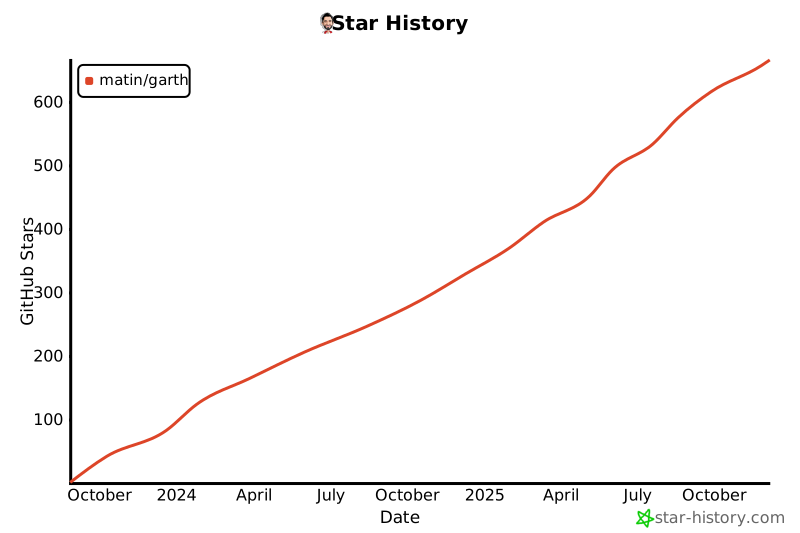
## Star History
 ================================================
FILE: .devcontainer/noop.txt
================================================
This file copied into the container along with environment.yml* from the parent
folder. This file is included to prevents the Dockerfile COPY instruction from
failing if no environment.yml is found.
================================================
FILE: src/garth/__init__.py
================================================
from .data import (
BodyBatteryData,
DailyBodyBatteryStress,
HRVData,
SleepData,
WeightData,
)
from .http import Client, client
from .stats import (
DailyHRV,
DailyHydration,
DailyIntensityMinutes,
DailySleep,
DailySteps,
DailyStress,
WeeklyIntensityMinutes,
WeeklySteps,
WeeklyStress,
)
from .users import UserProfile, UserSettings
from .version import __version__
__all__ = [
"BodyBatteryData",
"Client",
"DailyBodyBatteryStress",
"DailyHRV",
"DailyHydration",
"DailyIntensityMinutes",
"DailySleep",
"DailySteps",
"DailyStress",
"HRVData",
"SleepData",
"WeightData",
"UserProfile",
"UserSettings",
"WeeklyIntensityMinutes",
"WeeklySteps",
"WeeklyStress",
"__version__",
"client",
"configure",
"connectapi",
"download",
"login",
"resume",
"save",
"upload",
]
configure = client.configure
connectapi = client.connectapi
download = client.download
login = client.login
resume = client.load
save = client.dump
upload = client.upload
================================================
FILE: src/garth/auth_tokens.py
================================================
import time
from datetime import datetime
from pydantic.dataclasses import dataclass
@dataclass
class OAuth1Token:
oauth_token: str
oauth_token_secret: str
mfa_token: str | None = None
mfa_expiration_timestamp: datetime | None = None
domain: str | None = None
@dataclass
class OAuth2Token:
scope: str
jti: str
token_type: str
access_token: str
refresh_token: str
expires_in: int
expires_at: int
refresh_token_expires_in: int
refresh_token_expires_at: int
@property
def expired(self):
return self.expires_at < time.time()
@property
def refresh_expired(self):
return self.refresh_token_expires_at < time.time()
def __str__(self):
return f"{self.token_type.title()} {self.access_token}"
================================================
FILE: src/garth/cli.py
================================================
import argparse
import getpass
import garth
def main():
parser = argparse.ArgumentParser(prog="garth")
parser.add_argument(
"--domain",
"-d",
default="garmin.com",
help=(
"Domain for Garmin Connect (default: garmin.com). "
"Use garmin.cn for China."
),
)
subparsers = parser.add_subparsers(dest="command")
subparsers.add_parser(
"login", help="Authenticate with Garmin Connect and print token"
)
args = parser.parse_args()
garth.configure(domain=args.domain)
match args.command:
case "login":
email = input("Email: ")
password = getpass.getpass("Password: ")
garth.login(email, password)
token = garth.client.dumps()
print(token)
case _:
parser.print_help()
================================================
FILE: src/garth/data/__init__.py
================================================
__all__ = [
"BodyBatteryData",
"BodyBatteryEvent",
"BodyBatteryReading",
"DailyBodyBatteryStress",
"HRVData",
"SleepData",
"StressReading",
"WeightData",
]
from .body_battery import (
BodyBatteryData,
BodyBatteryEvent,
BodyBatteryReading,
DailyBodyBatteryStress,
StressReading,
)
from .hrv import HRVData
from .sleep import SleepData
from .weight import WeightData
================================================
FILE: src/garth/data/_base.py
================================================
from abc import ABC, abstractmethod
from concurrent.futures import ThreadPoolExecutor
from datetime import date
from itertools import chain
from typing_extensions import Self
from .. import http
from ..utils import date_range, format_end_date
MAX_WORKERS = 10
class Data(ABC):
@classmethod
@abstractmethod
def get(
cls, day: date | str, *, client: http.Client | None = None
) -> Self | list[Self] | None: ...
@classmethod
def list(
cls,
end: date | str | None = None,
days: int = 1,
*,
client: http.Client | None = None,
max_workers: int = MAX_WORKERS,
) -> list[Self]:
client = client or http.client
end = format_end_date(end)
def fetch_date(date_):
if day := cls.get(date_, client=client):
return day
dates = date_range(end, days)
with ThreadPoolExecutor(max_workers=max_workers) as executor:
data = list(executor.map(fetch_date, dates))
data = [day for day in data if day is not None]
return list(
chain.from_iterable(
day if isinstance(day, list) else [day] for day in data
)
)
================================================
FILE: src/garth/data/body_battery/__init__.py
================================================
__all__ = [
"BodyBatteryData",
"BodyBatteryEvent",
"BodyBatteryReading",
"DailyBodyBatteryStress",
"StressReading",
]
from .daily_stress import DailyBodyBatteryStress
from .events import BodyBatteryData, BodyBatteryEvent
from .readings import BodyBatteryReading, StressReading
================================================
FILE: src/garth/data/body_battery/daily_stress.py
================================================
from datetime import date, datetime
from functools import cached_property
from typing import Any
from pydantic.dataclasses import dataclass
from typing_extensions import Self
from ... import http
from ...utils import camel_to_snake_dict, format_end_date
from .._base import Data
from .readings import (
BodyBatteryReading,
StressReading,
parse_body_battery_readings,
parse_stress_readings,
)
@dataclass
class DailyBodyBatteryStress(Data):
"""Complete daily Body Battery and stress data."""
user_profile_pk: int
calendar_date: date
start_timestamp_gmt: datetime
end_timestamp_gmt: datetime
start_timestamp_local: datetime
end_timestamp_local: datetime
max_stress_level: int
avg_stress_level: int
stress_chart_value_offset: int
stress_chart_y_axis_origin: int
stress_values_array: list[list[int]]
body_battery_values_array: list[list[Any]]
@cached_property
def body_battery_readings(self) -> list[BodyBatteryReading]:
"""Convert body battery values array to structured readings."""
return parse_body_battery_readings(self.body_battery_values_array)
@property
def stress_readings(self) -> list[StressReading]:
"""Convert stress values array to structured readings."""
return parse_stress_readings(self.stress_values_array)
@property
def current_body_battery(self) -> int | None:
"""Get the latest Body Battery level."""
readings = self.body_battery_readings
return readings[-1].level if readings else None
@property
def max_body_battery(self) -> int | None:
"""Get the maximum Body Battery level for the day."""
readings = self.body_battery_readings
return max(reading.level for reading in readings) if readings else None
@property
def min_body_battery(self) -> int | None:
"""Get the minimum Body Battery level for the day."""
readings = self.body_battery_readings
return min(reading.level for reading in readings) if readings else None
@property
def body_battery_change(self) -> int | None:
"""Calculate the Body Battery change for the day."""
readings = self.body_battery_readings
if not readings or len(readings) < 2:
return None
return readings[-1].level - readings[0].level
@classmethod
def get(
cls,
day: date | str | None = None,
*,
client: http.Client | None = None,
) -> Self | None:
"""Get complete Body Battery and stress data for a specific date."""
client = client or http.client
date_str = format_end_date(day)
path = f"/wellness-service/wellness/dailyStress/{date_str}"
response = client.connectapi(path)
if not isinstance(response, dict):
return None
snake_response = camel_to_snake_dict(response)
return cls(**snake_response)
================================================
FILE: src/garth/data/body_battery/events.py
================================================
import logging
from datetime import date, datetime
from typing import Any
from pydantic.dataclasses import dataclass
from typing_extensions import Self
from ... import http
from ...utils import format_end_date
from .._base import Data
from .readings import BodyBatteryReading, parse_body_battery_readings
MAX_WORKERS = 10
@dataclass
class BodyBatteryEvent:
"""Body Battery event data."""
event_type: str
event_start_time_gmt: datetime
timezone_offset: int
duration_in_milliseconds: int
body_battery_impact: int
feedback_type: str
short_feedback: str
@dataclass
class BodyBatteryData(Data):
"""Legacy Body Battery events data (sleep events only)."""
event: BodyBatteryEvent | None = None
activity_name: str | None = None
activity_type: str | None = None
activity_id: str | None = None
average_stress: float | None = None
stress_values_array: list[list[int]] | None = None
body_battery_values_array: list[list[Any]] | None = None
@property
def body_battery_readings(self) -> list[BodyBatteryReading]:
"""Convert body battery values array to structured readings."""
return parse_body_battery_readings(self.body_battery_values_array)
@property
def current_level(self) -> int | None:
"""Get the latest Body Battery level."""
readings = self.body_battery_readings
return readings[-1].level if readings else None
@property
def max_level(self) -> int | None:
"""Get the maximum Body Battery level for the day."""
readings = self.body_battery_readings
return max(reading.level for reading in readings) if readings else None
@property
def min_level(self) -> int | None:
"""Get the minimum Body Battery level for the day."""
readings = self.body_battery_readings
return min(reading.level for reading in readings) if readings else None
@classmethod
def get(
cls,
date_str: str | date | None = None,
*,
client: http.Client | None = None,
) -> list[Self]:
"""Get Body Battery events for a specific date."""
client = client or http.client
date_str = format_end_date(date_str)
path = f"/wellness-service/wellness/bodyBattery/events/{date_str}"
try:
response = client.connectapi(path)
except Exception as e:
logging.warning(f"Failed to fetch Body Battery events: {e}")
return []
if not isinstance(response, list):
return []
events = []
for item in response:
try:
# Parse event data with validation
event_data = item.get("event")
# Validate event_data exists before accessing properties
if event_data is None:
logging.warning(f"Missing event data in item: {item}")
event = None
else:
# Validate and parse datetime with explicit error handling
event_start_time_str = event_data.get("eventStartTimeGmt")
if not event_start_time_str:
logging.error(
f"Missing eventStartTimeGmt in event data: "
f"{event_data}"
)
raise ValueError(
"eventStartTimeGmt is required but missing"
)
try:
event_start_time_gmt = datetime.fromisoformat(
event_start_time_str.replace("Z", "+00:00")
)
except (ValueError, AttributeError) as e:
logging.error(
f"Invalid datetime format "
f"'{event_start_time_str}': {e}"
)
raise ValueError(
f"Invalid eventStartTimeGmt format: "
f"{event_start_time_str}"
) from e
# Validate numeric fields
timezone_offset = event_data.get("timezoneOffset", 0)
if not isinstance(timezone_offset, (int, float)):
logging.warning(
f"Invalid timezone_offset type: "
f"{type(timezone_offset)}, using 0"
)
timezone_offset = 0
duration_ms = event_data.get("durationInMilliseconds", 0)
if not isinstance(duration_ms, (int, float)):
logging.warning(
f"Invalid durationInMilliseconds type: "
f"{type(duration_ms)}, using 0"
)
duration_ms = 0
battery_impact = event_data.get("bodyBatteryImpact", 0)
if not isinstance(battery_impact, (int, float)):
logging.warning(
f"Invalid bodyBatteryImpact type: "
f"{type(battery_impact)}, using 0"
)
battery_impact = 0
event = BodyBatteryEvent(
event_type=event_data.get("eventType", ""),
event_start_time_gmt=event_start_time_gmt,
timezone_offset=int(timezone_offset),
duration_in_milliseconds=int(duration_ms),
body_battery_impact=int(battery_impact),
feedback_type=event_data.get("feedbackType", ""),
short_feedback=event_data.get("shortFeedback", ""),
)
# Validate data arrays
stress_values = item.get("stressValuesArray")
if stress_values is not None and not isinstance(
stress_values, list
):
logging.warning(
f"Invalid stressValuesArray type: "
f"{type(stress_values)}, using None"
)
stress_values = None
battery_values = item.get("bodyBatteryValuesArray")
if battery_values is not None and not isinstance(
battery_values, list
):
logging.warning(
f"Invalid bodyBatteryValuesArray type: "
f"{type(battery_values)}, using None"
)
battery_values = None
# Validate average_stress
avg_stress = item.get("averageStress")
if avg_stress is not None and not isinstance(
avg_stress, (int, float)
):
logging.warning(
f"Invalid averageStress type: "
f"{type(avg_stress)}, using None"
)
avg_stress = None
events.append(
cls(
event=event,
activity_name=item.get("activityName"),
activity_type=item.get("activityType"),
activity_id=item.get("activityId"),
average_stress=avg_stress,
stress_values_array=stress_values,
body_battery_values_array=battery_values,
)
)
except ValueError as e:
# Re-raise validation errors with context
logging.error(
f"Data validation error for Body Battery event item "
f"{item}: {e}"
)
continue
except Exception as e:
# Log unexpected errors with full context
logging.error(
f"Unexpected error parsing Body Battery event item "
f"{item}: {e}",
exc_info=True,
)
continue
# Log summary of data quality issues
total_items = len(response)
parsed_events = len(events)
if parsed_events < total_items:
skipped = total_items - parsed_events
logging.info(
f"Body Battery events parsing: {parsed_events}/{total_items} "
f"successful, {skipped} skipped due to data issues"
)
return events
================================================
FILE: src/garth/data/body_battery/readings.py
================================================
from typing import Any
from pydantic.dataclasses import dataclass
@dataclass
class BodyBatteryReading:
"""Individual Body Battery reading."""
timestamp: int
status: str
level: int
version: float
@dataclass
class StressReading:
"""Individual stress reading."""
timestamp: int
stress_level: int
def parse_body_battery_readings(
body_battery_values_array: list[list[Any]] | None,
) -> list[BodyBatteryReading]:
"""Convert body battery values array to structured readings."""
readings = []
for values in body_battery_values_array or []:
# Each reading requires 4 values: timestamp, status, level, version
if len(values) >= 4:
readings.append(
BodyBatteryReading(
timestamp=values[0],
status=values[1],
level=values[2],
version=values[3],
)
)
# Sort readings by timestamp to ensure chronological order
return sorted(readings, key=lambda reading: reading.timestamp)
def parse_stress_readings(
stress_values_array: list[list[int]] | None,
) -> list[StressReading]:
"""Convert stress values array to structured readings."""
readings = []
for values in stress_values_array or []:
# Each reading requires 2 values: timestamp, stress_level
if len(values) >= 2:
readings.append(
StressReading(timestamp=values[0], stress_level=values[1])
)
# Sort readings by timestamp to ensure chronological order
return sorted(readings, key=lambda reading: reading.timestamp)
================================================
FILE: src/garth/data/hrv.py
================================================
from datetime import date, datetime
from pydantic.dataclasses import dataclass
from typing_extensions import Self
from .. import http
from ..utils import camel_to_snake_dict
from ._base import Data
@dataclass
class Baseline:
low_upper: int
balanced_low: int
balanced_upper: int
marker_value: float
@dataclass
class HRVSummary:
calendar_date: date
weekly_avg: int
last_night_avg: int | None
last_night_5_min_high: int
baseline: Baseline
status: str
feedback_phrase: str
create_time_stamp: datetime
@dataclass
class HRVReading:
hrv_value: int
reading_time_gmt: datetime
reading_time_local: datetime
@dataclass
class HRVData(Data):
user_profile_pk: int
hrv_summary: HRVSummary
hrv_readings: list[HRVReading]
start_timestamp_gmt: datetime
end_timestamp_gmt: datetime
start_timestamp_local: datetime
end_timestamp_local: datetime
sleep_start_timestamp_gmt: datetime
sleep_end_timestamp_gmt: datetime
sleep_start_timestamp_local: datetime
sleep_end_timestamp_local: datetime
@classmethod
def get(
cls, day: date | str, *, client: http.Client | None = None
) -> Self | None:
client = client or http.client
path = f"/hrv-service/hrv/{day}"
hrv_data = client.connectapi(path)
if not hrv_data:
return None
hrv_data = camel_to_snake_dict(hrv_data)
assert isinstance(hrv_data, dict)
return cls(**hrv_data)
@classmethod
def list(cls, *args, **kwargs) -> list[Self]:
data = super().list(*args, **kwargs)
return sorted(data, key=lambda d: d.hrv_summary.calendar_date)
================================================
FILE: src/garth/data/sleep.py
================================================
from datetime import date, datetime
from typing import Optional, Union
from pydantic.dataclasses import dataclass
from typing_extensions import Self
from .. import http
from ..utils import camel_to_snake_dict, get_localized_datetime
from ._base import Data
@dataclass
class Score:
qualifier_key: str
optimal_start: Optional[float] = None
optimal_end: Optional[float] = None
value: Optional[int] = None
ideal_start_in_seconds: Optional[float] = None
ideal_end_in_seconds: Optional[float] = None
@dataclass
class SleepScores:
total_duration: Score
stress: Score
awake_count: Score
overall: Score
rem_percentage: Score
restlessness: Score
light_percentage: Score
deep_percentage: Score
@dataclass
class DailySleepDTO:
id: int
user_profile_pk: int
calendar_date: date
sleep_time_seconds: int
nap_time_seconds: int
sleep_window_confirmed: bool
sleep_window_confirmation_type: str
sleep_start_timestamp_gmt: int
sleep_end_timestamp_gmt: int
sleep_start_timestamp_local: int
sleep_end_timestamp_local: int
device_rem_capable: bool
retro: bool
unmeasurable_sleep_seconds: Optional[int] = None
deep_sleep_seconds: Optional[int] = None
light_sleep_seconds: Optional[int] = None
rem_sleep_seconds: Optional[int] = None
awake_sleep_seconds: Optional[int] = None
sleep_from_device: Optional[bool] = None
sleep_version: Optional[int] = None
awake_count: Optional[int] = None
sleep_scores: Optional[SleepScores] = None
auto_sleep_start_timestamp_gmt: Optional[int] = None
auto_sleep_end_timestamp_gmt: Optional[int] = None
sleep_quality_type_pk: Optional[int] = None
sleep_result_type_pk: Optional[int] = None
average_sp_o2_value: Optional[float] = None
lowest_sp_o2_value: Optional[int] = None
highest_sp_o2_value: Optional[int] = None
average_sp_o2_hr_sleep: Optional[float] = None
average_respiration_value: Optional[float] = None
lowest_respiration_value: Optional[float] = None
highest_respiration_value: Optional[float] = None
avg_sleep_stress: Optional[float] = None
age_group: Optional[str] = None
sleep_score_feedback: Optional[str] = None
sleep_score_insight: Optional[str] = None
@property
def sleep_start(self) -> datetime:
return get_localized_datetime(
self.sleep_start_timestamp_gmt, self.sleep_start_timestamp_local
)
@property
def sleep_end(self) -> datetime:
return get_localized_datetime(
self.sleep_end_timestamp_gmt, self.sleep_end_timestamp_local
)
@dataclass
class SleepMovement:
start_gmt: datetime
end_gmt: datetime
activity_level: float
@dataclass
class SleepData(Data):
daily_sleep_dto: DailySleepDTO
sleep_movement: Optional[list[SleepMovement]] = None
@classmethod
def get(
cls,
day: Union[date, str],
*,
buffer_minutes: int = 60,
client: Optional[http.Client] = None,
) -> Optional[Self]:
client = client or http.client
path = (
f"/wellness-service/wellness/dailySleepData/{client.username}?"
f"nonSleepBufferMinutes={buffer_minutes}&date={day}"
)
sleep_data = client.connectapi(path)
assert sleep_data
sleep_data = camel_to_snake_dict(sleep_data)
assert isinstance(sleep_data, dict)
return (
cls(**sleep_data) if sleep_data["daily_sleep_dto"]["id"] else None
)
@classmethod
def list(cls, *args, **kwargs) -> list[Self]:
data = super().list(*args, **kwargs)
return sorted(data, key=lambda x: x.daily_sleep_dto.calendar_date)
================================================
FILE: src/garth/data/weight.py
================================================
from datetime import date, datetime, timedelta
from itertools import chain
from pydantic import Field, ValidationInfo, field_validator
from pydantic.dataclasses import dataclass
from typing_extensions import Self
from .. import http
from ..utils import (
camel_to_snake_dict,
format_end_date,
get_localized_datetime,
)
from ._base import MAX_WORKERS, Data
@dataclass
class WeightData(Data):
sample_pk: int
calendar_date: date
weight: int
source_type: str
weight_delta: float
timestamp_gmt: int
datetime_utc: datetime = Field(..., alias="timestamp_gmt")
datetime_local: datetime = Field(..., alias="date")
bmi: float | None = None
body_fat: float | None = None
body_water: float | None = None
bone_mass: int | None = None
muscle_mass: int | None = None
physique_rating: float | None = None
visceral_fat: float | None = None
metabolic_age: int | None = None
@field_validator("datetime_local", mode="before")
@classmethod
def to_localized_datetime(cls, v: int, info: ValidationInfo) -> datetime:
return get_localized_datetime(info.data["timestamp_gmt"], v)
@classmethod
def get(
cls, day: date | str, *, client: http.Client | None = None
) -> Self | None:
client = client or http.client
path = f"/weight-service/weight/dayview/{day}"
data = client.connectapi(path)
day_weight_list = data["dateWeightList"] if data else []
if not day_weight_list:
return None
# Get first (most recent) weight entry for the day
weight_data = camel_to_snake_dict(day_weight_list[0])
return cls(**weight_data)
@classmethod
def list(
cls,
end: date | str | None = None,
days: int = 1,
*,
client: http.Client | None = None,
max_workers: int = MAX_WORKERS,
) -> list[Self]:
client = client or http.client
end = format_end_date(end)
start = end - timedelta(days=days - 1)
data = client.connectapi(
f"/weight-service/weight/range/{start}/{end}?includeAll=true"
)
weight_summaries = data["dailyWeightSummaries"] if data else []
weight_metrics = chain.from_iterable(
summary["allWeightMetrics"] for summary in weight_summaries
)
weight_data_list = (
cls(**camel_to_snake_dict(weight_data))
for weight_data in weight_metrics
)
return sorted(weight_data_list, key=lambda d: d.datetime_utc)
================================================
FILE: src/garth/exc.py
================================================
from dataclasses import dataclass
from requests import HTTPError
@dataclass
class GarthException(Exception):
"""Base exception for all garth exceptions."""
msg: str
@dataclass
class GarthHTTPError(GarthException):
error: HTTPError
def __str__(self) -> str:
return f"{self.msg}: {self.error}"
================================================
FILE: src/garth/http.py
================================================
import base64
import json
import os
from typing import IO, Any, Dict, Literal, Tuple
from urllib.parse import urljoin
from requests import HTTPError, Response, Session
from requests.adapters import HTTPAdapter, Retry
from . import sso
from .auth_tokens import OAuth1Token, OAuth2Token
from .exc import GarthHTTPError
from .utils import asdict
USER_AGENT = {"User-Agent": "GCM-iOS-5.7.2.1"}
class Client:
sess: Session
last_resp: Response
domain: str = "garmin.com"
oauth1_token: OAuth1Token | Literal["needs_mfa"] | None = None
oauth2_token: OAuth2Token | dict[str, Any] | None = None
timeout: int = 10
retries: int = 3
status_forcelist: Tuple[int, ...] = (408, 429, 500, 502, 503, 504)
backoff_factor: float = 0.5
pool_connections: int = 10
pool_maxsize: int = 10
_user_profile: Dict[str, Any] | None = None
def __init__(self, session: Session | None = None, **kwargs):
self.sess = session if session else Session()
self.sess.headers.update(USER_AGENT)
self.configure(
timeout=self.timeout,
retries=self.retries,
status_forcelist=self.status_forcelist,
backoff_factor=self.backoff_factor,
**kwargs,
)
def configure(
self,
/,
oauth1_token: OAuth1Token | None = None,
oauth2_token: OAuth2Token | None = None,
domain: str | None = None,
proxies: Dict[str, str] | None = None,
ssl_verify: bool | None = None,
timeout: int | None = None,
retries: int | None = None,
status_forcelist: Tuple[int, ...] | None = None,
backoff_factor: float | None = None,
pool_connections: int | None = None,
pool_maxsize: int | None = None,
):
if oauth1_token is not None:
self.oauth1_token = oauth1_token
if oauth2_token is not None:
self.oauth2_token = oauth2_token
if domain:
self.domain = domain
if proxies is not None:
self.sess.proxies.update(proxies)
if ssl_verify is not None:
self.sess.verify = ssl_verify
if timeout is not None:
self.timeout = timeout
if retries is not None:
self.retries = retries
if status_forcelist is not None:
self.status_forcelist = status_forcelist
if backoff_factor is not None:
self.backoff_factor = backoff_factor
if pool_connections is not None:
self.pool_connections = pool_connections
if pool_maxsize is not None:
self.pool_maxsize = pool_maxsize
retry = Retry(
total=self.retries,
status_forcelist=self.status_forcelist,
backoff_factor=self.backoff_factor,
)
adapter = HTTPAdapter(
max_retries=retry,
pool_connections=self.pool_connections,
pool_maxsize=self.pool_maxsize,
)
self.sess.mount("https://", adapter)
@property
def user_profile(self):
if not self._user_profile:
self._user_profile = self.connectapi(
"/userprofile-service/socialProfile"
)
assert isinstance(self._user_profile, dict), (
"No profile from connectapi"
)
return self._user_profile
@property
def profile(self):
return self.user_profile
@property
def username(self):
return self.user_profile["userName"]
def request(
self,
method: str,
subdomain: str,
path: str,
/,
api: bool = False,
referrer: str | bool = False,
headers: dict = {},
**kwargs,
) -> Response:
url = f"https://{subdomain}.{self.domain}"
url = urljoin(url, path)
if referrer is True and self.last_resp:
headers["referer"] = self.last_resp.url
if api:
assert self.oauth1_token, (
"OAuth1 token is required for API requests"
)
if (
not isinstance(self.oauth2_token, OAuth2Token)
or self.oauth2_token.expired
):
self.refresh_oauth2()
headers["Authorization"] = str(self.oauth2_token)
self.last_resp = self.sess.request(
method,
url,
headers=headers,
timeout=self.timeout,
**kwargs,
)
try:
self.last_resp.raise_for_status()
except HTTPError as e:
raise GarthHTTPError(
msg="Error in request",
error=e,
)
return self.last_resp
def get(self, *args, **kwargs) -> Response:
return self.request("GET", *args, **kwargs)
def post(self, *args, **kwargs) -> Response:
return self.request("POST", *args, **kwargs)
def delete(self, *args, **kwargs) -> Response:
return self.request("DELETE", *args, **kwargs)
def put(self, *args, **kwargs) -> Response:
return self.request("PUT", *args, **kwargs)
def login(self, *args, **kwargs):
self.oauth1_token, self.oauth2_token = sso.login(
*args, **kwargs, client=self
)
return self.oauth1_token, self.oauth2_token
def resume_login(self, *args, **kwargs):
self.oauth1_token, self.oauth2_token = sso.resume_login(
*args, **kwargs
)
return self.oauth1_token, self.oauth2_token
def refresh_oauth2(self):
assert self.oauth1_token and isinstance(
self.oauth1_token, OAuth1Token
), "OAuth1 token is required for OAuth2 refresh"
# There is a way to perform a refresh of an OAuth2 token, but it
# appears even Garmin uses this approach when the OAuth2 is expired
self.oauth2_token = sso.exchange(self.oauth1_token, self)
def connectapi(
self, path: str, method="GET", **kwargs
) -> Dict[str, Any] | None:
resp = self.request(method, "connectapi", path, api=True, **kwargs)
if resp.status_code == 204:
return None
return resp.json()
def download(self, path: str, **kwargs) -> bytes:
resp = self.get("connectapi", path, api=True, **kwargs)
return resp.content
def upload(
self, fp: IO[bytes], /, path: str = "/upload-service/upload"
) -> Dict[str, Any]:
fname = os.path.basename(fp.name)
files = {"file": (fname, fp)}
result = self.connectapi(
path,
method="POST",
files=files,
)
assert result is not None, "No result from upload"
return result
def dump(self, dir_path: str):
dir_path = os.path.expanduser(dir_path)
os.makedirs(dir_path, exist_ok=True)
with open(os.path.join(dir_path, "oauth1_token.json"), "w") as f:
if self.oauth1_token:
json.dump(asdict(self.oauth1_token), f, indent=4)
with open(os.path.join(dir_path, "oauth2_token.json"), "w") as f:
if self.oauth2_token:
json.dump(asdict(self.oauth2_token), f, indent=4)
def dumps(self) -> str:
r = []
r.append(asdict(self.oauth1_token))
r.append(asdict(self.oauth2_token))
s = json.dumps(r)
return base64.b64encode(s.encode()).decode()
def load(self, dir_path: str):
dir_path = os.path.expanduser(dir_path)
with open(os.path.join(dir_path, "oauth1_token.json")) as f:
oauth1 = OAuth1Token(**json.load(f))
with open(os.path.join(dir_path, "oauth2_token.json")) as f:
oauth2 = OAuth2Token(**json.load(f))
self.configure(
oauth1_token=oauth1, oauth2_token=oauth2, domain=oauth1.domain
)
def loads(self, s: str):
oauth1, oauth2 = json.loads(base64.b64decode(s))
self.configure(
oauth1_token=OAuth1Token(**oauth1),
oauth2_token=OAuth2Token(**oauth2),
domain=oauth1.get("domain"),
)
client = Client()
================================================
FILE: src/garth/sso.py
================================================
import asyncio
import re
import time
from typing import Any, Callable, Dict, Literal, Tuple
from urllib.parse import parse_qs
import requests
from requests import Session
from requests_oauthlib import OAuth1Session
from . import http
from .auth_tokens import OAuth1Token, OAuth2Token
from .exc import GarthException
CSRF_RE = re.compile(r'name="_csrf"\s+value="(.+?)"')
TITLE_RE = re.compile(r"(.+?)")
OAUTH_CONSUMER_URL = "https://thegarth.s3.amazonaws.com/oauth_consumer.json"
OAUTH_CONSUMER: Dict[str, str] = {}
USER_AGENT = {"User-Agent": "com.garmin.android.apps.connectmobile"}
class GarminOAuth1Session(OAuth1Session):
def __init__(
self,
/,
parent: Session | None = None,
**kwargs,
):
global OAUTH_CONSUMER
if not OAUTH_CONSUMER:
OAUTH_CONSUMER = requests.get(OAUTH_CONSUMER_URL).json()
super().__init__(
OAUTH_CONSUMER["consumer_key"],
OAUTH_CONSUMER["consumer_secret"],
**kwargs,
)
if parent is not None:
self.mount("https://", parent.adapters["https://"])
self.proxies = parent.proxies
self.verify = parent.verify
def login(
email: str,
password: str,
/,
client: "http.Client | None" = None,
prompt_mfa: Callable | None = lambda: input("MFA code: "),
return_on_mfa: bool = False,
) -> (
Tuple[OAuth1Token, OAuth2Token]
| Tuple[Literal["needs_mfa"], dict[str, Any]]
):
"""Login to Garmin Connect.
Args:
email: Garmin account email
password: Garmin account password
client: Optional HTTP client to use
prompt_mfa: Callable that prompts for MFA code. Returns on MFA if None.
return_on_mfa: If True, returns dict with MFA info instead of prompting
Returns:
If return_on_mfa=False (default):
Tuple[OAuth1Token, OAuth2Token]: OAuth tokens after login
If return_on_mfa=True and MFA required:
dict: Contains needs_mfa and client_state for resume_login()
"""
client = client or http.client
# Define params based on domain
SSO = f"https://sso.{client.domain}/sso"
SSO_EMBED = f"{SSO}/embed"
SSO_EMBED_PARAMS = dict(
id="gauth-widget",
embedWidget="true",
gauthHost=SSO,
)
SIGNIN_PARAMS = {
**SSO_EMBED_PARAMS,
**dict(
gauthHost=SSO_EMBED,
service=SSO_EMBED,
source=SSO_EMBED,
redirectAfterAccountLoginUrl=SSO_EMBED,
redirectAfterAccountCreationUrl=SSO_EMBED,
),
}
# Set cookies
client.get("sso", "/sso/embed", params=SSO_EMBED_PARAMS)
# Get CSRF token
client.get(
"sso",
"/sso/signin",
params=SIGNIN_PARAMS,
referrer=True,
)
csrf_token = get_csrf_token(client.last_resp.text)
# Submit login form with email and password
client.post(
"sso",
"/sso/signin",
params=SIGNIN_PARAMS,
referrer=True,
data=dict(
username=email,
password=password,
embed="true",
_csrf=csrf_token,
),
)
title = get_title(client.last_resp.text)
# Handle MFA
if "MFA" in title:
if return_on_mfa or prompt_mfa is None:
return "needs_mfa", {
"signin_params": SIGNIN_PARAMS,
"client": client,
}
handle_mfa(client, SIGNIN_PARAMS, prompt_mfa)
title = get_title(client.last_resp.text)
if title != "Success":
raise GarthException(f"Unexpected title: {title}")
return _complete_login(client)
def get_oauth1_token(ticket: str, client: "http.Client") -> OAuth1Token:
sess = GarminOAuth1Session(parent=client.sess)
base_url = f"https://connectapi.{client.domain}/oauth-service/oauth/"
login_url = f"https://sso.{client.domain}/sso/embed"
url = (
f"{base_url}preauthorized?ticket={ticket}&login-url={login_url}"
"&accepts-mfa-tokens=true"
)
resp = sess.get(
url,
headers=USER_AGENT,
timeout=client.timeout,
)
resp.raise_for_status()
parsed = parse_qs(resp.text)
token = {k: v[0] for k, v in parsed.items()}
return OAuth1Token(domain=client.domain, **token) # type: ignore
def exchange(oauth1: OAuth1Token, client: "http.Client") -> OAuth2Token:
sess = GarminOAuth1Session(
resource_owner_key=oauth1.oauth_token,
resource_owner_secret=oauth1.oauth_token_secret,
parent=client.sess,
)
data = dict(mfa_token=oauth1.mfa_token) if oauth1.mfa_token else {}
base_url = f"https://connectapi.{client.domain}/oauth-service/oauth/"
url = f"{base_url}exchange/user/2.0"
headers = {
**USER_AGENT,
**{"Content-Type": "application/x-www-form-urlencoded"},
}
resp = sess.post(
url,
headers=headers,
data=data,
timeout=client.timeout,
)
resp.raise_for_status()
token = resp.json()
return OAuth2Token(**set_expirations(token))
def handle_mfa(
client: "http.Client", signin_params: dict, prompt_mfa: Callable
) -> None:
csrf_token = get_csrf_token(client.last_resp.text)
if asyncio.iscoroutinefunction(prompt_mfa):
mfa_code = asyncio.run(prompt_mfa())
else:
mfa_code = prompt_mfa()
client.post(
"sso",
"/sso/verifyMFA/loginEnterMfaCode",
params=signin_params,
referrer=True,
data={
"mfa-code": mfa_code,
"embed": "true",
"_csrf": csrf_token,
"fromPage": "setupEnterMfaCode",
},
)
def set_expirations(token: dict) -> dict:
token["expires_at"] = int(time.time() + token["expires_in"])
token["refresh_token_expires_at"] = int(
time.time() + token["refresh_token_expires_in"]
)
return token
def get_csrf_token(html: str) -> str:
m = CSRF_RE.search(html)
if not m:
raise GarthException("Couldn't find CSRF token")
return m.group(1)
def get_title(html: str) -> str:
m = TITLE_RE.search(html)
if not m:
raise GarthException("Couldn't find title")
return m.group(1)
def resume_login(
client_state: dict, mfa_code: str
) -> Tuple[OAuth1Token, OAuth2Token]:
"""Complete login after MFA code is provided.
Args:
client_state: The client state from login() when MFA was needed
mfa_code: The MFA code provided by the user
Returns:
Tuple[OAuth1Token, OAuth2Token]: The OAuth tokens after login
"""
client = client_state["client"]
signin_params = client_state["signin_params"]
handle_mfa(client, signin_params, lambda: mfa_code)
return _complete_login(client)
def _complete_login(client: "http.Client") -> Tuple[OAuth1Token, OAuth2Token]:
"""Complete the login process after successful authentication.
Args:
client: The HTTP client
Returns:
Tuple[OAuth1Token, OAuth2Token]: The OAuth tokens
"""
# Parse ticket
m = re.search(r'embed\?ticket=([^"]+)"', client.last_resp.text)
if not m:
raise GarthException(
"Couldn't find ticket in response"
) # pragma: no cover
ticket = m.group(1)
oauth1 = get_oauth1_token(ticket, client)
oauth2 = exchange(oauth1, client)
return oauth1, oauth2
================================================
FILE: src/garth/stats/__init__.py
================================================
__all__ = [
"DailyHRV",
"DailyHydration",
"DailyIntensityMinutes",
"DailySleep",
"DailySteps",
"DailyStress",
"WeeklyIntensityMinutes",
"WeeklyStress",
"WeeklySteps",
]
from .hrv import DailyHRV
from .hydration import DailyHydration
from .intensity_minutes import DailyIntensityMinutes, WeeklyIntensityMinutes
from .sleep import DailySleep
from .steps import DailySteps, WeeklySteps
from .stress import DailyStress, WeeklyStress
================================================
FILE: src/garth/stats/_base.py
================================================
from datetime import date, timedelta
from typing import ClassVar
from pydantic.dataclasses import dataclass
from typing_extensions import Self
from .. import http
from ..utils import camel_to_snake_dict, format_end_date
@dataclass
class Stats:
calendar_date: date
_path: ClassVar[str]
_page_size: ClassVar[int]
@classmethod
def list(
cls,
end: date | str | None = None,
period: int = 1,
*,
client: http.Client | None = None,
) -> list[Self]:
client = client or http.client
end = format_end_date(end)
period_type = "days" if "daily" in cls._path else "weeks"
if period > cls._page_size:
page = cls.list(end, cls._page_size, client=client)
if not page:
return []
page = (
cls.list(
end - timedelta(**{period_type: cls._page_size}),
period - cls._page_size,
client=client,
)
+ page
)
return page
start = end - timedelta(**{period_type: period - 1})
path = cls._path.format(start=start, end=end, period=period)
page_dirs = client.connectapi(path)
if not isinstance(page_dirs, list) or not page_dirs:
return []
page_dirs = [d for d in page_dirs if isinstance(d, dict)]
if page_dirs and "values" in page_dirs[0]:
page_dirs = [{**stat, **stat.pop("values")} for stat in page_dirs]
page_dirs = [camel_to_snake_dict(stat) for stat in page_dirs]
return [cls(**stat) for stat in page_dirs]
================================================
FILE: src/garth/stats/hrv.py
================================================
from datetime import date, datetime, timedelta
from typing import Any, ClassVar, cast
from pydantic.dataclasses import dataclass
from typing_extensions import Self
from .. import http
from ..utils import camel_to_snake_dict, format_end_date
@dataclass
class HRVBaseline:
low_upper: int
balanced_low: int
balanced_upper: int
marker_value: float | None
@dataclass
class DailyHRV:
calendar_date: date
weekly_avg: int | None
last_night_avg: int | None
last_night_5_min_high: int | None
baseline: HRVBaseline | None
status: str
feedback_phrase: str
create_time_stamp: datetime
_path: ClassVar[str] = "/hrv-service/hrv/daily/{start}/{end}"
_page_size: ClassVar[int] = 28
@classmethod
def list(
cls,
end: date | str | None = None,
period: int = 28,
*,
client: http.Client | None = None,
) -> list[Self]:
client = client or http.client
end = format_end_date(end)
# Paginate if period is greater than page size
if period > cls._page_size:
page = cls.list(end, cls._page_size, client=client)
if not page:
return []
page = (
cls.list(
end - timedelta(days=cls._page_size),
period - cls._page_size,
client=client,
)
+ page
)
return page
start = end - timedelta(days=period - 1)
path = cls._path.format(start=start, end=end)
response = client.connectapi(path)
if response is None:
return []
daily_hrv = camel_to_snake_dict(response)["hrv_summaries"]
daily_hrv = cast(list[dict[str, Any]], daily_hrv)
return [cls(**hrv) for hrv in daily_hrv]
================================================
FILE: src/garth/stats/hydration.py
================================================
from typing import ClassVar
from pydantic.dataclasses import dataclass
from ._base import Stats
BASE_PATH = "/usersummary-service/stats/hydration"
@dataclass
class DailyHydration(Stats):
value_in_ml: float
goal_in_ml: float
_path: ClassVar[str] = f"{BASE_PATH}/daily/{{start}}/{{end}}"
_page_size: ClassVar[int] = 28
================================================
FILE: src/garth/stats/intensity_minutes.py
================================================
from typing import ClassVar
from pydantic.dataclasses import dataclass
from ._base import Stats
BASE_PATH = "/usersummary-service/stats/im"
@dataclass
class DailyIntensityMinutes(Stats):
weekly_goal: int
moderate_value: int | None = None
vigorous_value: int | None = None
_path: ClassVar[str] = f"{BASE_PATH}/daily/{{start}}/{{end}}"
_page_size: ClassVar[int] = 28
@dataclass
class WeeklyIntensityMinutes(Stats):
weekly_goal: int
moderate_value: int | None = None
vigorous_value: int | None = None
_path: ClassVar[str] = f"{BASE_PATH}/weekly/{{start}}/{{end}}"
_page_size: ClassVar[int] = 52
================================================
FILE: src/garth/stats/sleep.py
================================================
from typing import ClassVar
from pydantic.dataclasses import dataclass
from ._base import Stats
@dataclass
class DailySleep(Stats):
value: int | None
_path: ClassVar[str] = (
"/wellness-service/stats/daily/sleep/score/{start}/{end}"
)
_page_size: ClassVar[int] = 28
================================================
FILE: src/garth/stats/steps.py
================================================
from typing import ClassVar
from pydantic.dataclasses import dataclass
from ._base import Stats
BASE_PATH = "/usersummary-service/stats/steps"
@dataclass
class DailySteps(Stats):
total_steps: int | None
total_distance: int | None
step_goal: int
_path: ClassVar[str] = f"{BASE_PATH}/daily/{{start}}/{{end}}"
_page_size: ClassVar[int] = 28
@dataclass
class WeeklySteps(Stats):
total_steps: int
average_steps: float
average_distance: float
total_distance: float
wellness_data_days_count: int
_path: ClassVar[str] = f"{BASE_PATH}/weekly/{{end}}/{{period}}"
_page_size: ClassVar[int] = 52
================================================
FILE: src/garth/stats/stress.py
================================================
from typing import ClassVar
from pydantic.dataclasses import dataclass
from ._base import Stats
BASE_PATH = "/usersummary-service/stats/stress"
@dataclass
class DailyStress(Stats):
overall_stress_level: int
rest_stress_duration: int | None = None
low_stress_duration: int | None = None
medium_stress_duration: int | None = None
high_stress_duration: int | None = None
_path: ClassVar[str] = f"{BASE_PATH}/daily/{{start}}/{{end}}"
_page_size: ClassVar[int] = 28
@dataclass
class WeeklyStress(Stats):
value: int
_path: ClassVar[str] = f"{BASE_PATH}/weekly/{{end}}/{{period}}"
_page_size: ClassVar[int] = 52
================================================
FILE: src/garth/users/__init__.py
================================================
from .profile import UserProfile
from .settings import UserSettings
__all__ = ["UserProfile", "UserSettings"]
================================================
FILE: src/garth/users/profile.py
================================================
from pydantic.dataclasses import dataclass
from typing_extensions import Self
from .. import http
from ..utils import camel_to_snake_dict
@dataclass
class UserProfile:
id: int
profile_id: int
garmin_guid: str
display_name: str
full_name: str
user_name: str
profile_image_type: str | None
profile_image_url_large: str | None
profile_image_url_medium: str | None
profile_image_url_small: str | None
location: str | None
facebook_url: str | None
twitter_url: str | None
personal_website: str | None
motivation: str | None
bio: str | None
primary_activity: str | None
favorite_activity_types: list[str]
running_training_speed: float
cycling_training_speed: float
favorite_cycling_activity_types: list[str]
cycling_classification: str | None
cycling_max_avg_power: float
swimming_training_speed: float
profile_visibility: str
activity_start_visibility: str
activity_map_visibility: str
course_visibility: str
activity_heart_rate_visibility: str
activity_power_visibility: str
badge_visibility: str
show_age: bool
show_weight: bool
show_height: bool
show_weight_class: bool
show_age_range: bool
show_gender: bool
show_activity_class: bool
show_vo_2_max: bool
show_personal_records: bool
show_last_12_months: bool
show_lifetime_totals: bool
show_upcoming_events: bool
show_recent_favorites: bool
show_recent_device: bool
show_recent_gear: bool
show_badges: bool
other_activity: str | None
other_primary_activity: str | None
other_motivation: str | None
user_roles: list[str]
name_approved: bool
user_profile_full_name: str
make_golf_scorecards_private: bool
allow_golf_live_scoring: bool
allow_golf_scoring_by_connections: bool
user_level: int
user_point: int
level_update_date: str
level_is_viewed: bool
level_point_threshold: int
user_point_offset: int
user_pro: bool
@classmethod
def get(cls, /, client: http.Client | None = None) -> Self:
client = client or http.client
profile = client.connectapi("/userprofile-service/socialProfile")
assert isinstance(profile, dict)
return cls(**camel_to_snake_dict(profile))
================================================
FILE: src/garth/users/settings.py
================================================
from datetime import date
from typing import Dict
from pydantic.dataclasses import dataclass
from typing_extensions import Self
from .. import http
from ..utils import camel_to_snake_dict
@dataclass
class PowerFormat:
format_id: int
format_key: str
min_fraction: int
max_fraction: int
grouping_used: bool
display_format: str | None
@dataclass
class FirstDayOfWeek:
day_id: int
day_name: str
sort_order: int
is_possible_first_day: bool
@dataclass
class WeatherLocation:
use_fixed_location: bool | None
latitude: float | None
longitude: float | None
location_name: str | None
iso_country_code: str | None
postal_code: str | None
@dataclass
class UserData:
gender: str
weight: float
height: float
time_format: str
birth_date: date
measurement_system: str
activity_level: str | None
handedness: str
power_format: PowerFormat
heart_rate_format: PowerFormat
first_day_of_week: FirstDayOfWeek
vo_2_max_running: float | None
vo_2_max_cycling: float | None
lactate_threshold_speed: float | None
lactate_threshold_heart_rate: float | None
dive_number: int | None
intensity_minutes_calc_method: str
moderate_intensity_minutes_hr_zone: int
vigorous_intensity_minutes_hr_zone: int
hydration_measurement_unit: str
hydration_containers: list[Dict[str, float | str | None]]
hydration_auto_goal_enabled: bool
firstbeat_max_stress_score: float | None
firstbeat_cycling_lt_timestamp: int | None
firstbeat_running_lt_timestamp: int | None
threshold_heart_rate_auto_detected: bool
ftp_auto_detected: bool | None
training_status_paused_date: str | None
weather_location: WeatherLocation | None
golf_distance_unit: str | None
golf_elevation_unit: str | None
golf_speed_unit: str | None
external_bottom_time: float | None
@dataclass
class UserSleep:
sleep_time: int
default_sleep_time: bool
wake_time: int
default_wake_time: bool
@dataclass
class UserSleepWindow:
sleep_window_frequency: str
start_sleep_time_seconds_from_midnight: int
end_sleep_time_seconds_from_midnight: int
@dataclass
class UserSettings:
id: int
user_data: UserData
user_sleep: UserSleep
connect_date: str | None
source_type: str | None
user_sleep_windows: list[UserSleepWindow] | None = None
@classmethod
def get(cls, /, client: http.Client | None = None) -> Self:
client = client or http.client
settings = client.connectapi(
"/userprofile-service/userprofile/user-settings"
)
assert isinstance(settings, dict)
data = camel_to_snake_dict(settings)
return cls(**data)
================================================
FILE: src/garth/utils.py
================================================
import dataclasses
import re
from datetime import date, datetime, timedelta, timezone
from typing import Any, Dict, List, Union
CAMEL_TO_SNAKE = re.compile(
r"((?<=[a-z0-9])[A-Z]|(?!^)[A-Z](?=[a-z])|(?<=[a-zA-Z])[0-9])"
)
def camel_to_snake(camel_str: str) -> str:
snake_str = CAMEL_TO_SNAKE.sub(r"_\1", camel_str)
return snake_str.lower()
def camel_to_snake_dict(camel_dict: Dict[str, Any]) -> Dict[str, Any]:
"""
Converts a dictionary's keys from camel case to snake case. This version
handles nested dictionaries and lists.
"""
snake_dict: Dict[str, Any] = {}
for k, v in camel_dict.items():
new_key = camel_to_snake(k)
if isinstance(v, dict):
snake_dict[new_key] = camel_to_snake_dict(v)
elif isinstance(v, list):
snake_dict[new_key] = [
camel_to_snake_dict(i) if isinstance(i, dict) else i for i in v
]
else:
snake_dict[new_key] = v
return snake_dict
def format_end_date(end: Union[date, str, None]) -> date:
if end is None:
end = date.today()
elif isinstance(end, str):
end = date.fromisoformat(end)
return end
def date_range(date_: Union[date, str], days: int):
date_ = date_ if isinstance(date_, date) else date.fromisoformat(date_)
for day in range(days):
yield date_ - timedelta(days=day)
def asdict(obj):
if dataclasses.is_dataclass(obj):
result = {}
for field in dataclasses.fields(obj):
value = getattr(obj, field.name)
result[field.name] = asdict(value)
return result
if isinstance(obj, List):
return [asdict(v) for v in obj]
if isinstance(obj, (datetime, date)):
return obj.isoformat()
return obj
def get_localized_datetime(
gmt_timestamp: int, local_timestamp: int
) -> datetime:
local_diff = local_timestamp - gmt_timestamp
local_offset = timezone(timedelta(milliseconds=local_diff))
gmt_time = datetime.fromtimestamp(gmt_timestamp / 1000, timezone.utc)
return gmt_time.astimezone(local_offset)
================================================
FILE: src/garth/version.py
================================================
__version__ = "0.5.17"
================================================
FILE: tests/conftest.py
================================================
import gzip
import io
import json
import os
import re
import time
import pytest
from requests import Session
from garth.auth_tokens import OAuth1Token, OAuth2Token
from garth.http import Client
@pytest.fixture
def session():
return Session()
@pytest.fixture
def client(session) -> Client:
return Client(session=session)
@pytest.fixture
def oauth1_token_dict() -> dict:
return dict(
oauth_token="7fdff19aa9d64dda83e9d7858473aed1",
oauth_token_secret="49919d7c4c8241ac93fb4345886fbcea",
mfa_token="ab316f8640f3491f999f3298f3d6f1bb",
mfa_expiration_timestamp="2024-08-02 05:56:10.000",
domain="garmin.com",
)
@pytest.fixture
def oauth1_token(oauth1_token_dict) -> OAuth1Token:
return OAuth1Token(**oauth1_token_dict)
@pytest.fixture
def oauth2_token_dict() -> dict:
return dict(
scope="CONNECT_READ CONNECT_WRITE",
jti="foo",
token_type="Bearer",
access_token="bar",
refresh_token="baz",
expires_in=3599,
refresh_token_expires_in=7199,
)
@pytest.fixture
def oauth2_token(oauth2_token_dict: dict) -> OAuth2Token:
token = OAuth2Token(
expires_at=int(time.time() + 3599),
refresh_token_expires_at=int(time.time() + 7199),
**oauth2_token_dict,
)
return token
@pytest.fixture
def authed_client(
oauth1_token: OAuth1Token, oauth2_token: OAuth2Token
) -> Client:
client = Client()
try:
client.load(os.environ["GARTH_HOME"])
except KeyError:
client.configure(oauth1_token=oauth1_token, oauth2_token=oauth2_token)
assert client.oauth2_token and isinstance(client.oauth2_token, OAuth2Token)
assert not client.oauth2_token.expired
return client
@pytest.fixture
def vcr(vcr):
if "GARTH_HOME" not in os.environ:
vcr.record_mode = "none"
return vcr
def sanitize_cookie(cookie_value) -> str:
return re.sub(r"=[^;]*", "=SANITIZED", cookie_value)
def sanitize_request(request):
if request.body:
try:
body = request.body.decode("utf8")
except UnicodeDecodeError:
...
else:
for key in ["username", "password", "refresh_token"]:
body = re.sub(key + r"=[^&]*", f"{key}=SANITIZED", body)
request.body = body.encode("utf8")
if "Cookie" in request.headers:
cookies = request.headers["Cookie"].split("; ")
sanitized_cookies = [sanitize_cookie(cookie) for cookie in cookies]
request.headers["Cookie"] = "; ".join(sanitized_cookies)
return request
def sanitize_response(response):
try:
encoding = response["headers"].pop("Content-Encoding")
except KeyError:
...
else:
if encoding[0] == "gzip":
body = response["body"]["string"]
buffer = io.BytesIO(body)
try:
body = gzip.GzipFile(fileobj=buffer).read()
except gzip.BadGzipFile: # pragma: no cover
...
else:
response["body"]["string"] = body
for key in ["set-cookie", "Set-Cookie"]:
if key in response["headers"]:
cookies = response["headers"][key]
sanitized_cookies = [sanitize_cookie(cookie) for cookie in cookies]
response["headers"][key] = sanitized_cookies
try:
body = response["body"]["string"].decode("utf8")
except UnicodeDecodeError:
pass
else:
patterns = [
"oauth_token=[^&]*",
"oauth_token_secret=[^&]*",
"mfa_token=[^&]*",
]
for pattern in patterns:
body = re.sub(pattern, pattern.split("=")[0] + "=SANITIZED", body)
try:
body_json = json.loads(body)
except json.JSONDecodeError:
pass
else:
if body_json and isinstance(body_json, dict):
for field in [
"access_token",
"refresh_token",
"jti",
"consumer_key",
"consumer_secret",
]:
if field in body_json:
body_json[field] = "SANITIZED"
body = json.dumps(body_json)
response["body"]["string"] = body.encode("utf8")
return response
@pytest.fixture(scope="session")
def vcr_config():
return {
"filter_headers": [("Authorization", "Bearer SANITIZED")],
"before_record_request": sanitize_request,
"before_record_response": sanitize_response,
}
================================================
FILE: tests/data/test_body_battery_data.py
================================================
from datetime import date
from unittest.mock import MagicMock
import pytest
from garth import BodyBatteryData, DailyBodyBatteryStress
from garth.http import Client
@pytest.mark.vcr
def test_body_battery_data_get(authed_client: Client):
body_battery_data = BodyBatteryData.get("2023-07-20", client=authed_client)
assert isinstance(body_battery_data, list)
if body_battery_data:
# Check first event if available
event = body_battery_data[0]
assert event is not None
# Test body battery readings property
readings = event.body_battery_readings
assert isinstance(readings, list)
if readings:
# Test reading structure
reading = readings[0]
assert hasattr(reading, "timestamp")
assert hasattr(reading, "status")
assert hasattr(reading, "level")
assert hasattr(reading, "version")
# Test level properties
assert event.current_level is not None and isinstance(
event.current_level, int
)
assert event.max_level is not None and isinstance(
event.max_level, int
)
assert event.min_level is not None and isinstance(
event.min_level, int
)
@pytest.mark.vcr
def test_body_battery_data_list(authed_client: Client):
days = 3
end = date(2023, 7, 20)
body_battery_data = BodyBatteryData.list(end, days, client=authed_client)
assert isinstance(body_battery_data, list)
# Test that we get data (may be empty if no events)
assert len(body_battery_data) >= 0
@pytest.mark.vcr
def test_daily_body_battery_stress_get(authed_client: Client):
daily_data = DailyBodyBatteryStress.get("2023-07-20", client=authed_client)
if daily_data:
# Test basic structure
assert daily_data.user_profile_pk
assert daily_data.calendar_date == date(2023, 7, 20)
assert daily_data.start_timestamp_gmt
assert daily_data.end_timestamp_gmt
# Test stress data
assert isinstance(daily_data.max_stress_level, int)
assert isinstance(daily_data.avg_stress_level, int)
assert isinstance(daily_data.stress_values_array, list)
assert isinstance(daily_data.body_battery_values_array, list)
# Test stress readings property
stress_readings = daily_data.stress_readings
assert isinstance(stress_readings, list)
if stress_readings:
stress_reading = stress_readings[0]
assert hasattr(stress_reading, "timestamp")
assert hasattr(stress_reading, "stress_level")
# Test body battery readings property
bb_readings = daily_data.body_battery_readings
assert isinstance(bb_readings, list)
if bb_readings:
bb_reading = bb_readings[0]
assert hasattr(bb_reading, "timestamp")
assert hasattr(bb_reading, "status")
assert hasattr(bb_reading, "level")
assert hasattr(bb_reading, "version")
# Test computed properties
assert daily_data.current_body_battery is not None and isinstance(
daily_data.current_body_battery, int
)
assert daily_data.max_body_battery is not None and isinstance(
daily_data.max_body_battery, int
)
assert daily_data.min_body_battery is not None and isinstance(
daily_data.min_body_battery, int
)
# Test body battery change
if len(bb_readings) >= 2:
change = daily_data.body_battery_change
assert change is not None
@pytest.mark.vcr
def test_daily_body_battery_stress_get_no_data(authed_client: Client):
# Test with a date that likely has no data
daily_data = DailyBodyBatteryStress.get("2020-01-01", client=authed_client)
# Should return None if no data available
assert daily_data is None or isinstance(daily_data, DailyBodyBatteryStress)
@pytest.mark.vcr
def test_daily_body_battery_stress_list(authed_client: Client):
days = 3
end = date(2023, 7, 20)
# Use max_workers=1 to avoid VCR issues with concurrent requests
daily_data_list = DailyBodyBatteryStress.list(
end, days, client=authed_client, max_workers=1
)
assert isinstance(daily_data_list, list)
assert (
len(daily_data_list) <= days
) # May be less if some days have no data
# Test that each item is correct type
for daily_data in daily_data_list:
assert isinstance(daily_data, DailyBodyBatteryStress)
assert isinstance(daily_data.calendar_date, date)
assert daily_data.user_profile_pk
@pytest.mark.vcr
def test_body_battery_properties_edge_cases(authed_client: Client):
# Test empty data handling
daily_data = DailyBodyBatteryStress.get("2023-07-20", client=authed_client)
if daily_data:
# Test with potentially empty arrays
if not daily_data.body_battery_values_array:
assert daily_data.body_battery_readings == []
assert daily_data.current_body_battery is None
assert daily_data.max_body_battery is None
assert daily_data.min_body_battery is None
assert daily_data.body_battery_change is None
if not daily_data.stress_values_array:
assert daily_data.stress_readings == []
# Error handling tests for BodyBatteryData.get()
def test_body_battery_data_get_api_error():
"""Test handling of API errors."""
mock_client = MagicMock()
mock_client.connectapi.side_effect = Exception("API Error")
result = BodyBatteryData.get("2023-07-20", client=mock_client)
assert result == []
def test_body_battery_data_get_invalid_response():
"""Test handling of non-list responses."""
mock_client = MagicMock()
mock_client.connectapi.return_value = {"error": "Invalid response"}
result = BodyBatteryData.get("2023-07-20", client=mock_client)
assert result == []
def test_body_battery_data_get_missing_event_data():
"""Test handling of items with missing event data."""
mock_client = MagicMock()
mock_client.connectapi.return_value = [
{"activityName": "Test", "averageStress": 25} # Missing "event" key
]
result = BodyBatteryData.get("2023-07-20", client=mock_client)
assert len(result) == 1
assert result[0].event is None
def test_body_battery_data_get_missing_event_start_time():
"""Test handling of event data missing eventStartTimeGmt."""
mock_client = MagicMock()
mock_client.connectapi.return_value = [
{
"event": {"eventType": "sleep"}, # Missing eventStartTimeGmt
"activityName": "Test",
"averageStress": 25,
}
]
result = BodyBatteryData.get("2023-07-20", client=mock_client)
assert result == [] # Should skip invalid items
def test_body_battery_data_get_invalid_datetime_format():
"""Test handling of invalid datetime format."""
mock_client = MagicMock()
mock_client.connectapi.return_value = [
{
"event": {
"eventType": "sleep",
"eventStartTimeGmt": "invalid-date",
},
"activityName": "Test",
"averageStress": 25,
}
]
result = BodyBatteryData.get("2023-07-20", client=mock_client)
assert result == [] # Should skip invalid items
def test_body_battery_data_get_invalid_field_types():
"""Test handling of invalid field types."""
mock_client = MagicMock()
mock_client.connectapi.return_value = [
{
"event": {
"eventType": "sleep",
"eventStartTimeGmt": "2023-07-20T10:00:00.000Z",
"timezoneOffset": "invalid", # Should be number
"durationInMilliseconds": "invalid", # Should be number
"bodyBatteryImpact": "invalid", # Should be number
},
"activityName": "Test",
"averageStress": "invalid", # Should be number
"stressValuesArray": "invalid", # Should be list
"bodyBatteryValuesArray": "invalid", # Should be list
}
]
result = BodyBatteryData.get("2023-07-20", client=mock_client)
assert len(result) == 1
# Should handle invalid types gracefully
def test_body_battery_data_get_validation_error():
"""Test handling of validation errors during object creation."""
mock_client = MagicMock()
mock_client.connectapi.return_value = [
{
"event": {
"eventType": "sleep",
"eventStartTimeGmt": "2023-07-20T10:00:00.000Z",
# Missing required fields for BodyBatteryEvent
},
# Missing required fields for BodyBatteryData
}
]
result = BodyBatteryData.get("2023-07-20", client=mock_client)
# Should handle validation errors and continue processing
assert isinstance(result, list)
assert len(result) == 1 # Should create object with missing fields as None
assert result[0].event is not None # Event should be created
assert result[0].activity_name is None # Missing fields should be None
def test_body_battery_data_get_mixed_valid_invalid():
"""Test processing with mix of valid and invalid items."""
mock_client = MagicMock()
mock_client.connectapi.return_value = [
{
"event": {
"eventType": "sleep",
"eventStartTimeGmt": "2023-07-20T10:00:00.000Z",
"timezoneOffset": -25200000,
"durationInMilliseconds": 28800000,
"bodyBatteryImpact": 35,
"feedbackType": "good_sleep",
"shortFeedback": "Good sleep",
},
"activityName": None,
"activityType": None,
"activityId": None,
"averageStress": 15.5,
"stressValuesArray": [[1689811800000, 12]],
"bodyBatteryValuesArray": [[1689811800000, "charging", 45, 1.0]],
},
{
# Invalid - missing eventStartTimeGmt
"event": {"eventType": "sleep"},
"activityName": "Test",
},
]
result = BodyBatteryData.get("2023-07-20", client=mock_client)
# Should process valid items and skip invalid ones
assert len(result) == 1 # Only the valid item should be processed
assert result[0].event is not None
def test_body_battery_data_get_unexpected_error():
"""Test handling of unexpected errors during object creation."""
mock_client = MagicMock()
# Create a special object that raises an exception when accessed
class ExceptionRaisingDict(dict):
def get(self, key, default=None):
if key == "activityName":
raise RuntimeError("Unexpected error during object creation")
return super().get(key, default)
# Create mock data with problematic item
mock_response_item = ExceptionRaisingDict(
{
"event": {
"eventType": "sleep",
"eventStartTimeGmt": "2023-07-20T10:00:00.000Z",
"timezoneOffset": -25200000,
"durationInMilliseconds": 28800000,
"bodyBatteryImpact": 35,
"feedbackType": "good_sleep",
"shortFeedback": "Good sleep",
},
"activityName": None,
"activityType": None,
"activityId": None,
"averageStress": 15.5,
"stressValuesArray": [[1689811800000, 12]],
"bodyBatteryValuesArray": [[1689811800000, "charging", 45, 1.0]],
}
)
mock_client.connectapi.return_value = [mock_response_item]
result = BodyBatteryData.get("2023-07-20", client=mock_client)
# Should handle unexpected errors and return empty list
assert result == []
================================================
FILE: tests/data/test_hrv_data.py
================================================
from datetime import date
import pytest
from garth import HRVData
from garth.http import Client
@pytest.mark.vcr
def test_hrv_data_get(authed_client: Client):
hrv_data = HRVData.get("2023-07-20", client=authed_client)
assert hrv_data
assert hrv_data.user_profile_pk
assert hrv_data.hrv_summary.calendar_date == date(2023, 7, 20)
assert HRVData.get("2021-07-20", client=authed_client) is None
@pytest.mark.vcr
def test_hrv_data_list(authed_client: Client):
days = 2
end = date(2023, 7, 20)
hrv_data = HRVData.list(end, days, client=authed_client, max_workers=1)
assert len(hrv_data) == days
assert hrv_data[-1].hrv_summary.calendar_date == end
================================================
FILE: tests/data/test_sleep_data.py
================================================
from datetime import date
import pytest
from garth import SleepData
from garth.http import Client
@pytest.mark.vcr
def test_sleep_data_get(authed_client: Client):
sleep_data = SleepData.get("2021-07-20", client=authed_client)
assert sleep_data
assert sleep_data.daily_sleep_dto.calendar_date == date(2021, 7, 20)
assert sleep_data.daily_sleep_dto.sleep_start
assert sleep_data.daily_sleep_dto.sleep_end
@pytest.mark.vcr
def test_sleep_data_list(authed_client: Client):
end = date(2021, 7, 20)
days = 20
sleep_data = SleepData.list(end, days, client=authed_client, max_workers=1)
assert sleep_data[-1].daily_sleep_dto.calendar_date == end
assert len(sleep_data) == days
================================================
FILE: tests/data/test_weight_data.py
================================================
from datetime import date, timedelta, timezone
import pytest
from garth.data import WeightData
from garth.http import Client
@pytest.mark.vcr
def test_get_daily_weight_data(authed_client: Client):
weight_data = WeightData.get(date(2025, 6, 15), client=authed_client)
assert weight_data is not None
assert weight_data.source_type == "INDEX_SCALE"
assert weight_data.weight is not None
assert weight_data.bmi is not None
assert weight_data.body_fat is not None
assert weight_data.body_water is not None
assert weight_data.bone_mass is not None
assert weight_data.muscle_mass is not None
# Timezone should match your account settings, my case is -6
assert weight_data.datetime_local.tzinfo == timezone(timedelta(hours=-6))
assert weight_data.datetime_utc.tzinfo == timezone.utc
@pytest.mark.vcr
def test_get_manual_weight_data(authed_client: Client):
weight_data = WeightData.get(date(2025, 6, 14), client=authed_client)
assert weight_data is not None
assert weight_data.source_type == "MANUAL"
assert weight_data.weight is not None
assert weight_data.bmi is None
assert weight_data.body_fat is None
assert weight_data.body_water is None
assert weight_data.bone_mass is None
assert weight_data.muscle_mass is None
@pytest.mark.vcr
def test_get_nonexistent_weight_data(authed_client: Client):
weight_data = WeightData.get(date(2020, 1, 1), client=authed_client)
assert weight_data is None
@pytest.mark.vcr
def test_weight_data_list(authed_client: Client):
end = date(2025, 6, 15)
days = 15
weight_data = WeightData.list(end, days, client=authed_client)
# Only 4 weight entries recorded at time of test
assert len(weight_data) == 4
assert all(isinstance(data, WeightData) for data in weight_data)
assert all(
weight_data[i].datetime_utc <= weight_data[i + 1].datetime_utc
for i in range(len(weight_data) - 1)
)
@pytest.mark.vcr
def test_weight_data_list_single_day(authed_client: Client):
end = date(2025, 6, 14)
weight_data = WeightData.list(end, client=authed_client)
assert len(weight_data) == 2
assert all(isinstance(data, WeightData) for data in weight_data)
assert weight_data[0].source_type == "INDEX_SCALE"
assert weight_data[1].source_type == "MANUAL"
@pytest.mark.vcr
def test_weight_data_list_empty(authed_client: Client):
end = date(2020, 1, 1)
days = 15
weight_data = WeightData.list(end, days, client=authed_client)
assert len(weight_data) == 0
================================================
FILE: tests/stats/test_hrv.py
================================================
from datetime import date
import pytest
from garth import DailyHRV
from garth.http import Client
@pytest.mark.vcr
def test_daily_hrv(authed_client: Client):
end = date(2023, 7, 20)
days = 20
daily_hrv = DailyHRV.list(end, days, client=authed_client)
assert daily_hrv[-1].calendar_date == end
assert len(daily_hrv) == days
@pytest.mark.vcr
def test_daily_hrv_paginate(authed_client: Client):
end = date(2023, 7, 20)
days = 40
daily_hrv = DailyHRV.list(end, days, client=authed_client)
assert daily_hrv[-1].calendar_date == end
assert len(daily_hrv) == days
@pytest.mark.vcr
def test_daily_hrv_no_results(authed_client: Client):
end = date(1990, 7, 20)
daily_hrv = DailyHRV.list(end, client=authed_client)
assert daily_hrv == []
@pytest.mark.vcr
def test_daily_hrv_paginate_no_results(authed_client: Client):
end = date(1990, 7, 20)
days = 40
daily_hrv = DailyHRV.list(end, days, client=authed_client)
assert daily_hrv == []
================================================
FILE: tests/stats/test_hydration.py
================================================
from datetime import date
import pytest
from garth import DailyHydration
from garth.http import Client
@pytest.mark.vcr
def test_daily_hydration(authed_client: Client):
end = date(2024, 6, 29)
daily_hydration = DailyHydration.list(end, client=authed_client)
assert daily_hydration[-1].calendar_date == end
assert daily_hydration[-1].value_in_ml == 1750.0
assert daily_hydration[-1].goal_in_ml == 2800.0
================================================
FILE: tests/stats/test_intensity_minutes.py
================================================
from datetime import date
import pytest
from garth import DailyIntensityMinutes, WeeklyIntensityMinutes
from garth.http import Client
@pytest.mark.vcr
def test_daily_intensity_minutes(authed_client: Client):
end = date(2023, 7, 20)
days = 20
daily_im = DailyIntensityMinutes.list(end, days, client=authed_client)
assert daily_im[-1].calendar_date == end
assert len(daily_im) == days
@pytest.mark.vcr
def test_weekly_intensity_minutes(authed_client: Client):
end = date(2023, 7, 20)
weeks = 12
weekly_im = WeeklyIntensityMinutes.list(end, weeks, client=authed_client)
assert len(weekly_im) == weeks
assert (
weekly_im[-1].calendar_date.isocalendar()[
1
] # in python3.9+ [1] can be .week
== end.isocalendar()[1]
)
================================================
FILE: tests/stats/test_sleep_stats.py
================================================
from datetime import date
import pytest
from garth import DailySleep
from garth.http import Client
@pytest.mark.vcr
def test_daily_sleep(authed_client: Client):
end = date(2023, 7, 20)
days = 20
daily_sleep = DailySleep.list(end, days, client=authed_client)
assert daily_sleep[-1].calendar_date == end
assert len(daily_sleep) == days
================================================
FILE: tests/stats/test_steps.py
================================================
from datetime import date, timedelta
import pytest
from garth import DailySteps, WeeklySteps
from garth.http import Client
@pytest.mark.vcr
def test_daily_steps(authed_client: Client):
end = date(2023, 7, 20)
days = 20
daily_steps = DailySteps.list(end, days, client=authed_client)
assert daily_steps[-1].calendar_date == end
assert len(daily_steps) == days
@pytest.mark.vcr
def test_weekly_steps(authed_client: Client):
end = date(2023, 7, 20)
weeks = 52
weekly_steps = WeeklySteps.list(end, weeks, client=authed_client)
assert len(weekly_steps) == weeks
assert weekly_steps[-1].calendar_date == end - timedelta(days=6)
================================================
FILE: tests/stats/test_stress.py
================================================
from datetime import date, timedelta
import pytest
from garth import DailyStress, WeeklyStress
from garth.http import Client
@pytest.mark.vcr
def test_daily_stress(authed_client: Client):
end = date(2023, 7, 20)
days = 20
daily_stress = DailyStress.list(end, days, client=authed_client)
assert daily_stress[-1].calendar_date == end
assert len(daily_stress) == days
@pytest.mark.vcr
def test_daily_stress_pagination(authed_client: Client):
end = date(2023, 7, 20)
days = 60
daily_stress = DailyStress.list(end, days, client=authed_client)
assert len(daily_stress) == days
@pytest.mark.vcr
def test_weekly_stress(authed_client: Client):
end = date(2023, 7, 20)
weeks = 52
weekly_stress = WeeklyStress.list(end, weeks, client=authed_client)
assert len(weekly_stress) == weeks
assert weekly_stress[-1].calendar_date == end - timedelta(days=6)
@pytest.mark.vcr
def test_weekly_stress_pagination(authed_client: Client):
end = date(2023, 7, 20)
weeks = 60
weekly_stress = WeeklyStress.list(end, weeks, client=authed_client)
assert len(weekly_stress) == weeks
assert weekly_stress[-1].calendar_date == end - timedelta(days=6)
@pytest.mark.vcr
def test_weekly_stress_beyond_data(authed_client: Client):
end = date(2023, 7, 20)
weeks = 1000
weekly_stress = WeeklyStress.list(end, weeks, client=authed_client)
assert len(weekly_stress) < weeks
================================================
FILE: tests/test_auth_tokens.py
================================================
import time
from garth.auth_tokens import OAuth2Token
def test_is_expired(oauth2_token: OAuth2Token):
oauth2_token.expires_at = int(time.time() - 1)
assert oauth2_token.expired is True
def test_refresh_is_expired(oauth2_token: OAuth2Token):
oauth2_token.refresh_token_expires_at = int(time.time() - 1)
assert oauth2_token.refresh_expired is True
def test_str(oauth2_token: OAuth2Token):
assert str(oauth2_token) == "Bearer bar"
================================================
FILE: tests/test_cli.py
================================================
import builtins
import getpass
import sys
import pytest
from garth.cli import main
def test_help_flag(monkeypatch, capsys):
# -h should print help and exit with code 0
monkeypatch.setattr(sys, "argv", ["garth", "-h"])
with pytest.raises(SystemExit) as excinfo:
main()
assert excinfo.value.code == 0
out, err = capsys.readouterr()
assert "usage:" in out.lower()
def test_no_args_prints_help(monkeypatch, capsys):
# No args should print help and not exit
monkeypatch.setattr(sys, "argv", ["garth"])
main()
out, err = capsys.readouterr()
assert "usage:" in out.lower()
@pytest.mark.vcr
def test_login_command(monkeypatch, capsys):
def mock_input(prompt):
match prompt:
case "Email: ":
return "user@example.com"
case "MFA code: ":
code = "023226"
return code
monkeypatch.setattr(sys, "argv", ["garth", "login"])
monkeypatch.setattr(builtins, "input", mock_input)
monkeypatch.setattr(getpass, "getpass", lambda _: "correct_password")
main()
out, err = capsys.readouterr()
assert out
assert not err
================================================
FILE: tests/test_http.py
================================================
import tempfile
import time
from typing import Any, cast
import pytest
from requests.adapters import HTTPAdapter
from garth.auth_tokens import OAuth1Token, OAuth2Token
from garth.exc import GarthHTTPError
from garth.http import Client
def test_dump_and_load(authed_client: Client):
with tempfile.TemporaryDirectory() as tempdir:
authed_client.dump(tempdir)
new_client = Client()
new_client.load(tempdir)
assert new_client.oauth1_token == authed_client.oauth1_token
assert new_client.oauth2_token == authed_client.oauth2_token
def test_dumps_and_loads(authed_client: Client):
s = authed_client.dumps()
new_client = Client()
new_client.loads(s)
assert new_client.oauth1_token == authed_client.oauth1_token
assert new_client.oauth2_token == authed_client.oauth2_token
def test_configure_oauth2_token(client: Client, oauth2_token: OAuth2Token):
assert client.oauth2_token is None
client.configure(oauth2_token=oauth2_token)
assert client.oauth2_token == oauth2_token
def test_configure_domain(client: Client):
assert client.domain == "garmin.com"
client.configure(domain="garmin.cn")
assert client.domain == "garmin.cn"
def test_configure_proxies(client: Client):
assert client.sess.proxies == {}
proxy = {"https": "http://localhost:8888"}
client.configure(proxies=proxy)
assert client.sess.proxies["https"] == proxy["https"]
def test_configure_ssl_verify(client: Client):
assert client.sess.verify is True
client.configure(ssl_verify=False)
assert client.sess.verify is False
def test_configure_timeout(client: Client):
assert client.timeout == 10
client.configure(timeout=99)
assert client.timeout == 99
def test_configure_retry(client: Client):
assert client.retries == 3
adapter = client.sess.adapters["https://"]
assert isinstance(adapter, HTTPAdapter)
assert adapter.max_retries.total == client.retries
client.configure(retries=99)
assert client.retries == 99
adapter = client.sess.adapters["https://"]
assert isinstance(adapter, HTTPAdapter)
assert adapter.max_retries.total == 99
def test_configure_status_forcelist(client: Client):
assert client.status_forcelist == (408, 429, 500, 502, 503, 504)
adapter = client.sess.adapters["https://"]
assert isinstance(adapter, HTTPAdapter)
assert adapter.max_retries.status_forcelist == client.status_forcelist
client.configure(status_forcelist=(200, 201, 202))
assert client.status_forcelist == (200, 201, 202)
adapter = client.sess.adapters["https://"]
assert isinstance(adapter, HTTPAdapter)
assert adapter.max_retries.status_forcelist == client.status_forcelist
def test_configure_backoff_factor(client: Client):
assert client.backoff_factor == 0.5
adapter = client.sess.adapters["https://"]
assert isinstance(adapter, HTTPAdapter)
assert adapter.max_retries.backoff_factor == client.backoff_factor
client.configure(backoff_factor=0.99)
assert client.backoff_factor == 0.99
adapter = client.sess.adapters["https://"]
assert isinstance(adapter, HTTPAdapter)
assert adapter.max_retries.backoff_factor == client.backoff_factor
def test_configure_pool_maxsize(client: Client):
assert client.pool_maxsize == 10
client.configure(pool_maxsize=99)
assert client.pool_maxsize == 99
adapter = client.sess.adapters["https://"]
assert isinstance(adapter, HTTPAdapter)
assert adapter.poolmanager.connection_pool_kw["maxsize"] == 99
def test_configure_pool_connections(client: Client):
client.configure(pool_connections=99)
assert client.pool_connections == 99
adapter = client.sess.adapters["https://"]
assert isinstance(adapter, HTTPAdapter)
assert getattr(adapter, "_pool_connections", None) == 99, (
"Pool connections not properly configured"
)
@pytest.mark.vcr
def test_client_request(client: Client):
resp = client.request("GET", "connect", "/")
assert resp.ok
with pytest.raises(GarthHTTPError) as e:
client.request("GET", "connectapi", "/")
assert "404" in str(e.value)
@pytest.mark.vcr
def test_login_success_mfa(monkeypatch, client: Client):
def mock_input(_):
return "327751"
monkeypatch.setattr("builtins.input", mock_input)
assert client.oauth1_token is None
assert client.oauth2_token is None
client.login("user@example.com", "correct_password")
assert client.oauth1_token
assert client.oauth2_token
@pytest.mark.vcr
def test_username(authed_client: Client):
assert authed_client._user_profile is None
assert authed_client.username
assert authed_client._user_profile
@pytest.mark.vcr
def test_profile_alias(authed_client: Client):
assert authed_client._user_profile is None
profile = authed_client.profile
assert profile == authed_client.user_profile
assert authed_client._user_profile is not None
@pytest.mark.vcr
def test_connectapi(authed_client: Client):
stress = cast(
list[dict[str, Any]],
authed_client.connectapi(
"/usersummary-service/stats/stress/daily/2023-07-21/2023-07-21"
),
)
assert stress
assert isinstance(stress, list)
assert len(stress) == 1
assert stress[0]["calendarDate"] == "2023-07-21"
assert list(stress[0]["values"].keys()) == [
"highStressDuration",
"lowStressDuration",
"overallStressLevel",
"restStressDuration",
"mediumStressDuration",
]
@pytest.mark.vcr
def test_refresh_oauth2_token(authed_client: Client):
assert authed_client.oauth2_token and isinstance(
authed_client.oauth2_token, OAuth2Token
)
authed_client.oauth2_token.expires_at = int(time.time())
assert authed_client.oauth2_token.expired
profile = authed_client.connectapi("/userprofile-service/socialProfile")
assert profile
assert isinstance(profile, dict)
assert profile["userName"]
@pytest.mark.vcr
def test_download(authed_client: Client):
downloaded = authed_client.download(
"/download-service/files/activity/11998957007"
)
assert downloaded
zip_magic_number = b"\x50\x4b\x03\x04"
assert downloaded[:4] == zip_magic_number
@pytest.mark.vcr
def test_upload(authed_client: Client):
fpath = "tests/12129115726_ACTIVITY.fit"
with open(fpath, "rb") as f:
uploaded = authed_client.upload(f)
assert uploaded
@pytest.mark.vcr
def test_delete(authed_client: Client):
activity_id = "12135235656"
path = f"/activity-service/activity/{activity_id}"
assert authed_client.connectapi(path)
authed_client.delete(
"connectapi",
path,
api=True,
)
with pytest.raises(GarthHTTPError) as e:
authed_client.connectapi(path)
assert "404" in str(e.value)
@pytest.mark.vcr
def test_put(authed_client: Client):
data = [
{
"changeState": "CHANGED",
"trainingMethod": "HR_RESERVE",
"lactateThresholdHeartRateUsed": 170,
"maxHeartRateUsed": 185,
"restingHrAutoUpdateUsed": False,
"sport": "DEFAULT",
"zone1Floor": 130,
"zone2Floor": 140,
"zone3Floor": 150,
"zone4Floor": 160,
"zone5Floor": 170,
}
]
path = "/biometric-service/heartRateZones"
authed_client.put(
"connectapi",
path,
api=True,
json=data,
)
assert authed_client.connectapi(path)
@pytest.mark.vcr
def test_resume_login(client: Client):
result = client.login(
"example@example.com",
"correct_password",
return_on_mfa=True,
)
assert isinstance(result, tuple)
result_type, client_state = result
assert isinstance(client_state, dict)
assert result_type == "needs_mfa"
assert "signin_params" in client_state
assert "client" in client_state
code = "123456" # obtain from custom login
# test resuming the login
oauth1, oauth2 = client.resume_login(client_state, code)
assert oauth1
assert isinstance(oauth1, OAuth1Token)
assert oauth2
assert isinstance(oauth2, OAuth2Token)
================================================
FILE: tests/test_sso.py
================================================
import time
import pytest
from garth import sso
from garth.auth_tokens import OAuth1Token, OAuth2Token
from garth.exc import GarthException, GarthHTTPError
from garth.http import Client
@pytest.mark.vcr
def test_login_email_password_fail(client: Client):
with pytest.raises(GarthHTTPError):
sso.login("user@example.com", "wrong_p@ssword", client=client)
@pytest.mark.vcr
def test_login_success(client: Client):
oauth1, oauth2 = sso.login(
"user@example.com", "correct_password", client=client
)
assert oauth1
assert isinstance(oauth1, OAuth1Token)
assert oauth2
assert isinstance(oauth2, OAuth2Token)
@pytest.mark.vcr
def test_login_success_mfa(monkeypatch, client: Client):
def mock_input(_):
return "671091"
monkeypatch.setattr("builtins.input", mock_input)
oauth1, oauth2 = sso.login(
"user@example.com", "correct_password", client=client
)
assert oauth1
assert isinstance(oauth1, OAuth1Token)
assert oauth2
assert isinstance(oauth2, OAuth2Token)
@pytest.mark.vcr
def test_login_success_mfa_async(monkeypatch, client: Client):
def mock_input(_):
return "031174"
async def prompt_mfa():
return input("MFA code: ")
monkeypatch.setattr("builtins.input", mock_input)
oauth1, oauth2 = sso.login(
"user@example.com",
"correct_password",
client=client,
prompt_mfa=prompt_mfa,
)
assert oauth1
assert isinstance(oauth1, OAuth1Token)
assert oauth2
assert isinstance(oauth2, OAuth2Token)
@pytest.mark.vcr
def test_login_mfa_fail(client: Client):
with pytest.raises(GarthException):
oauth1, oauth2 = sso.login(
"user@example.com",
"correct_password",
client=client,
prompt_mfa=lambda: "123456",
)
@pytest.mark.vcr
def test_login_return_on_mfa(client: Client):
result = sso.login(
"user@example.com",
"correct_password",
client=client,
return_on_mfa=True,
)
assert isinstance(result, tuple)
result_type, client_state = result
assert isinstance(client_state, dict)
assert result_type == "needs_mfa"
assert "signin_params" in client_state
assert "client" in client_state
code = "123456" # obtain from custom login
# test resuming the login
oauth1, oauth2 = sso.resume_login(client_state, code)
assert oauth1
assert isinstance(oauth1, OAuth1Token)
assert oauth2
assert isinstance(oauth2, OAuth2Token)
def test_set_expirations(oauth2_token_dict: dict):
token = sso.set_expirations(oauth2_token_dict)
assert (
token["expires_at"] - time.time() - oauth2_token_dict["expires_in"] < 1
)
assert (
token["refresh_token_expires_at"]
- time.time()
- oauth2_token_dict["refresh_token_expires_in"]
< 1
)
@pytest.mark.vcr
def test_exchange(authed_client: Client):
assert authed_client.oauth1_token and isinstance(
authed_client.oauth1_token, OAuth1Token
)
oauth1_token = authed_client.oauth1_token
oauth2_token = sso.exchange(oauth1_token, client=authed_client)
assert not oauth2_token.expired
assert not oauth2_token.refresh_expired
assert oauth2_token.token_type.title() == "Bearer"
assert authed_client.oauth2_token != oauth2_token
def test_get_csrf_token():
html = """
================================================
FILE: .devcontainer/noop.txt
================================================
This file copied into the container along with environment.yml* from the parent
folder. This file is included to prevents the Dockerfile COPY instruction from
failing if no environment.yml is found.
================================================
FILE: src/garth/__init__.py
================================================
from .data import (
BodyBatteryData,
DailyBodyBatteryStress,
HRVData,
SleepData,
WeightData,
)
from .http import Client, client
from .stats import (
DailyHRV,
DailyHydration,
DailyIntensityMinutes,
DailySleep,
DailySteps,
DailyStress,
WeeklyIntensityMinutes,
WeeklySteps,
WeeklyStress,
)
from .users import UserProfile, UserSettings
from .version import __version__
__all__ = [
"BodyBatteryData",
"Client",
"DailyBodyBatteryStress",
"DailyHRV",
"DailyHydration",
"DailyIntensityMinutes",
"DailySleep",
"DailySteps",
"DailyStress",
"HRVData",
"SleepData",
"WeightData",
"UserProfile",
"UserSettings",
"WeeklyIntensityMinutes",
"WeeklySteps",
"WeeklyStress",
"__version__",
"client",
"configure",
"connectapi",
"download",
"login",
"resume",
"save",
"upload",
]
configure = client.configure
connectapi = client.connectapi
download = client.download
login = client.login
resume = client.load
save = client.dump
upload = client.upload
================================================
FILE: src/garth/auth_tokens.py
================================================
import time
from datetime import datetime
from pydantic.dataclasses import dataclass
@dataclass
class OAuth1Token:
oauth_token: str
oauth_token_secret: str
mfa_token: str | None = None
mfa_expiration_timestamp: datetime | None = None
domain: str | None = None
@dataclass
class OAuth2Token:
scope: str
jti: str
token_type: str
access_token: str
refresh_token: str
expires_in: int
expires_at: int
refresh_token_expires_in: int
refresh_token_expires_at: int
@property
def expired(self):
return self.expires_at < time.time()
@property
def refresh_expired(self):
return self.refresh_token_expires_at < time.time()
def __str__(self):
return f"{self.token_type.title()} {self.access_token}"
================================================
FILE: src/garth/cli.py
================================================
import argparse
import getpass
import garth
def main():
parser = argparse.ArgumentParser(prog="garth")
parser.add_argument(
"--domain",
"-d",
default="garmin.com",
help=(
"Domain for Garmin Connect (default: garmin.com). "
"Use garmin.cn for China."
),
)
subparsers = parser.add_subparsers(dest="command")
subparsers.add_parser(
"login", help="Authenticate with Garmin Connect and print token"
)
args = parser.parse_args()
garth.configure(domain=args.domain)
match args.command:
case "login":
email = input("Email: ")
password = getpass.getpass("Password: ")
garth.login(email, password)
token = garth.client.dumps()
print(token)
case _:
parser.print_help()
================================================
FILE: src/garth/data/__init__.py
================================================
__all__ = [
"BodyBatteryData",
"BodyBatteryEvent",
"BodyBatteryReading",
"DailyBodyBatteryStress",
"HRVData",
"SleepData",
"StressReading",
"WeightData",
]
from .body_battery import (
BodyBatteryData,
BodyBatteryEvent,
BodyBatteryReading,
DailyBodyBatteryStress,
StressReading,
)
from .hrv import HRVData
from .sleep import SleepData
from .weight import WeightData
================================================
FILE: src/garth/data/_base.py
================================================
from abc import ABC, abstractmethod
from concurrent.futures import ThreadPoolExecutor
from datetime import date
from itertools import chain
from typing_extensions import Self
from .. import http
from ..utils import date_range, format_end_date
MAX_WORKERS = 10
class Data(ABC):
@classmethod
@abstractmethod
def get(
cls, day: date | str, *, client: http.Client | None = None
) -> Self | list[Self] | None: ...
@classmethod
def list(
cls,
end: date | str | None = None,
days: int = 1,
*,
client: http.Client | None = None,
max_workers: int = MAX_WORKERS,
) -> list[Self]:
client = client or http.client
end = format_end_date(end)
def fetch_date(date_):
if day := cls.get(date_, client=client):
return day
dates = date_range(end, days)
with ThreadPoolExecutor(max_workers=max_workers) as executor:
data = list(executor.map(fetch_date, dates))
data = [day for day in data if day is not None]
return list(
chain.from_iterable(
day if isinstance(day, list) else [day] for day in data
)
)
================================================
FILE: src/garth/data/body_battery/__init__.py
================================================
__all__ = [
"BodyBatteryData",
"BodyBatteryEvent",
"BodyBatteryReading",
"DailyBodyBatteryStress",
"StressReading",
]
from .daily_stress import DailyBodyBatteryStress
from .events import BodyBatteryData, BodyBatteryEvent
from .readings import BodyBatteryReading, StressReading
================================================
FILE: src/garth/data/body_battery/daily_stress.py
================================================
from datetime import date, datetime
from functools import cached_property
from typing import Any
from pydantic.dataclasses import dataclass
from typing_extensions import Self
from ... import http
from ...utils import camel_to_snake_dict, format_end_date
from .._base import Data
from .readings import (
BodyBatteryReading,
StressReading,
parse_body_battery_readings,
parse_stress_readings,
)
@dataclass
class DailyBodyBatteryStress(Data):
"""Complete daily Body Battery and stress data."""
user_profile_pk: int
calendar_date: date
start_timestamp_gmt: datetime
end_timestamp_gmt: datetime
start_timestamp_local: datetime
end_timestamp_local: datetime
max_stress_level: int
avg_stress_level: int
stress_chart_value_offset: int
stress_chart_y_axis_origin: int
stress_values_array: list[list[int]]
body_battery_values_array: list[list[Any]]
@cached_property
def body_battery_readings(self) -> list[BodyBatteryReading]:
"""Convert body battery values array to structured readings."""
return parse_body_battery_readings(self.body_battery_values_array)
@property
def stress_readings(self) -> list[StressReading]:
"""Convert stress values array to structured readings."""
return parse_stress_readings(self.stress_values_array)
@property
def current_body_battery(self) -> int | None:
"""Get the latest Body Battery level."""
readings = self.body_battery_readings
return readings[-1].level if readings else None
@property
def max_body_battery(self) -> int | None:
"""Get the maximum Body Battery level for the day."""
readings = self.body_battery_readings
return max(reading.level for reading in readings) if readings else None
@property
def min_body_battery(self) -> int | None:
"""Get the minimum Body Battery level for the day."""
readings = self.body_battery_readings
return min(reading.level for reading in readings) if readings else None
@property
def body_battery_change(self) -> int | None:
"""Calculate the Body Battery change for the day."""
readings = self.body_battery_readings
if not readings or len(readings) < 2:
return None
return readings[-1].level - readings[0].level
@classmethod
def get(
cls,
day: date | str | None = None,
*,
client: http.Client | None = None,
) -> Self | None:
"""Get complete Body Battery and stress data for a specific date."""
client = client or http.client
date_str = format_end_date(day)
path = f"/wellness-service/wellness/dailyStress/{date_str}"
response = client.connectapi(path)
if not isinstance(response, dict):
return None
snake_response = camel_to_snake_dict(response)
return cls(**snake_response)
================================================
FILE: src/garth/data/body_battery/events.py
================================================
import logging
from datetime import date, datetime
from typing import Any
from pydantic.dataclasses import dataclass
from typing_extensions import Self
from ... import http
from ...utils import format_end_date
from .._base import Data
from .readings import BodyBatteryReading, parse_body_battery_readings
MAX_WORKERS = 10
@dataclass
class BodyBatteryEvent:
"""Body Battery event data."""
event_type: str
event_start_time_gmt: datetime
timezone_offset: int
duration_in_milliseconds: int
body_battery_impact: int
feedback_type: str
short_feedback: str
@dataclass
class BodyBatteryData(Data):
"""Legacy Body Battery events data (sleep events only)."""
event: BodyBatteryEvent | None = None
activity_name: str | None = None
activity_type: str | None = None
activity_id: str | None = None
average_stress: float | None = None
stress_values_array: list[list[int]] | None = None
body_battery_values_array: list[list[Any]] | None = None
@property
def body_battery_readings(self) -> list[BodyBatteryReading]:
"""Convert body battery values array to structured readings."""
return parse_body_battery_readings(self.body_battery_values_array)
@property
def current_level(self) -> int | None:
"""Get the latest Body Battery level."""
readings = self.body_battery_readings
return readings[-1].level if readings else None
@property
def max_level(self) -> int | None:
"""Get the maximum Body Battery level for the day."""
readings = self.body_battery_readings
return max(reading.level for reading in readings) if readings else None
@property
def min_level(self) -> int | None:
"""Get the minimum Body Battery level for the day."""
readings = self.body_battery_readings
return min(reading.level for reading in readings) if readings else None
@classmethod
def get(
cls,
date_str: str | date | None = None,
*,
client: http.Client | None = None,
) -> list[Self]:
"""Get Body Battery events for a specific date."""
client = client or http.client
date_str = format_end_date(date_str)
path = f"/wellness-service/wellness/bodyBattery/events/{date_str}"
try:
response = client.connectapi(path)
except Exception as e:
logging.warning(f"Failed to fetch Body Battery events: {e}")
return []
if not isinstance(response, list):
return []
events = []
for item in response:
try:
# Parse event data with validation
event_data = item.get("event")
# Validate event_data exists before accessing properties
if event_data is None:
logging.warning(f"Missing event data in item: {item}")
event = None
else:
# Validate and parse datetime with explicit error handling
event_start_time_str = event_data.get("eventStartTimeGmt")
if not event_start_time_str:
logging.error(
f"Missing eventStartTimeGmt in event data: "
f"{event_data}"
)
raise ValueError(
"eventStartTimeGmt is required but missing"
)
try:
event_start_time_gmt = datetime.fromisoformat(
event_start_time_str.replace("Z", "+00:00")
)
except (ValueError, AttributeError) as e:
logging.error(
f"Invalid datetime format "
f"'{event_start_time_str}': {e}"
)
raise ValueError(
f"Invalid eventStartTimeGmt format: "
f"{event_start_time_str}"
) from e
# Validate numeric fields
timezone_offset = event_data.get("timezoneOffset", 0)
if not isinstance(timezone_offset, (int, float)):
logging.warning(
f"Invalid timezone_offset type: "
f"{type(timezone_offset)}, using 0"
)
timezone_offset = 0
duration_ms = event_data.get("durationInMilliseconds", 0)
if not isinstance(duration_ms, (int, float)):
logging.warning(
f"Invalid durationInMilliseconds type: "
f"{type(duration_ms)}, using 0"
)
duration_ms = 0
battery_impact = event_data.get("bodyBatteryImpact", 0)
if not isinstance(battery_impact, (int, float)):
logging.warning(
f"Invalid bodyBatteryImpact type: "
f"{type(battery_impact)}, using 0"
)
battery_impact = 0
event = BodyBatteryEvent(
event_type=event_data.get("eventType", ""),
event_start_time_gmt=event_start_time_gmt,
timezone_offset=int(timezone_offset),
duration_in_milliseconds=int(duration_ms),
body_battery_impact=int(battery_impact),
feedback_type=event_data.get("feedbackType", ""),
short_feedback=event_data.get("shortFeedback", ""),
)
# Validate data arrays
stress_values = item.get("stressValuesArray")
if stress_values is not None and not isinstance(
stress_values, list
):
logging.warning(
f"Invalid stressValuesArray type: "
f"{type(stress_values)}, using None"
)
stress_values = None
battery_values = item.get("bodyBatteryValuesArray")
if battery_values is not None and not isinstance(
battery_values, list
):
logging.warning(
f"Invalid bodyBatteryValuesArray type: "
f"{type(battery_values)}, using None"
)
battery_values = None
# Validate average_stress
avg_stress = item.get("averageStress")
if avg_stress is not None and not isinstance(
avg_stress, (int, float)
):
logging.warning(
f"Invalid averageStress type: "
f"{type(avg_stress)}, using None"
)
avg_stress = None
events.append(
cls(
event=event,
activity_name=item.get("activityName"),
activity_type=item.get("activityType"),
activity_id=item.get("activityId"),
average_stress=avg_stress,
stress_values_array=stress_values,
body_battery_values_array=battery_values,
)
)
except ValueError as e:
# Re-raise validation errors with context
logging.error(
f"Data validation error for Body Battery event item "
f"{item}: {e}"
)
continue
except Exception as e:
# Log unexpected errors with full context
logging.error(
f"Unexpected error parsing Body Battery event item "
f"{item}: {e}",
exc_info=True,
)
continue
# Log summary of data quality issues
total_items = len(response)
parsed_events = len(events)
if parsed_events < total_items:
skipped = total_items - parsed_events
logging.info(
f"Body Battery events parsing: {parsed_events}/{total_items} "
f"successful, {skipped} skipped due to data issues"
)
return events
================================================
FILE: src/garth/data/body_battery/readings.py
================================================
from typing import Any
from pydantic.dataclasses import dataclass
@dataclass
class BodyBatteryReading:
"""Individual Body Battery reading."""
timestamp: int
status: str
level: int
version: float
@dataclass
class StressReading:
"""Individual stress reading."""
timestamp: int
stress_level: int
def parse_body_battery_readings(
body_battery_values_array: list[list[Any]] | None,
) -> list[BodyBatteryReading]:
"""Convert body battery values array to structured readings."""
readings = []
for values in body_battery_values_array or []:
# Each reading requires 4 values: timestamp, status, level, version
if len(values) >= 4:
readings.append(
BodyBatteryReading(
timestamp=values[0],
status=values[1],
level=values[2],
version=values[3],
)
)
# Sort readings by timestamp to ensure chronological order
return sorted(readings, key=lambda reading: reading.timestamp)
def parse_stress_readings(
stress_values_array: list[list[int]] | None,
) -> list[StressReading]:
"""Convert stress values array to structured readings."""
readings = []
for values in stress_values_array or []:
# Each reading requires 2 values: timestamp, stress_level
if len(values) >= 2:
readings.append(
StressReading(timestamp=values[0], stress_level=values[1])
)
# Sort readings by timestamp to ensure chronological order
return sorted(readings, key=lambda reading: reading.timestamp)
================================================
FILE: src/garth/data/hrv.py
================================================
from datetime import date, datetime
from pydantic.dataclasses import dataclass
from typing_extensions import Self
from .. import http
from ..utils import camel_to_snake_dict
from ._base import Data
@dataclass
class Baseline:
low_upper: int
balanced_low: int
balanced_upper: int
marker_value: float
@dataclass
class HRVSummary:
calendar_date: date
weekly_avg: int
last_night_avg: int | None
last_night_5_min_high: int
baseline: Baseline
status: str
feedback_phrase: str
create_time_stamp: datetime
@dataclass
class HRVReading:
hrv_value: int
reading_time_gmt: datetime
reading_time_local: datetime
@dataclass
class HRVData(Data):
user_profile_pk: int
hrv_summary: HRVSummary
hrv_readings: list[HRVReading]
start_timestamp_gmt: datetime
end_timestamp_gmt: datetime
start_timestamp_local: datetime
end_timestamp_local: datetime
sleep_start_timestamp_gmt: datetime
sleep_end_timestamp_gmt: datetime
sleep_start_timestamp_local: datetime
sleep_end_timestamp_local: datetime
@classmethod
def get(
cls, day: date | str, *, client: http.Client | None = None
) -> Self | None:
client = client or http.client
path = f"/hrv-service/hrv/{day}"
hrv_data = client.connectapi(path)
if not hrv_data:
return None
hrv_data = camel_to_snake_dict(hrv_data)
assert isinstance(hrv_data, dict)
return cls(**hrv_data)
@classmethod
def list(cls, *args, **kwargs) -> list[Self]:
data = super().list(*args, **kwargs)
return sorted(data, key=lambda d: d.hrv_summary.calendar_date)
================================================
FILE: src/garth/data/sleep.py
================================================
from datetime import date, datetime
from typing import Optional, Union
from pydantic.dataclasses import dataclass
from typing_extensions import Self
from .. import http
from ..utils import camel_to_snake_dict, get_localized_datetime
from ._base import Data
@dataclass
class Score:
qualifier_key: str
optimal_start: Optional[float] = None
optimal_end: Optional[float] = None
value: Optional[int] = None
ideal_start_in_seconds: Optional[float] = None
ideal_end_in_seconds: Optional[float] = None
@dataclass
class SleepScores:
total_duration: Score
stress: Score
awake_count: Score
overall: Score
rem_percentage: Score
restlessness: Score
light_percentage: Score
deep_percentage: Score
@dataclass
class DailySleepDTO:
id: int
user_profile_pk: int
calendar_date: date
sleep_time_seconds: int
nap_time_seconds: int
sleep_window_confirmed: bool
sleep_window_confirmation_type: str
sleep_start_timestamp_gmt: int
sleep_end_timestamp_gmt: int
sleep_start_timestamp_local: int
sleep_end_timestamp_local: int
device_rem_capable: bool
retro: bool
unmeasurable_sleep_seconds: Optional[int] = None
deep_sleep_seconds: Optional[int] = None
light_sleep_seconds: Optional[int] = None
rem_sleep_seconds: Optional[int] = None
awake_sleep_seconds: Optional[int] = None
sleep_from_device: Optional[bool] = None
sleep_version: Optional[int] = None
awake_count: Optional[int] = None
sleep_scores: Optional[SleepScores] = None
auto_sleep_start_timestamp_gmt: Optional[int] = None
auto_sleep_end_timestamp_gmt: Optional[int] = None
sleep_quality_type_pk: Optional[int] = None
sleep_result_type_pk: Optional[int] = None
average_sp_o2_value: Optional[float] = None
lowest_sp_o2_value: Optional[int] = None
highest_sp_o2_value: Optional[int] = None
average_sp_o2_hr_sleep: Optional[float] = None
average_respiration_value: Optional[float] = None
lowest_respiration_value: Optional[float] = None
highest_respiration_value: Optional[float] = None
avg_sleep_stress: Optional[float] = None
age_group: Optional[str] = None
sleep_score_feedback: Optional[str] = None
sleep_score_insight: Optional[str] = None
@property
def sleep_start(self) -> datetime:
return get_localized_datetime(
self.sleep_start_timestamp_gmt, self.sleep_start_timestamp_local
)
@property
def sleep_end(self) -> datetime:
return get_localized_datetime(
self.sleep_end_timestamp_gmt, self.sleep_end_timestamp_local
)
@dataclass
class SleepMovement:
start_gmt: datetime
end_gmt: datetime
activity_level: float
@dataclass
class SleepData(Data):
daily_sleep_dto: DailySleepDTO
sleep_movement: Optional[list[SleepMovement]] = None
@classmethod
def get(
cls,
day: Union[date, str],
*,
buffer_minutes: int = 60,
client: Optional[http.Client] = None,
) -> Optional[Self]:
client = client or http.client
path = (
f"/wellness-service/wellness/dailySleepData/{client.username}?"
f"nonSleepBufferMinutes={buffer_minutes}&date={day}"
)
sleep_data = client.connectapi(path)
assert sleep_data
sleep_data = camel_to_snake_dict(sleep_data)
assert isinstance(sleep_data, dict)
return (
cls(**sleep_data) if sleep_data["daily_sleep_dto"]["id"] else None
)
@classmethod
def list(cls, *args, **kwargs) -> list[Self]:
data = super().list(*args, **kwargs)
return sorted(data, key=lambda x: x.daily_sleep_dto.calendar_date)
================================================
FILE: src/garth/data/weight.py
================================================
from datetime import date, datetime, timedelta
from itertools import chain
from pydantic import Field, ValidationInfo, field_validator
from pydantic.dataclasses import dataclass
from typing_extensions import Self
from .. import http
from ..utils import (
camel_to_snake_dict,
format_end_date,
get_localized_datetime,
)
from ._base import MAX_WORKERS, Data
@dataclass
class WeightData(Data):
sample_pk: int
calendar_date: date
weight: int
source_type: str
weight_delta: float
timestamp_gmt: int
datetime_utc: datetime = Field(..., alias="timestamp_gmt")
datetime_local: datetime = Field(..., alias="date")
bmi: float | None = None
body_fat: float | None = None
body_water: float | None = None
bone_mass: int | None = None
muscle_mass: int | None = None
physique_rating: float | None = None
visceral_fat: float | None = None
metabolic_age: int | None = None
@field_validator("datetime_local", mode="before")
@classmethod
def to_localized_datetime(cls, v: int, info: ValidationInfo) -> datetime:
return get_localized_datetime(info.data["timestamp_gmt"], v)
@classmethod
def get(
cls, day: date | str, *, client: http.Client | None = None
) -> Self | None:
client = client or http.client
path = f"/weight-service/weight/dayview/{day}"
data = client.connectapi(path)
day_weight_list = data["dateWeightList"] if data else []
if not day_weight_list:
return None
# Get first (most recent) weight entry for the day
weight_data = camel_to_snake_dict(day_weight_list[0])
return cls(**weight_data)
@classmethod
def list(
cls,
end: date | str | None = None,
days: int = 1,
*,
client: http.Client | None = None,
max_workers: int = MAX_WORKERS,
) -> list[Self]:
client = client or http.client
end = format_end_date(end)
start = end - timedelta(days=days - 1)
data = client.connectapi(
f"/weight-service/weight/range/{start}/{end}?includeAll=true"
)
weight_summaries = data["dailyWeightSummaries"] if data else []
weight_metrics = chain.from_iterable(
summary["allWeightMetrics"] for summary in weight_summaries
)
weight_data_list = (
cls(**camel_to_snake_dict(weight_data))
for weight_data in weight_metrics
)
return sorted(weight_data_list, key=lambda d: d.datetime_utc)
================================================
FILE: src/garth/exc.py
================================================
from dataclasses import dataclass
from requests import HTTPError
@dataclass
class GarthException(Exception):
"""Base exception for all garth exceptions."""
msg: str
@dataclass
class GarthHTTPError(GarthException):
error: HTTPError
def __str__(self) -> str:
return f"{self.msg}: {self.error}"
================================================
FILE: src/garth/http.py
================================================
import base64
import json
import os
from typing import IO, Any, Dict, Literal, Tuple
from urllib.parse import urljoin
from requests import HTTPError, Response, Session
from requests.adapters import HTTPAdapter, Retry
from . import sso
from .auth_tokens import OAuth1Token, OAuth2Token
from .exc import GarthHTTPError
from .utils import asdict
USER_AGENT = {"User-Agent": "GCM-iOS-5.7.2.1"}
class Client:
sess: Session
last_resp: Response
domain: str = "garmin.com"
oauth1_token: OAuth1Token | Literal["needs_mfa"] | None = None
oauth2_token: OAuth2Token | dict[str, Any] | None = None
timeout: int = 10
retries: int = 3
status_forcelist: Tuple[int, ...] = (408, 429, 500, 502, 503, 504)
backoff_factor: float = 0.5
pool_connections: int = 10
pool_maxsize: int = 10
_user_profile: Dict[str, Any] | None = None
def __init__(self, session: Session | None = None, **kwargs):
self.sess = session if session else Session()
self.sess.headers.update(USER_AGENT)
self.configure(
timeout=self.timeout,
retries=self.retries,
status_forcelist=self.status_forcelist,
backoff_factor=self.backoff_factor,
**kwargs,
)
def configure(
self,
/,
oauth1_token: OAuth1Token | None = None,
oauth2_token: OAuth2Token | None = None,
domain: str | None = None,
proxies: Dict[str, str] | None = None,
ssl_verify: bool | None = None,
timeout: int | None = None,
retries: int | None = None,
status_forcelist: Tuple[int, ...] | None = None,
backoff_factor: float | None = None,
pool_connections: int | None = None,
pool_maxsize: int | None = None,
):
if oauth1_token is not None:
self.oauth1_token = oauth1_token
if oauth2_token is not None:
self.oauth2_token = oauth2_token
if domain:
self.domain = domain
if proxies is not None:
self.sess.proxies.update(proxies)
if ssl_verify is not None:
self.sess.verify = ssl_verify
if timeout is not None:
self.timeout = timeout
if retries is not None:
self.retries = retries
if status_forcelist is not None:
self.status_forcelist = status_forcelist
if backoff_factor is not None:
self.backoff_factor = backoff_factor
if pool_connections is not None:
self.pool_connections = pool_connections
if pool_maxsize is not None:
self.pool_maxsize = pool_maxsize
retry = Retry(
total=self.retries,
status_forcelist=self.status_forcelist,
backoff_factor=self.backoff_factor,
)
adapter = HTTPAdapter(
max_retries=retry,
pool_connections=self.pool_connections,
pool_maxsize=self.pool_maxsize,
)
self.sess.mount("https://", adapter)
@property
def user_profile(self):
if not self._user_profile:
self._user_profile = self.connectapi(
"/userprofile-service/socialProfile"
)
assert isinstance(self._user_profile, dict), (
"No profile from connectapi"
)
return self._user_profile
@property
def profile(self):
return self.user_profile
@property
def username(self):
return self.user_profile["userName"]
def request(
self,
method: str,
subdomain: str,
path: str,
/,
api: bool = False,
referrer: str | bool = False,
headers: dict = {},
**kwargs,
) -> Response:
url = f"https://{subdomain}.{self.domain}"
url = urljoin(url, path)
if referrer is True and self.last_resp:
headers["referer"] = self.last_resp.url
if api:
assert self.oauth1_token, (
"OAuth1 token is required for API requests"
)
if (
not isinstance(self.oauth2_token, OAuth2Token)
or self.oauth2_token.expired
):
self.refresh_oauth2()
headers["Authorization"] = str(self.oauth2_token)
self.last_resp = self.sess.request(
method,
url,
headers=headers,
timeout=self.timeout,
**kwargs,
)
try:
self.last_resp.raise_for_status()
except HTTPError as e:
raise GarthHTTPError(
msg="Error in request",
error=e,
)
return self.last_resp
def get(self, *args, **kwargs) -> Response:
return self.request("GET", *args, **kwargs)
def post(self, *args, **kwargs) -> Response:
return self.request("POST", *args, **kwargs)
def delete(self, *args, **kwargs) -> Response:
return self.request("DELETE", *args, **kwargs)
def put(self, *args, **kwargs) -> Response:
return self.request("PUT", *args, **kwargs)
def login(self, *args, **kwargs):
self.oauth1_token, self.oauth2_token = sso.login(
*args, **kwargs, client=self
)
return self.oauth1_token, self.oauth2_token
def resume_login(self, *args, **kwargs):
self.oauth1_token, self.oauth2_token = sso.resume_login(
*args, **kwargs
)
return self.oauth1_token, self.oauth2_token
def refresh_oauth2(self):
assert self.oauth1_token and isinstance(
self.oauth1_token, OAuth1Token
), "OAuth1 token is required for OAuth2 refresh"
# There is a way to perform a refresh of an OAuth2 token, but it
# appears even Garmin uses this approach when the OAuth2 is expired
self.oauth2_token = sso.exchange(self.oauth1_token, self)
def connectapi(
self, path: str, method="GET", **kwargs
) -> Dict[str, Any] | None:
resp = self.request(method, "connectapi", path, api=True, **kwargs)
if resp.status_code == 204:
return None
return resp.json()
def download(self, path: str, **kwargs) -> bytes:
resp = self.get("connectapi", path, api=True, **kwargs)
return resp.content
def upload(
self, fp: IO[bytes], /, path: str = "/upload-service/upload"
) -> Dict[str, Any]:
fname = os.path.basename(fp.name)
files = {"file": (fname, fp)}
result = self.connectapi(
path,
method="POST",
files=files,
)
assert result is not None, "No result from upload"
return result
def dump(self, dir_path: str):
dir_path = os.path.expanduser(dir_path)
os.makedirs(dir_path, exist_ok=True)
with open(os.path.join(dir_path, "oauth1_token.json"), "w") as f:
if self.oauth1_token:
json.dump(asdict(self.oauth1_token), f, indent=4)
with open(os.path.join(dir_path, "oauth2_token.json"), "w") as f:
if self.oauth2_token:
json.dump(asdict(self.oauth2_token), f, indent=4)
def dumps(self) -> str:
r = []
r.append(asdict(self.oauth1_token))
r.append(asdict(self.oauth2_token))
s = json.dumps(r)
return base64.b64encode(s.encode()).decode()
def load(self, dir_path: str):
dir_path = os.path.expanduser(dir_path)
with open(os.path.join(dir_path, "oauth1_token.json")) as f:
oauth1 = OAuth1Token(**json.load(f))
with open(os.path.join(dir_path, "oauth2_token.json")) as f:
oauth2 = OAuth2Token(**json.load(f))
self.configure(
oauth1_token=oauth1, oauth2_token=oauth2, domain=oauth1.domain
)
def loads(self, s: str):
oauth1, oauth2 = json.loads(base64.b64decode(s))
self.configure(
oauth1_token=OAuth1Token(**oauth1),
oauth2_token=OAuth2Token(**oauth2),
domain=oauth1.get("domain"),
)
client = Client()
================================================
FILE: src/garth/sso.py
================================================
import asyncio
import re
import time
from typing import Any, Callable, Dict, Literal, Tuple
from urllib.parse import parse_qs
import requests
from requests import Session
from requests_oauthlib import OAuth1Session
from . import http
from .auth_tokens import OAuth1Token, OAuth2Token
from .exc import GarthException
CSRF_RE = re.compile(r'name="_csrf"\s+value="(.+?)"')
TITLE_RE = re.compile(r"(.+?)")
OAUTH_CONSUMER_URL = "https://thegarth.s3.amazonaws.com/oauth_consumer.json"
OAUTH_CONSUMER: Dict[str, str] = {}
USER_AGENT = {"User-Agent": "com.garmin.android.apps.connectmobile"}
class GarminOAuth1Session(OAuth1Session):
def __init__(
self,
/,
parent: Session | None = None,
**kwargs,
):
global OAUTH_CONSUMER
if not OAUTH_CONSUMER:
OAUTH_CONSUMER = requests.get(OAUTH_CONSUMER_URL).json()
super().__init__(
OAUTH_CONSUMER["consumer_key"],
OAUTH_CONSUMER["consumer_secret"],
**kwargs,
)
if parent is not None:
self.mount("https://", parent.adapters["https://"])
self.proxies = parent.proxies
self.verify = parent.verify
def login(
email: str,
password: str,
/,
client: "http.Client | None" = None,
prompt_mfa: Callable | None = lambda: input("MFA code: "),
return_on_mfa: bool = False,
) -> (
Tuple[OAuth1Token, OAuth2Token]
| Tuple[Literal["needs_mfa"], dict[str, Any]]
):
"""Login to Garmin Connect.
Args:
email: Garmin account email
password: Garmin account password
client: Optional HTTP client to use
prompt_mfa: Callable that prompts for MFA code. Returns on MFA if None.
return_on_mfa: If True, returns dict with MFA info instead of prompting
Returns:
If return_on_mfa=False (default):
Tuple[OAuth1Token, OAuth2Token]: OAuth tokens after login
If return_on_mfa=True and MFA required:
dict: Contains needs_mfa and client_state for resume_login()
"""
client = client or http.client
# Define params based on domain
SSO = f"https://sso.{client.domain}/sso"
SSO_EMBED = f"{SSO}/embed"
SSO_EMBED_PARAMS = dict(
id="gauth-widget",
embedWidget="true",
gauthHost=SSO,
)
SIGNIN_PARAMS = {
**SSO_EMBED_PARAMS,
**dict(
gauthHost=SSO_EMBED,
service=SSO_EMBED,
source=SSO_EMBED,
redirectAfterAccountLoginUrl=SSO_EMBED,
redirectAfterAccountCreationUrl=SSO_EMBED,
),
}
# Set cookies
client.get("sso", "/sso/embed", params=SSO_EMBED_PARAMS)
# Get CSRF token
client.get(
"sso",
"/sso/signin",
params=SIGNIN_PARAMS,
referrer=True,
)
csrf_token = get_csrf_token(client.last_resp.text)
# Submit login form with email and password
client.post(
"sso",
"/sso/signin",
params=SIGNIN_PARAMS,
referrer=True,
data=dict(
username=email,
password=password,
embed="true",
_csrf=csrf_token,
),
)
title = get_title(client.last_resp.text)
# Handle MFA
if "MFA" in title:
if return_on_mfa or prompt_mfa is None:
return "needs_mfa", {
"signin_params": SIGNIN_PARAMS,
"client": client,
}
handle_mfa(client, SIGNIN_PARAMS, prompt_mfa)
title = get_title(client.last_resp.text)
if title != "Success":
raise GarthException(f"Unexpected title: {title}")
return _complete_login(client)
def get_oauth1_token(ticket: str, client: "http.Client") -> OAuth1Token:
sess = GarminOAuth1Session(parent=client.sess)
base_url = f"https://connectapi.{client.domain}/oauth-service/oauth/"
login_url = f"https://sso.{client.domain}/sso/embed"
url = (
f"{base_url}preauthorized?ticket={ticket}&login-url={login_url}"
"&accepts-mfa-tokens=true"
)
resp = sess.get(
url,
headers=USER_AGENT,
timeout=client.timeout,
)
resp.raise_for_status()
parsed = parse_qs(resp.text)
token = {k: v[0] for k, v in parsed.items()}
return OAuth1Token(domain=client.domain, **token) # type: ignore
def exchange(oauth1: OAuth1Token, client: "http.Client") -> OAuth2Token:
sess = GarminOAuth1Session(
resource_owner_key=oauth1.oauth_token,
resource_owner_secret=oauth1.oauth_token_secret,
parent=client.sess,
)
data = dict(mfa_token=oauth1.mfa_token) if oauth1.mfa_token else {}
base_url = f"https://connectapi.{client.domain}/oauth-service/oauth/"
url = f"{base_url}exchange/user/2.0"
headers = {
**USER_AGENT,
**{"Content-Type": "application/x-www-form-urlencoded"},
}
resp = sess.post(
url,
headers=headers,
data=data,
timeout=client.timeout,
)
resp.raise_for_status()
token = resp.json()
return OAuth2Token(**set_expirations(token))
def handle_mfa(
client: "http.Client", signin_params: dict, prompt_mfa: Callable
) -> None:
csrf_token = get_csrf_token(client.last_resp.text)
if asyncio.iscoroutinefunction(prompt_mfa):
mfa_code = asyncio.run(prompt_mfa())
else:
mfa_code = prompt_mfa()
client.post(
"sso",
"/sso/verifyMFA/loginEnterMfaCode",
params=signin_params,
referrer=True,
data={
"mfa-code": mfa_code,
"embed": "true",
"_csrf": csrf_token,
"fromPage": "setupEnterMfaCode",
},
)
def set_expirations(token: dict) -> dict:
token["expires_at"] = int(time.time() + token["expires_in"])
token["refresh_token_expires_at"] = int(
time.time() + token["refresh_token_expires_in"]
)
return token
def get_csrf_token(html: str) -> str:
m = CSRF_RE.search(html)
if not m:
raise GarthException("Couldn't find CSRF token")
return m.group(1)
def get_title(html: str) -> str:
m = TITLE_RE.search(html)
if not m:
raise GarthException("Couldn't find title")
return m.group(1)
def resume_login(
client_state: dict, mfa_code: str
) -> Tuple[OAuth1Token, OAuth2Token]:
"""Complete login after MFA code is provided.
Args:
client_state: The client state from login() when MFA was needed
mfa_code: The MFA code provided by the user
Returns:
Tuple[OAuth1Token, OAuth2Token]: The OAuth tokens after login
"""
client = client_state["client"]
signin_params = client_state["signin_params"]
handle_mfa(client, signin_params, lambda: mfa_code)
return _complete_login(client)
def _complete_login(client: "http.Client") -> Tuple[OAuth1Token, OAuth2Token]:
"""Complete the login process after successful authentication.
Args:
client: The HTTP client
Returns:
Tuple[OAuth1Token, OAuth2Token]: The OAuth tokens
"""
# Parse ticket
m = re.search(r'embed\?ticket=([^"]+)"', client.last_resp.text)
if not m:
raise GarthException(
"Couldn't find ticket in response"
) # pragma: no cover
ticket = m.group(1)
oauth1 = get_oauth1_token(ticket, client)
oauth2 = exchange(oauth1, client)
return oauth1, oauth2
================================================
FILE: src/garth/stats/__init__.py
================================================
__all__ = [
"DailyHRV",
"DailyHydration",
"DailyIntensityMinutes",
"DailySleep",
"DailySteps",
"DailyStress",
"WeeklyIntensityMinutes",
"WeeklyStress",
"WeeklySteps",
]
from .hrv import DailyHRV
from .hydration import DailyHydration
from .intensity_minutes import DailyIntensityMinutes, WeeklyIntensityMinutes
from .sleep import DailySleep
from .steps import DailySteps, WeeklySteps
from .stress import DailyStress, WeeklyStress
================================================
FILE: src/garth/stats/_base.py
================================================
from datetime import date, timedelta
from typing import ClassVar
from pydantic.dataclasses import dataclass
from typing_extensions import Self
from .. import http
from ..utils import camel_to_snake_dict, format_end_date
@dataclass
class Stats:
calendar_date: date
_path: ClassVar[str]
_page_size: ClassVar[int]
@classmethod
def list(
cls,
end: date | str | None = None,
period: int = 1,
*,
client: http.Client | None = None,
) -> list[Self]:
client = client or http.client
end = format_end_date(end)
period_type = "days" if "daily" in cls._path else "weeks"
if period > cls._page_size:
page = cls.list(end, cls._page_size, client=client)
if not page:
return []
page = (
cls.list(
end - timedelta(**{period_type: cls._page_size}),
period - cls._page_size,
client=client,
)
+ page
)
return page
start = end - timedelta(**{period_type: period - 1})
path = cls._path.format(start=start, end=end, period=period)
page_dirs = client.connectapi(path)
if not isinstance(page_dirs, list) or not page_dirs:
return []
page_dirs = [d for d in page_dirs if isinstance(d, dict)]
if page_dirs and "values" in page_dirs[0]:
page_dirs = [{**stat, **stat.pop("values")} for stat in page_dirs]
page_dirs = [camel_to_snake_dict(stat) for stat in page_dirs]
return [cls(**stat) for stat in page_dirs]
================================================
FILE: src/garth/stats/hrv.py
================================================
from datetime import date, datetime, timedelta
from typing import Any, ClassVar, cast
from pydantic.dataclasses import dataclass
from typing_extensions import Self
from .. import http
from ..utils import camel_to_snake_dict, format_end_date
@dataclass
class HRVBaseline:
low_upper: int
balanced_low: int
balanced_upper: int
marker_value: float | None
@dataclass
class DailyHRV:
calendar_date: date
weekly_avg: int | None
last_night_avg: int | None
last_night_5_min_high: int | None
baseline: HRVBaseline | None
status: str
feedback_phrase: str
create_time_stamp: datetime
_path: ClassVar[str] = "/hrv-service/hrv/daily/{start}/{end}"
_page_size: ClassVar[int] = 28
@classmethod
def list(
cls,
end: date | str | None = None,
period: int = 28,
*,
client: http.Client | None = None,
) -> list[Self]:
client = client or http.client
end = format_end_date(end)
# Paginate if period is greater than page size
if period > cls._page_size:
page = cls.list(end, cls._page_size, client=client)
if not page:
return []
page = (
cls.list(
end - timedelta(days=cls._page_size),
period - cls._page_size,
client=client,
)
+ page
)
return page
start = end - timedelta(days=period - 1)
path = cls._path.format(start=start, end=end)
response = client.connectapi(path)
if response is None:
return []
daily_hrv = camel_to_snake_dict(response)["hrv_summaries"]
daily_hrv = cast(list[dict[str, Any]], daily_hrv)
return [cls(**hrv) for hrv in daily_hrv]
================================================
FILE: src/garth/stats/hydration.py
================================================
from typing import ClassVar
from pydantic.dataclasses import dataclass
from ._base import Stats
BASE_PATH = "/usersummary-service/stats/hydration"
@dataclass
class DailyHydration(Stats):
value_in_ml: float
goal_in_ml: float
_path: ClassVar[str] = f"{BASE_PATH}/daily/{{start}}/{{end}}"
_page_size: ClassVar[int] = 28
================================================
FILE: src/garth/stats/intensity_minutes.py
================================================
from typing import ClassVar
from pydantic.dataclasses import dataclass
from ._base import Stats
BASE_PATH = "/usersummary-service/stats/im"
@dataclass
class DailyIntensityMinutes(Stats):
weekly_goal: int
moderate_value: int | None = None
vigorous_value: int | None = None
_path: ClassVar[str] = f"{BASE_PATH}/daily/{{start}}/{{end}}"
_page_size: ClassVar[int] = 28
@dataclass
class WeeklyIntensityMinutes(Stats):
weekly_goal: int
moderate_value: int | None = None
vigorous_value: int | None = None
_path: ClassVar[str] = f"{BASE_PATH}/weekly/{{start}}/{{end}}"
_page_size: ClassVar[int] = 52
================================================
FILE: src/garth/stats/sleep.py
================================================
from typing import ClassVar
from pydantic.dataclasses import dataclass
from ._base import Stats
@dataclass
class DailySleep(Stats):
value: int | None
_path: ClassVar[str] = (
"/wellness-service/stats/daily/sleep/score/{start}/{end}"
)
_page_size: ClassVar[int] = 28
================================================
FILE: src/garth/stats/steps.py
================================================
from typing import ClassVar
from pydantic.dataclasses import dataclass
from ._base import Stats
BASE_PATH = "/usersummary-service/stats/steps"
@dataclass
class DailySteps(Stats):
total_steps: int | None
total_distance: int | None
step_goal: int
_path: ClassVar[str] = f"{BASE_PATH}/daily/{{start}}/{{end}}"
_page_size: ClassVar[int] = 28
@dataclass
class WeeklySteps(Stats):
total_steps: int
average_steps: float
average_distance: float
total_distance: float
wellness_data_days_count: int
_path: ClassVar[str] = f"{BASE_PATH}/weekly/{{end}}/{{period}}"
_page_size: ClassVar[int] = 52
================================================
FILE: src/garth/stats/stress.py
================================================
from typing import ClassVar
from pydantic.dataclasses import dataclass
from ._base import Stats
BASE_PATH = "/usersummary-service/stats/stress"
@dataclass
class DailyStress(Stats):
overall_stress_level: int
rest_stress_duration: int | None = None
low_stress_duration: int | None = None
medium_stress_duration: int | None = None
high_stress_duration: int | None = None
_path: ClassVar[str] = f"{BASE_PATH}/daily/{{start}}/{{end}}"
_page_size: ClassVar[int] = 28
@dataclass
class WeeklyStress(Stats):
value: int
_path: ClassVar[str] = f"{BASE_PATH}/weekly/{{end}}/{{period}}"
_page_size: ClassVar[int] = 52
================================================
FILE: src/garth/users/__init__.py
================================================
from .profile import UserProfile
from .settings import UserSettings
__all__ = ["UserProfile", "UserSettings"]
================================================
FILE: src/garth/users/profile.py
================================================
from pydantic.dataclasses import dataclass
from typing_extensions import Self
from .. import http
from ..utils import camel_to_snake_dict
@dataclass
class UserProfile:
id: int
profile_id: int
garmin_guid: str
display_name: str
full_name: str
user_name: str
profile_image_type: str | None
profile_image_url_large: str | None
profile_image_url_medium: str | None
profile_image_url_small: str | None
location: str | None
facebook_url: str | None
twitter_url: str | None
personal_website: str | None
motivation: str | None
bio: str | None
primary_activity: str | None
favorite_activity_types: list[str]
running_training_speed: float
cycling_training_speed: float
favorite_cycling_activity_types: list[str]
cycling_classification: str | None
cycling_max_avg_power: float
swimming_training_speed: float
profile_visibility: str
activity_start_visibility: str
activity_map_visibility: str
course_visibility: str
activity_heart_rate_visibility: str
activity_power_visibility: str
badge_visibility: str
show_age: bool
show_weight: bool
show_height: bool
show_weight_class: bool
show_age_range: bool
show_gender: bool
show_activity_class: bool
show_vo_2_max: bool
show_personal_records: bool
show_last_12_months: bool
show_lifetime_totals: bool
show_upcoming_events: bool
show_recent_favorites: bool
show_recent_device: bool
show_recent_gear: bool
show_badges: bool
other_activity: str | None
other_primary_activity: str | None
other_motivation: str | None
user_roles: list[str]
name_approved: bool
user_profile_full_name: str
make_golf_scorecards_private: bool
allow_golf_live_scoring: bool
allow_golf_scoring_by_connections: bool
user_level: int
user_point: int
level_update_date: str
level_is_viewed: bool
level_point_threshold: int
user_point_offset: int
user_pro: bool
@classmethod
def get(cls, /, client: http.Client | None = None) -> Self:
client = client or http.client
profile = client.connectapi("/userprofile-service/socialProfile")
assert isinstance(profile, dict)
return cls(**camel_to_snake_dict(profile))
================================================
FILE: src/garth/users/settings.py
================================================
from datetime import date
from typing import Dict
from pydantic.dataclasses import dataclass
from typing_extensions import Self
from .. import http
from ..utils import camel_to_snake_dict
@dataclass
class PowerFormat:
format_id: int
format_key: str
min_fraction: int
max_fraction: int
grouping_used: bool
display_format: str | None
@dataclass
class FirstDayOfWeek:
day_id: int
day_name: str
sort_order: int
is_possible_first_day: bool
@dataclass
class WeatherLocation:
use_fixed_location: bool | None
latitude: float | None
longitude: float | None
location_name: str | None
iso_country_code: str | None
postal_code: str | None
@dataclass
class UserData:
gender: str
weight: float
height: float
time_format: str
birth_date: date
measurement_system: str
activity_level: str | None
handedness: str
power_format: PowerFormat
heart_rate_format: PowerFormat
first_day_of_week: FirstDayOfWeek
vo_2_max_running: float | None
vo_2_max_cycling: float | None
lactate_threshold_speed: float | None
lactate_threshold_heart_rate: float | None
dive_number: int | None
intensity_minutes_calc_method: str
moderate_intensity_minutes_hr_zone: int
vigorous_intensity_minutes_hr_zone: int
hydration_measurement_unit: str
hydration_containers: list[Dict[str, float | str | None]]
hydration_auto_goal_enabled: bool
firstbeat_max_stress_score: float | None
firstbeat_cycling_lt_timestamp: int | None
firstbeat_running_lt_timestamp: int | None
threshold_heart_rate_auto_detected: bool
ftp_auto_detected: bool | None
training_status_paused_date: str | None
weather_location: WeatherLocation | None
golf_distance_unit: str | None
golf_elevation_unit: str | None
golf_speed_unit: str | None
external_bottom_time: float | None
@dataclass
class UserSleep:
sleep_time: int
default_sleep_time: bool
wake_time: int
default_wake_time: bool
@dataclass
class UserSleepWindow:
sleep_window_frequency: str
start_sleep_time_seconds_from_midnight: int
end_sleep_time_seconds_from_midnight: int
@dataclass
class UserSettings:
id: int
user_data: UserData
user_sleep: UserSleep
connect_date: str | None
source_type: str | None
user_sleep_windows: list[UserSleepWindow] | None = None
@classmethod
def get(cls, /, client: http.Client | None = None) -> Self:
client = client or http.client
settings = client.connectapi(
"/userprofile-service/userprofile/user-settings"
)
assert isinstance(settings, dict)
data = camel_to_snake_dict(settings)
return cls(**data)
================================================
FILE: src/garth/utils.py
================================================
import dataclasses
import re
from datetime import date, datetime, timedelta, timezone
from typing import Any, Dict, List, Union
CAMEL_TO_SNAKE = re.compile(
r"((?<=[a-z0-9])[A-Z]|(?!^)[A-Z](?=[a-z])|(?<=[a-zA-Z])[0-9])"
)
def camel_to_snake(camel_str: str) -> str:
snake_str = CAMEL_TO_SNAKE.sub(r"_\1", camel_str)
return snake_str.lower()
def camel_to_snake_dict(camel_dict: Dict[str, Any]) -> Dict[str, Any]:
"""
Converts a dictionary's keys from camel case to snake case. This version
handles nested dictionaries and lists.
"""
snake_dict: Dict[str, Any] = {}
for k, v in camel_dict.items():
new_key = camel_to_snake(k)
if isinstance(v, dict):
snake_dict[new_key] = camel_to_snake_dict(v)
elif isinstance(v, list):
snake_dict[new_key] = [
camel_to_snake_dict(i) if isinstance(i, dict) else i for i in v
]
else:
snake_dict[new_key] = v
return snake_dict
def format_end_date(end: Union[date, str, None]) -> date:
if end is None:
end = date.today()
elif isinstance(end, str):
end = date.fromisoformat(end)
return end
def date_range(date_: Union[date, str], days: int):
date_ = date_ if isinstance(date_, date) else date.fromisoformat(date_)
for day in range(days):
yield date_ - timedelta(days=day)
def asdict(obj):
if dataclasses.is_dataclass(obj):
result = {}
for field in dataclasses.fields(obj):
value = getattr(obj, field.name)
result[field.name] = asdict(value)
return result
if isinstance(obj, List):
return [asdict(v) for v in obj]
if isinstance(obj, (datetime, date)):
return obj.isoformat()
return obj
def get_localized_datetime(
gmt_timestamp: int, local_timestamp: int
) -> datetime:
local_diff = local_timestamp - gmt_timestamp
local_offset = timezone(timedelta(milliseconds=local_diff))
gmt_time = datetime.fromtimestamp(gmt_timestamp / 1000, timezone.utc)
return gmt_time.astimezone(local_offset)
================================================
FILE: src/garth/version.py
================================================
__version__ = "0.5.17"
================================================
FILE: tests/conftest.py
================================================
import gzip
import io
import json
import os
import re
import time
import pytest
from requests import Session
from garth.auth_tokens import OAuth1Token, OAuth2Token
from garth.http import Client
@pytest.fixture
def session():
return Session()
@pytest.fixture
def client(session) -> Client:
return Client(session=session)
@pytest.fixture
def oauth1_token_dict() -> dict:
return dict(
oauth_token="7fdff19aa9d64dda83e9d7858473aed1",
oauth_token_secret="49919d7c4c8241ac93fb4345886fbcea",
mfa_token="ab316f8640f3491f999f3298f3d6f1bb",
mfa_expiration_timestamp="2024-08-02 05:56:10.000",
domain="garmin.com",
)
@pytest.fixture
def oauth1_token(oauth1_token_dict) -> OAuth1Token:
return OAuth1Token(**oauth1_token_dict)
@pytest.fixture
def oauth2_token_dict() -> dict:
return dict(
scope="CONNECT_READ CONNECT_WRITE",
jti="foo",
token_type="Bearer",
access_token="bar",
refresh_token="baz",
expires_in=3599,
refresh_token_expires_in=7199,
)
@pytest.fixture
def oauth2_token(oauth2_token_dict: dict) -> OAuth2Token:
token = OAuth2Token(
expires_at=int(time.time() + 3599),
refresh_token_expires_at=int(time.time() + 7199),
**oauth2_token_dict,
)
return token
@pytest.fixture
def authed_client(
oauth1_token: OAuth1Token, oauth2_token: OAuth2Token
) -> Client:
client = Client()
try:
client.load(os.environ["GARTH_HOME"])
except KeyError:
client.configure(oauth1_token=oauth1_token, oauth2_token=oauth2_token)
assert client.oauth2_token and isinstance(client.oauth2_token, OAuth2Token)
assert not client.oauth2_token.expired
return client
@pytest.fixture
def vcr(vcr):
if "GARTH_HOME" not in os.environ:
vcr.record_mode = "none"
return vcr
def sanitize_cookie(cookie_value) -> str:
return re.sub(r"=[^;]*", "=SANITIZED", cookie_value)
def sanitize_request(request):
if request.body:
try:
body = request.body.decode("utf8")
except UnicodeDecodeError:
...
else:
for key in ["username", "password", "refresh_token"]:
body = re.sub(key + r"=[^&]*", f"{key}=SANITIZED", body)
request.body = body.encode("utf8")
if "Cookie" in request.headers:
cookies = request.headers["Cookie"].split("; ")
sanitized_cookies = [sanitize_cookie(cookie) for cookie in cookies]
request.headers["Cookie"] = "; ".join(sanitized_cookies)
return request
def sanitize_response(response):
try:
encoding = response["headers"].pop("Content-Encoding")
except KeyError:
...
else:
if encoding[0] == "gzip":
body = response["body"]["string"]
buffer = io.BytesIO(body)
try:
body = gzip.GzipFile(fileobj=buffer).read()
except gzip.BadGzipFile: # pragma: no cover
...
else:
response["body"]["string"] = body
for key in ["set-cookie", "Set-Cookie"]:
if key in response["headers"]:
cookies = response["headers"][key]
sanitized_cookies = [sanitize_cookie(cookie) for cookie in cookies]
response["headers"][key] = sanitized_cookies
try:
body = response["body"]["string"].decode("utf8")
except UnicodeDecodeError:
pass
else:
patterns = [
"oauth_token=[^&]*",
"oauth_token_secret=[^&]*",
"mfa_token=[^&]*",
]
for pattern in patterns:
body = re.sub(pattern, pattern.split("=")[0] + "=SANITIZED", body)
try:
body_json = json.loads(body)
except json.JSONDecodeError:
pass
else:
if body_json and isinstance(body_json, dict):
for field in [
"access_token",
"refresh_token",
"jti",
"consumer_key",
"consumer_secret",
]:
if field in body_json:
body_json[field] = "SANITIZED"
body = json.dumps(body_json)
response["body"]["string"] = body.encode("utf8")
return response
@pytest.fixture(scope="session")
def vcr_config():
return {
"filter_headers": [("Authorization", "Bearer SANITIZED")],
"before_record_request": sanitize_request,
"before_record_response": sanitize_response,
}
================================================
FILE: tests/data/test_body_battery_data.py
================================================
from datetime import date
from unittest.mock import MagicMock
import pytest
from garth import BodyBatteryData, DailyBodyBatteryStress
from garth.http import Client
@pytest.mark.vcr
def test_body_battery_data_get(authed_client: Client):
body_battery_data = BodyBatteryData.get("2023-07-20", client=authed_client)
assert isinstance(body_battery_data, list)
if body_battery_data:
# Check first event if available
event = body_battery_data[0]
assert event is not None
# Test body battery readings property
readings = event.body_battery_readings
assert isinstance(readings, list)
if readings:
# Test reading structure
reading = readings[0]
assert hasattr(reading, "timestamp")
assert hasattr(reading, "status")
assert hasattr(reading, "level")
assert hasattr(reading, "version")
# Test level properties
assert event.current_level is not None and isinstance(
event.current_level, int
)
assert event.max_level is not None and isinstance(
event.max_level, int
)
assert event.min_level is not None and isinstance(
event.min_level, int
)
@pytest.mark.vcr
def test_body_battery_data_list(authed_client: Client):
days = 3
end = date(2023, 7, 20)
body_battery_data = BodyBatteryData.list(end, days, client=authed_client)
assert isinstance(body_battery_data, list)
# Test that we get data (may be empty if no events)
assert len(body_battery_data) >= 0
@pytest.mark.vcr
def test_daily_body_battery_stress_get(authed_client: Client):
daily_data = DailyBodyBatteryStress.get("2023-07-20", client=authed_client)
if daily_data:
# Test basic structure
assert daily_data.user_profile_pk
assert daily_data.calendar_date == date(2023, 7, 20)
assert daily_data.start_timestamp_gmt
assert daily_data.end_timestamp_gmt
# Test stress data
assert isinstance(daily_data.max_stress_level, int)
assert isinstance(daily_data.avg_stress_level, int)
assert isinstance(daily_data.stress_values_array, list)
assert isinstance(daily_data.body_battery_values_array, list)
# Test stress readings property
stress_readings = daily_data.stress_readings
assert isinstance(stress_readings, list)
if stress_readings:
stress_reading = stress_readings[0]
assert hasattr(stress_reading, "timestamp")
assert hasattr(stress_reading, "stress_level")
# Test body battery readings property
bb_readings = daily_data.body_battery_readings
assert isinstance(bb_readings, list)
if bb_readings:
bb_reading = bb_readings[0]
assert hasattr(bb_reading, "timestamp")
assert hasattr(bb_reading, "status")
assert hasattr(bb_reading, "level")
assert hasattr(bb_reading, "version")
# Test computed properties
assert daily_data.current_body_battery is not None and isinstance(
daily_data.current_body_battery, int
)
assert daily_data.max_body_battery is not None and isinstance(
daily_data.max_body_battery, int
)
assert daily_data.min_body_battery is not None and isinstance(
daily_data.min_body_battery, int
)
# Test body battery change
if len(bb_readings) >= 2:
change = daily_data.body_battery_change
assert change is not None
@pytest.mark.vcr
def test_daily_body_battery_stress_get_no_data(authed_client: Client):
# Test with a date that likely has no data
daily_data = DailyBodyBatteryStress.get("2020-01-01", client=authed_client)
# Should return None if no data available
assert daily_data is None or isinstance(daily_data, DailyBodyBatteryStress)
@pytest.mark.vcr
def test_daily_body_battery_stress_list(authed_client: Client):
days = 3
end = date(2023, 7, 20)
# Use max_workers=1 to avoid VCR issues with concurrent requests
daily_data_list = DailyBodyBatteryStress.list(
end, days, client=authed_client, max_workers=1
)
assert isinstance(daily_data_list, list)
assert (
len(daily_data_list) <= days
) # May be less if some days have no data
# Test that each item is correct type
for daily_data in daily_data_list:
assert isinstance(daily_data, DailyBodyBatteryStress)
assert isinstance(daily_data.calendar_date, date)
assert daily_data.user_profile_pk
@pytest.mark.vcr
def test_body_battery_properties_edge_cases(authed_client: Client):
# Test empty data handling
daily_data = DailyBodyBatteryStress.get("2023-07-20", client=authed_client)
if daily_data:
# Test with potentially empty arrays
if not daily_data.body_battery_values_array:
assert daily_data.body_battery_readings == []
assert daily_data.current_body_battery is None
assert daily_data.max_body_battery is None
assert daily_data.min_body_battery is None
assert daily_data.body_battery_change is None
if not daily_data.stress_values_array:
assert daily_data.stress_readings == []
# Error handling tests for BodyBatteryData.get()
def test_body_battery_data_get_api_error():
"""Test handling of API errors."""
mock_client = MagicMock()
mock_client.connectapi.side_effect = Exception("API Error")
result = BodyBatteryData.get("2023-07-20", client=mock_client)
assert result == []
def test_body_battery_data_get_invalid_response():
"""Test handling of non-list responses."""
mock_client = MagicMock()
mock_client.connectapi.return_value = {"error": "Invalid response"}
result = BodyBatteryData.get("2023-07-20", client=mock_client)
assert result == []
def test_body_battery_data_get_missing_event_data():
"""Test handling of items with missing event data."""
mock_client = MagicMock()
mock_client.connectapi.return_value = [
{"activityName": "Test", "averageStress": 25} # Missing "event" key
]
result = BodyBatteryData.get("2023-07-20", client=mock_client)
assert len(result) == 1
assert result[0].event is None
def test_body_battery_data_get_missing_event_start_time():
"""Test handling of event data missing eventStartTimeGmt."""
mock_client = MagicMock()
mock_client.connectapi.return_value = [
{
"event": {"eventType": "sleep"}, # Missing eventStartTimeGmt
"activityName": "Test",
"averageStress": 25,
}
]
result = BodyBatteryData.get("2023-07-20", client=mock_client)
assert result == [] # Should skip invalid items
def test_body_battery_data_get_invalid_datetime_format():
"""Test handling of invalid datetime format."""
mock_client = MagicMock()
mock_client.connectapi.return_value = [
{
"event": {
"eventType": "sleep",
"eventStartTimeGmt": "invalid-date",
},
"activityName": "Test",
"averageStress": 25,
}
]
result = BodyBatteryData.get("2023-07-20", client=mock_client)
assert result == [] # Should skip invalid items
def test_body_battery_data_get_invalid_field_types():
"""Test handling of invalid field types."""
mock_client = MagicMock()
mock_client.connectapi.return_value = [
{
"event": {
"eventType": "sleep",
"eventStartTimeGmt": "2023-07-20T10:00:00.000Z",
"timezoneOffset": "invalid", # Should be number
"durationInMilliseconds": "invalid", # Should be number
"bodyBatteryImpact": "invalid", # Should be number
},
"activityName": "Test",
"averageStress": "invalid", # Should be number
"stressValuesArray": "invalid", # Should be list
"bodyBatteryValuesArray": "invalid", # Should be list
}
]
result = BodyBatteryData.get("2023-07-20", client=mock_client)
assert len(result) == 1
# Should handle invalid types gracefully
def test_body_battery_data_get_validation_error():
"""Test handling of validation errors during object creation."""
mock_client = MagicMock()
mock_client.connectapi.return_value = [
{
"event": {
"eventType": "sleep",
"eventStartTimeGmt": "2023-07-20T10:00:00.000Z",
# Missing required fields for BodyBatteryEvent
},
# Missing required fields for BodyBatteryData
}
]
result = BodyBatteryData.get("2023-07-20", client=mock_client)
# Should handle validation errors and continue processing
assert isinstance(result, list)
assert len(result) == 1 # Should create object with missing fields as None
assert result[0].event is not None # Event should be created
assert result[0].activity_name is None # Missing fields should be None
def test_body_battery_data_get_mixed_valid_invalid():
"""Test processing with mix of valid and invalid items."""
mock_client = MagicMock()
mock_client.connectapi.return_value = [
{
"event": {
"eventType": "sleep",
"eventStartTimeGmt": "2023-07-20T10:00:00.000Z",
"timezoneOffset": -25200000,
"durationInMilliseconds": 28800000,
"bodyBatteryImpact": 35,
"feedbackType": "good_sleep",
"shortFeedback": "Good sleep",
},
"activityName": None,
"activityType": None,
"activityId": None,
"averageStress": 15.5,
"stressValuesArray": [[1689811800000, 12]],
"bodyBatteryValuesArray": [[1689811800000, "charging", 45, 1.0]],
},
{
# Invalid - missing eventStartTimeGmt
"event": {"eventType": "sleep"},
"activityName": "Test",
},
]
result = BodyBatteryData.get("2023-07-20", client=mock_client)
# Should process valid items and skip invalid ones
assert len(result) == 1 # Only the valid item should be processed
assert result[0].event is not None
def test_body_battery_data_get_unexpected_error():
"""Test handling of unexpected errors during object creation."""
mock_client = MagicMock()
# Create a special object that raises an exception when accessed
class ExceptionRaisingDict(dict):
def get(self, key, default=None):
if key == "activityName":
raise RuntimeError("Unexpected error during object creation")
return super().get(key, default)
# Create mock data with problematic item
mock_response_item = ExceptionRaisingDict(
{
"event": {
"eventType": "sleep",
"eventStartTimeGmt": "2023-07-20T10:00:00.000Z",
"timezoneOffset": -25200000,
"durationInMilliseconds": 28800000,
"bodyBatteryImpact": 35,
"feedbackType": "good_sleep",
"shortFeedback": "Good sleep",
},
"activityName": None,
"activityType": None,
"activityId": None,
"averageStress": 15.5,
"stressValuesArray": [[1689811800000, 12]],
"bodyBatteryValuesArray": [[1689811800000, "charging", 45, 1.0]],
}
)
mock_client.connectapi.return_value = [mock_response_item]
result = BodyBatteryData.get("2023-07-20", client=mock_client)
# Should handle unexpected errors and return empty list
assert result == []
================================================
FILE: tests/data/test_hrv_data.py
================================================
from datetime import date
import pytest
from garth import HRVData
from garth.http import Client
@pytest.mark.vcr
def test_hrv_data_get(authed_client: Client):
hrv_data = HRVData.get("2023-07-20", client=authed_client)
assert hrv_data
assert hrv_data.user_profile_pk
assert hrv_data.hrv_summary.calendar_date == date(2023, 7, 20)
assert HRVData.get("2021-07-20", client=authed_client) is None
@pytest.mark.vcr
def test_hrv_data_list(authed_client: Client):
days = 2
end = date(2023, 7, 20)
hrv_data = HRVData.list(end, days, client=authed_client, max_workers=1)
assert len(hrv_data) == days
assert hrv_data[-1].hrv_summary.calendar_date == end
================================================
FILE: tests/data/test_sleep_data.py
================================================
from datetime import date
import pytest
from garth import SleepData
from garth.http import Client
@pytest.mark.vcr
def test_sleep_data_get(authed_client: Client):
sleep_data = SleepData.get("2021-07-20", client=authed_client)
assert sleep_data
assert sleep_data.daily_sleep_dto.calendar_date == date(2021, 7, 20)
assert sleep_data.daily_sleep_dto.sleep_start
assert sleep_data.daily_sleep_dto.sleep_end
@pytest.mark.vcr
def test_sleep_data_list(authed_client: Client):
end = date(2021, 7, 20)
days = 20
sleep_data = SleepData.list(end, days, client=authed_client, max_workers=1)
assert sleep_data[-1].daily_sleep_dto.calendar_date == end
assert len(sleep_data) == days
================================================
FILE: tests/data/test_weight_data.py
================================================
from datetime import date, timedelta, timezone
import pytest
from garth.data import WeightData
from garth.http import Client
@pytest.mark.vcr
def test_get_daily_weight_data(authed_client: Client):
weight_data = WeightData.get(date(2025, 6, 15), client=authed_client)
assert weight_data is not None
assert weight_data.source_type == "INDEX_SCALE"
assert weight_data.weight is not None
assert weight_data.bmi is not None
assert weight_data.body_fat is not None
assert weight_data.body_water is not None
assert weight_data.bone_mass is not None
assert weight_data.muscle_mass is not None
# Timezone should match your account settings, my case is -6
assert weight_data.datetime_local.tzinfo == timezone(timedelta(hours=-6))
assert weight_data.datetime_utc.tzinfo == timezone.utc
@pytest.mark.vcr
def test_get_manual_weight_data(authed_client: Client):
weight_data = WeightData.get(date(2025, 6, 14), client=authed_client)
assert weight_data is not None
assert weight_data.source_type == "MANUAL"
assert weight_data.weight is not None
assert weight_data.bmi is None
assert weight_data.body_fat is None
assert weight_data.body_water is None
assert weight_data.bone_mass is None
assert weight_data.muscle_mass is None
@pytest.mark.vcr
def test_get_nonexistent_weight_data(authed_client: Client):
weight_data = WeightData.get(date(2020, 1, 1), client=authed_client)
assert weight_data is None
@pytest.mark.vcr
def test_weight_data_list(authed_client: Client):
end = date(2025, 6, 15)
days = 15
weight_data = WeightData.list(end, days, client=authed_client)
# Only 4 weight entries recorded at time of test
assert len(weight_data) == 4
assert all(isinstance(data, WeightData) for data in weight_data)
assert all(
weight_data[i].datetime_utc <= weight_data[i + 1].datetime_utc
for i in range(len(weight_data) - 1)
)
@pytest.mark.vcr
def test_weight_data_list_single_day(authed_client: Client):
end = date(2025, 6, 14)
weight_data = WeightData.list(end, client=authed_client)
assert len(weight_data) == 2
assert all(isinstance(data, WeightData) for data in weight_data)
assert weight_data[0].source_type == "INDEX_SCALE"
assert weight_data[1].source_type == "MANUAL"
@pytest.mark.vcr
def test_weight_data_list_empty(authed_client: Client):
end = date(2020, 1, 1)
days = 15
weight_data = WeightData.list(end, days, client=authed_client)
assert len(weight_data) == 0
================================================
FILE: tests/stats/test_hrv.py
================================================
from datetime import date
import pytest
from garth import DailyHRV
from garth.http import Client
@pytest.mark.vcr
def test_daily_hrv(authed_client: Client):
end = date(2023, 7, 20)
days = 20
daily_hrv = DailyHRV.list(end, days, client=authed_client)
assert daily_hrv[-1].calendar_date == end
assert len(daily_hrv) == days
@pytest.mark.vcr
def test_daily_hrv_paginate(authed_client: Client):
end = date(2023, 7, 20)
days = 40
daily_hrv = DailyHRV.list(end, days, client=authed_client)
assert daily_hrv[-1].calendar_date == end
assert len(daily_hrv) == days
@pytest.mark.vcr
def test_daily_hrv_no_results(authed_client: Client):
end = date(1990, 7, 20)
daily_hrv = DailyHRV.list(end, client=authed_client)
assert daily_hrv == []
@pytest.mark.vcr
def test_daily_hrv_paginate_no_results(authed_client: Client):
end = date(1990, 7, 20)
days = 40
daily_hrv = DailyHRV.list(end, days, client=authed_client)
assert daily_hrv == []
================================================
FILE: tests/stats/test_hydration.py
================================================
from datetime import date
import pytest
from garth import DailyHydration
from garth.http import Client
@pytest.mark.vcr
def test_daily_hydration(authed_client: Client):
end = date(2024, 6, 29)
daily_hydration = DailyHydration.list(end, client=authed_client)
assert daily_hydration[-1].calendar_date == end
assert daily_hydration[-1].value_in_ml == 1750.0
assert daily_hydration[-1].goal_in_ml == 2800.0
================================================
FILE: tests/stats/test_intensity_minutes.py
================================================
from datetime import date
import pytest
from garth import DailyIntensityMinutes, WeeklyIntensityMinutes
from garth.http import Client
@pytest.mark.vcr
def test_daily_intensity_minutes(authed_client: Client):
end = date(2023, 7, 20)
days = 20
daily_im = DailyIntensityMinutes.list(end, days, client=authed_client)
assert daily_im[-1].calendar_date == end
assert len(daily_im) == days
@pytest.mark.vcr
def test_weekly_intensity_minutes(authed_client: Client):
end = date(2023, 7, 20)
weeks = 12
weekly_im = WeeklyIntensityMinutes.list(end, weeks, client=authed_client)
assert len(weekly_im) == weeks
assert (
weekly_im[-1].calendar_date.isocalendar()[
1
] # in python3.9+ [1] can be .week
== end.isocalendar()[1]
)
================================================
FILE: tests/stats/test_sleep_stats.py
================================================
from datetime import date
import pytest
from garth import DailySleep
from garth.http import Client
@pytest.mark.vcr
def test_daily_sleep(authed_client: Client):
end = date(2023, 7, 20)
days = 20
daily_sleep = DailySleep.list(end, days, client=authed_client)
assert daily_sleep[-1].calendar_date == end
assert len(daily_sleep) == days
================================================
FILE: tests/stats/test_steps.py
================================================
from datetime import date, timedelta
import pytest
from garth import DailySteps, WeeklySteps
from garth.http import Client
@pytest.mark.vcr
def test_daily_steps(authed_client: Client):
end = date(2023, 7, 20)
days = 20
daily_steps = DailySteps.list(end, days, client=authed_client)
assert daily_steps[-1].calendar_date == end
assert len(daily_steps) == days
@pytest.mark.vcr
def test_weekly_steps(authed_client: Client):
end = date(2023, 7, 20)
weeks = 52
weekly_steps = WeeklySteps.list(end, weeks, client=authed_client)
assert len(weekly_steps) == weeks
assert weekly_steps[-1].calendar_date == end - timedelta(days=6)
================================================
FILE: tests/stats/test_stress.py
================================================
from datetime import date, timedelta
import pytest
from garth import DailyStress, WeeklyStress
from garth.http import Client
@pytest.mark.vcr
def test_daily_stress(authed_client: Client):
end = date(2023, 7, 20)
days = 20
daily_stress = DailyStress.list(end, days, client=authed_client)
assert daily_stress[-1].calendar_date == end
assert len(daily_stress) == days
@pytest.mark.vcr
def test_daily_stress_pagination(authed_client: Client):
end = date(2023, 7, 20)
days = 60
daily_stress = DailyStress.list(end, days, client=authed_client)
assert len(daily_stress) == days
@pytest.mark.vcr
def test_weekly_stress(authed_client: Client):
end = date(2023, 7, 20)
weeks = 52
weekly_stress = WeeklyStress.list(end, weeks, client=authed_client)
assert len(weekly_stress) == weeks
assert weekly_stress[-1].calendar_date == end - timedelta(days=6)
@pytest.mark.vcr
def test_weekly_stress_pagination(authed_client: Client):
end = date(2023, 7, 20)
weeks = 60
weekly_stress = WeeklyStress.list(end, weeks, client=authed_client)
assert len(weekly_stress) == weeks
assert weekly_stress[-1].calendar_date == end - timedelta(days=6)
@pytest.mark.vcr
def test_weekly_stress_beyond_data(authed_client: Client):
end = date(2023, 7, 20)
weeks = 1000
weekly_stress = WeeklyStress.list(end, weeks, client=authed_client)
assert len(weekly_stress) < weeks
================================================
FILE: tests/test_auth_tokens.py
================================================
import time
from garth.auth_tokens import OAuth2Token
def test_is_expired(oauth2_token: OAuth2Token):
oauth2_token.expires_at = int(time.time() - 1)
assert oauth2_token.expired is True
def test_refresh_is_expired(oauth2_token: OAuth2Token):
oauth2_token.refresh_token_expires_at = int(time.time() - 1)
assert oauth2_token.refresh_expired is True
def test_str(oauth2_token: OAuth2Token):
assert str(oauth2_token) == "Bearer bar"
================================================
FILE: tests/test_cli.py
================================================
import builtins
import getpass
import sys
import pytest
from garth.cli import main
def test_help_flag(monkeypatch, capsys):
# -h should print help and exit with code 0
monkeypatch.setattr(sys, "argv", ["garth", "-h"])
with pytest.raises(SystemExit) as excinfo:
main()
assert excinfo.value.code == 0
out, err = capsys.readouterr()
assert "usage:" in out.lower()
def test_no_args_prints_help(monkeypatch, capsys):
# No args should print help and not exit
monkeypatch.setattr(sys, "argv", ["garth"])
main()
out, err = capsys.readouterr()
assert "usage:" in out.lower()
@pytest.mark.vcr
def test_login_command(monkeypatch, capsys):
def mock_input(prompt):
match prompt:
case "Email: ":
return "user@example.com"
case "MFA code: ":
code = "023226"
return code
monkeypatch.setattr(sys, "argv", ["garth", "login"])
monkeypatch.setattr(builtins, "input", mock_input)
monkeypatch.setattr(getpass, "getpass", lambda _: "correct_password")
main()
out, err = capsys.readouterr()
assert out
assert not err
================================================
FILE: tests/test_http.py
================================================
import tempfile
import time
from typing import Any, cast
import pytest
from requests.adapters import HTTPAdapter
from garth.auth_tokens import OAuth1Token, OAuth2Token
from garth.exc import GarthHTTPError
from garth.http import Client
def test_dump_and_load(authed_client: Client):
with tempfile.TemporaryDirectory() as tempdir:
authed_client.dump(tempdir)
new_client = Client()
new_client.load(tempdir)
assert new_client.oauth1_token == authed_client.oauth1_token
assert new_client.oauth2_token == authed_client.oauth2_token
def test_dumps_and_loads(authed_client: Client):
s = authed_client.dumps()
new_client = Client()
new_client.loads(s)
assert new_client.oauth1_token == authed_client.oauth1_token
assert new_client.oauth2_token == authed_client.oauth2_token
def test_configure_oauth2_token(client: Client, oauth2_token: OAuth2Token):
assert client.oauth2_token is None
client.configure(oauth2_token=oauth2_token)
assert client.oauth2_token == oauth2_token
def test_configure_domain(client: Client):
assert client.domain == "garmin.com"
client.configure(domain="garmin.cn")
assert client.domain == "garmin.cn"
def test_configure_proxies(client: Client):
assert client.sess.proxies == {}
proxy = {"https": "http://localhost:8888"}
client.configure(proxies=proxy)
assert client.sess.proxies["https"] == proxy["https"]
def test_configure_ssl_verify(client: Client):
assert client.sess.verify is True
client.configure(ssl_verify=False)
assert client.sess.verify is False
def test_configure_timeout(client: Client):
assert client.timeout == 10
client.configure(timeout=99)
assert client.timeout == 99
def test_configure_retry(client: Client):
assert client.retries == 3
adapter = client.sess.adapters["https://"]
assert isinstance(adapter, HTTPAdapter)
assert adapter.max_retries.total == client.retries
client.configure(retries=99)
assert client.retries == 99
adapter = client.sess.adapters["https://"]
assert isinstance(adapter, HTTPAdapter)
assert adapter.max_retries.total == 99
def test_configure_status_forcelist(client: Client):
assert client.status_forcelist == (408, 429, 500, 502, 503, 504)
adapter = client.sess.adapters["https://"]
assert isinstance(adapter, HTTPAdapter)
assert adapter.max_retries.status_forcelist == client.status_forcelist
client.configure(status_forcelist=(200, 201, 202))
assert client.status_forcelist == (200, 201, 202)
adapter = client.sess.adapters["https://"]
assert isinstance(adapter, HTTPAdapter)
assert adapter.max_retries.status_forcelist == client.status_forcelist
def test_configure_backoff_factor(client: Client):
assert client.backoff_factor == 0.5
adapter = client.sess.adapters["https://"]
assert isinstance(adapter, HTTPAdapter)
assert adapter.max_retries.backoff_factor == client.backoff_factor
client.configure(backoff_factor=0.99)
assert client.backoff_factor == 0.99
adapter = client.sess.adapters["https://"]
assert isinstance(adapter, HTTPAdapter)
assert adapter.max_retries.backoff_factor == client.backoff_factor
def test_configure_pool_maxsize(client: Client):
assert client.pool_maxsize == 10
client.configure(pool_maxsize=99)
assert client.pool_maxsize == 99
adapter = client.sess.adapters["https://"]
assert isinstance(adapter, HTTPAdapter)
assert adapter.poolmanager.connection_pool_kw["maxsize"] == 99
def test_configure_pool_connections(client: Client):
client.configure(pool_connections=99)
assert client.pool_connections == 99
adapter = client.sess.adapters["https://"]
assert isinstance(adapter, HTTPAdapter)
assert getattr(adapter, "_pool_connections", None) == 99, (
"Pool connections not properly configured"
)
@pytest.mark.vcr
def test_client_request(client: Client):
resp = client.request("GET", "connect", "/")
assert resp.ok
with pytest.raises(GarthHTTPError) as e:
client.request("GET", "connectapi", "/")
assert "404" in str(e.value)
@pytest.mark.vcr
def test_login_success_mfa(monkeypatch, client: Client):
def mock_input(_):
return "327751"
monkeypatch.setattr("builtins.input", mock_input)
assert client.oauth1_token is None
assert client.oauth2_token is None
client.login("user@example.com", "correct_password")
assert client.oauth1_token
assert client.oauth2_token
@pytest.mark.vcr
def test_username(authed_client: Client):
assert authed_client._user_profile is None
assert authed_client.username
assert authed_client._user_profile
@pytest.mark.vcr
def test_profile_alias(authed_client: Client):
assert authed_client._user_profile is None
profile = authed_client.profile
assert profile == authed_client.user_profile
assert authed_client._user_profile is not None
@pytest.mark.vcr
def test_connectapi(authed_client: Client):
stress = cast(
list[dict[str, Any]],
authed_client.connectapi(
"/usersummary-service/stats/stress/daily/2023-07-21/2023-07-21"
),
)
assert stress
assert isinstance(stress, list)
assert len(stress) == 1
assert stress[0]["calendarDate"] == "2023-07-21"
assert list(stress[0]["values"].keys()) == [
"highStressDuration",
"lowStressDuration",
"overallStressLevel",
"restStressDuration",
"mediumStressDuration",
]
@pytest.mark.vcr
def test_refresh_oauth2_token(authed_client: Client):
assert authed_client.oauth2_token and isinstance(
authed_client.oauth2_token, OAuth2Token
)
authed_client.oauth2_token.expires_at = int(time.time())
assert authed_client.oauth2_token.expired
profile = authed_client.connectapi("/userprofile-service/socialProfile")
assert profile
assert isinstance(profile, dict)
assert profile["userName"]
@pytest.mark.vcr
def test_download(authed_client: Client):
downloaded = authed_client.download(
"/download-service/files/activity/11998957007"
)
assert downloaded
zip_magic_number = b"\x50\x4b\x03\x04"
assert downloaded[:4] == zip_magic_number
@pytest.mark.vcr
def test_upload(authed_client: Client):
fpath = "tests/12129115726_ACTIVITY.fit"
with open(fpath, "rb") as f:
uploaded = authed_client.upload(f)
assert uploaded
@pytest.mark.vcr
def test_delete(authed_client: Client):
activity_id = "12135235656"
path = f"/activity-service/activity/{activity_id}"
assert authed_client.connectapi(path)
authed_client.delete(
"connectapi",
path,
api=True,
)
with pytest.raises(GarthHTTPError) as e:
authed_client.connectapi(path)
assert "404" in str(e.value)
@pytest.mark.vcr
def test_put(authed_client: Client):
data = [
{
"changeState": "CHANGED",
"trainingMethod": "HR_RESERVE",
"lactateThresholdHeartRateUsed": 170,
"maxHeartRateUsed": 185,
"restingHrAutoUpdateUsed": False,
"sport": "DEFAULT",
"zone1Floor": 130,
"zone2Floor": 140,
"zone3Floor": 150,
"zone4Floor": 160,
"zone5Floor": 170,
}
]
path = "/biometric-service/heartRateZones"
authed_client.put(
"connectapi",
path,
api=True,
json=data,
)
assert authed_client.connectapi(path)
@pytest.mark.vcr
def test_resume_login(client: Client):
result = client.login(
"example@example.com",
"correct_password",
return_on_mfa=True,
)
assert isinstance(result, tuple)
result_type, client_state = result
assert isinstance(client_state, dict)
assert result_type == "needs_mfa"
assert "signin_params" in client_state
assert "client" in client_state
code = "123456" # obtain from custom login
# test resuming the login
oauth1, oauth2 = client.resume_login(client_state, code)
assert oauth1
assert isinstance(oauth1, OAuth1Token)
assert oauth2
assert isinstance(oauth2, OAuth2Token)
================================================
FILE: tests/test_sso.py
================================================
import time
import pytest
from garth import sso
from garth.auth_tokens import OAuth1Token, OAuth2Token
from garth.exc import GarthException, GarthHTTPError
from garth.http import Client
@pytest.mark.vcr
def test_login_email_password_fail(client: Client):
with pytest.raises(GarthHTTPError):
sso.login("user@example.com", "wrong_p@ssword", client=client)
@pytest.mark.vcr
def test_login_success(client: Client):
oauth1, oauth2 = sso.login(
"user@example.com", "correct_password", client=client
)
assert oauth1
assert isinstance(oauth1, OAuth1Token)
assert oauth2
assert isinstance(oauth2, OAuth2Token)
@pytest.mark.vcr
def test_login_success_mfa(monkeypatch, client: Client):
def mock_input(_):
return "671091"
monkeypatch.setattr("builtins.input", mock_input)
oauth1, oauth2 = sso.login(
"user@example.com", "correct_password", client=client
)
assert oauth1
assert isinstance(oauth1, OAuth1Token)
assert oauth2
assert isinstance(oauth2, OAuth2Token)
@pytest.mark.vcr
def test_login_success_mfa_async(monkeypatch, client: Client):
def mock_input(_):
return "031174"
async def prompt_mfa():
return input("MFA code: ")
monkeypatch.setattr("builtins.input", mock_input)
oauth1, oauth2 = sso.login(
"user@example.com",
"correct_password",
client=client,
prompt_mfa=prompt_mfa,
)
assert oauth1
assert isinstance(oauth1, OAuth1Token)
assert oauth2
assert isinstance(oauth2, OAuth2Token)
@pytest.mark.vcr
def test_login_mfa_fail(client: Client):
with pytest.raises(GarthException):
oauth1, oauth2 = sso.login(
"user@example.com",
"correct_password",
client=client,
prompt_mfa=lambda: "123456",
)
@pytest.mark.vcr
def test_login_return_on_mfa(client: Client):
result = sso.login(
"user@example.com",
"correct_password",
client=client,
return_on_mfa=True,
)
assert isinstance(result, tuple)
result_type, client_state = result
assert isinstance(client_state, dict)
assert result_type == "needs_mfa"
assert "signin_params" in client_state
assert "client" in client_state
code = "123456" # obtain from custom login
# test resuming the login
oauth1, oauth2 = sso.resume_login(client_state, code)
assert oauth1
assert isinstance(oauth1, OAuth1Token)
assert oauth2
assert isinstance(oauth2, OAuth2Token)
def test_set_expirations(oauth2_token_dict: dict):
token = sso.set_expirations(oauth2_token_dict)
assert (
token["expires_at"] - time.time() - oauth2_token_dict["expires_in"] < 1
)
assert (
token["refresh_token_expires_at"]
- time.time()
- oauth2_token_dict["refresh_token_expires_in"]
< 1
)
@pytest.mark.vcr
def test_exchange(authed_client: Client):
assert authed_client.oauth1_token and isinstance(
authed_client.oauth1_token, OAuth1Token
)
oauth1_token = authed_client.oauth1_token
oauth2_token = sso.exchange(oauth1_token, client=authed_client)
assert not oauth2_token.expired
assert not oauth2_token.refresh_expired
assert oauth2_token.token_type.title() == "Bearer"
assert authed_client.oauth2_token != oauth2_token
def test_get_csrf_token():
html = """
Success
"""
assert sso.get_csrf_token(html) == "foo"
def test_get_csrf_token_fail():
html = """
Success
"""
with pytest.raises(GarthException):
sso.get_csrf_token(html)
def test_get_title():
html = """
Success
Success
"""
assert sso.get_title(html) == "Success"
def test_get_title_fail():
html = """
Success
"""
with pytest.raises(GarthException):
sso.get_title(html)
================================================
FILE: tests/test_users.py
================================================
import pytest
from garth import UserProfile, UserSettings
from garth.http import Client
@pytest.mark.vcr
def test_user_profile(authed_client: Client):
profile = UserProfile.get(client=authed_client)
assert profile.user_name
@pytest.mark.vcr
def test_user_settings(authed_client: Client):
settings = UserSettings.get(client=authed_client)
assert settings.user_data
@pytest.mark.vcr
def test_user_settings_sleep_windows(authed_client: Client):
settings = UserSettings.get(client=authed_client)
assert settings.user_data
assert isinstance(settings.user_sleep_windows, list)
for window in settings.user_sleep_windows:
assert hasattr(window, "sleep_window_frequency")
assert hasattr(window, "start_sleep_time_seconds_from_midnight")
assert hasattr(window, "end_sleep_time_seconds_from_midnight")
================================================
FILE: tests/test_utils.py
================================================
from dataclasses import dataclass
from datetime import date, datetime
from garth.utils import (
asdict,
camel_to_snake,
camel_to_snake_dict,
format_end_date,
)
def test_camel_to_snake():
assert camel_to_snake("hiThereHuman") == "hi_there_human"
def test_camel_to_snake_dict():
assert camel_to_snake_dict({"hiThereHuman": "hi"}) == {
"hi_there_human": "hi"
}
def test_format_end_date():
assert format_end_date("2021-01-01") == date(2021, 1, 1)
assert format_end_date(None) == date.today()
assert format_end_date(date(2021, 1, 1)) == date(2021, 1, 1)
@dataclass
class AsDictTestClass:
name: str
age: int
birth_date: date
def test_asdict():
# Test for dataclass instance
instance = AsDictTestClass("Test", 20, date.today())
assert asdict(instance) == {
"name": "Test",
"age": 20,
"birth_date": date.today().isoformat(),
}
# Test for list of dataclass instances
instances = [
AsDictTestClass("Test1", 20, date.today()),
AsDictTestClass("Test2", 30, date.today()),
]
expected_output = [
{"name": "Test1", "age": 20, "birth_date": date.today().isoformat()},
{"name": "Test2", "age": 30, "birth_date": date.today().isoformat()},
]
assert asdict(instances) == expected_output
# Test for date instance
assert asdict(date.today()) == date.today().isoformat()
# Test for datetime instance
now = datetime.now()
assert asdict(now) == now.isoformat()
# Test for regular types
assert asdict("Test") == "Test"
assert asdict(123) == 123
assert asdict(None) is None